Kvant Physics Problem 1
Three communicating vessels contain water and are covered by pistons made of the same material and having the same thickness.
Verified: yes
Verdicts: PASS + PASS
Solve time: 16m10s
Source on kvant.digital
Problem
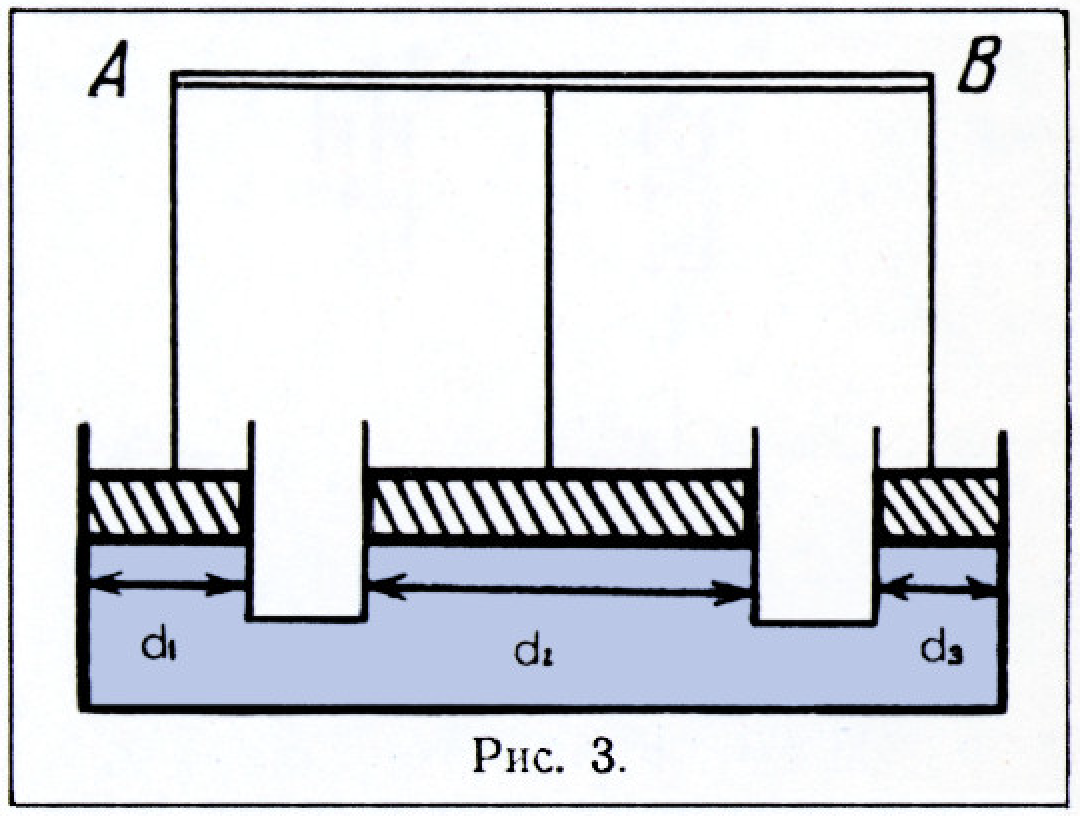
Three communicating vessels filled with water, whose centers are at the same distance $a$ from one another, are covered by pistons of equal thickness made of the same material (Fig. 3). Identical vertical rods are attached to the pistons; these rods are connected by hinges to a bar $AB$. At what point of the bar can a load be attached so that, in the equilibrium position, the bar remains horizontal, if the masses of the bar and the rods are negligible compared with the masses of the pistons and the load? The diameters of the vessels are indicated in the figure.
Setup and Assumptions
Three communicating vessels contain water and are covered by pistons made of the same material and having the same thickness. The diameters of the vessels are shown in the figure:
$$d_1=1,\qquad d_2=2,\qquad d_3=3,$$
in the same arbitrary length units.
The centers of the vessels lie on a straight line and the distance between neighboring centers is
$$a.$$
A horizontal bar $AB$ is connected by hinges to identical vertical rods attached to the pistons. A load of mass $M$ is suspended from the bar at an unknown point. The masses of the rods and the bar are neglected. The masses of the pistons and the load are not neglected.
The objective is to determine the point of attachment of the load such that, in equilibrium, the bar remains horizontal.
The water is treated as incompressible, the pistons move without friction, atmospheric pressure acts equally on all pistons and cancels from the equations, and the hinges transmit only forces. The equilibrium is static.
Let $A_i$ be the area of piston $i$, and let $m_i$ be its mass.
Because all pistons have the same thickness and are made of the same material,
$$m_i \propto A_i .$$
Physical Principles
For communicating vessels containing the same liquid, pressures at the same depth are equal.
Since the bar is horizontal, the pistons are at the same level. Hence the pressure immediately under each piston is the same. If $F_i$ is the downward force exerted on piston $i$,
$$\frac{F_1}{A_1} = \frac{F_2}{A_2} = \frac{F_3}{A_3}.$$
Each piston is in vertical equilibrium. The downward forces acting on piston $i$ are its own weight and the force $T_i$ transmitted by the rod:
$$F_i=m_i g+T_i .$$
The bar is massless and in static equilibrium. Hence
$$T_1+T_2+T_3=M g.$$
The load position is determined from the condition that the net torque on the bar vanishes.
Derivation
The piston areas are proportional to the squares of the diameters:
$$A_1:A_2:A_3 = 1^2:2^2:3^2 = 1:4:9.$$
Since the pistons have equal thickness and equal density,
$$m_1:m_2:m_3 = 1:4:9.$$
Write
$$A_i=k n_i, \qquad m_i=\mu n_i,$$
where
$$n_1=1,\qquad n_2=4,\qquad n_3=9.$$
Equality of pressure under the pistons gives
$$\frac{\mu n_i g+T_i}{k n_i}=C,$$
where $C$ is the common pressure.
Hence
$$T_i=n_i(Ck-\mu g).$$
Thus the rod forces are also proportional to the piston areas:
$$T_1:T_2:T_3=1:4:9.$$
Let
$$T_i=\lambda n_i.$$
Using the equilibrium of the massless bar,
$$\lambda(1+4+9)=Mg,$$
so
$$\lambda=\frac{Mg}{14}.$$
Therefore
$$T_1=\frac{Mg}{14}, \qquad T_2=\frac{4Mg}{14}, \qquad T_3=\frac{9Mg}{14}.$$
The rods pull downward on the bar with these forces.
Choose the left piston center as the origin. Then the three forces act at
$$x_1=0,\qquad x_2=a,\qquad x_3=2a.$$
Let the load be attached at coordinate $x$.
The condition of zero net torque about the left piston center is
$$Mg,x = T_2 a + T_3(2a).$$
Substituting the forces,
$$Mg,x = \frac{4Mg}{14}a + \frac{9Mg}{14}(2a).$$
Cancelling $Mg$,
$$x = \frac{4a+18a}{14} = \frac{22a}{14} = \frac{11a}{7}.$$
Thus the load must be placed at the center of gravity of the three downward rod forces.
Since
$$a < \frac{11a}{7} < 2a,$$
the point lies between the second and third rods.
Its distance from the third rod is
$$2a-\frac{11a}{7} = \frac{3a}{7},$$
and its distance from the second rod is
$$\frac{11a}{7}-a = \frac{4a}{7}.$$
Result
The required position of the load, measured from the center of the left vessel, is
$$x=\frac{11a}{7}.$$
Equivalently, the load must be attached between the rods connected to the vessels of diameters $2$ and $3$, at a distance
$$\frac{4a}{7}$$
from the middle rod and
$$\frac{3a}{7}$$
from the right rod.
$$\boxed{x=\frac{11a}{7}}$$
Sanity Checks
The quantity $x$ has the dimension of length because it is a numerical factor multiplying $a$. Dimensional consistency is satisfied.
The largest piston has diameter $3$, hence area proportional to $9$, and it contributes the largest force. The attachment point should lie closer to the rightmost piston than to the middle piston. The result places it at distances $3a/7$ and $4a/7$ from those rods respectively, which matches this expectation.
If all three piston diameters were equal, then the forces would be equal and the load would have to be attached at the midpoint of the three equally spaced supports,
$$x=a.$$
The present result, $x=11a/7>a$, is shifted toward the largest piston, exactly as expected.
The most delicate step is applying the equal-pressure condition. A common mistake is to use only the piston weights and forget that the rods transmit additional forces to the pistons. That error would lead to an incorrect force distribution and hence an incorrect load position.