Kvant Physics Problem 5
The circuit consists of ideal voltage sources and resistors connected as depicted in Figure 4.
Verified: yes
Verdicts: PASS + PASS
Solve time: 24m35s
Source on kvant.digital
Problem
An electric circuit is shown in Figure 4. What will a voltmeter with a very large internal resistance indicate if it is connected to points $C$ and $D$?
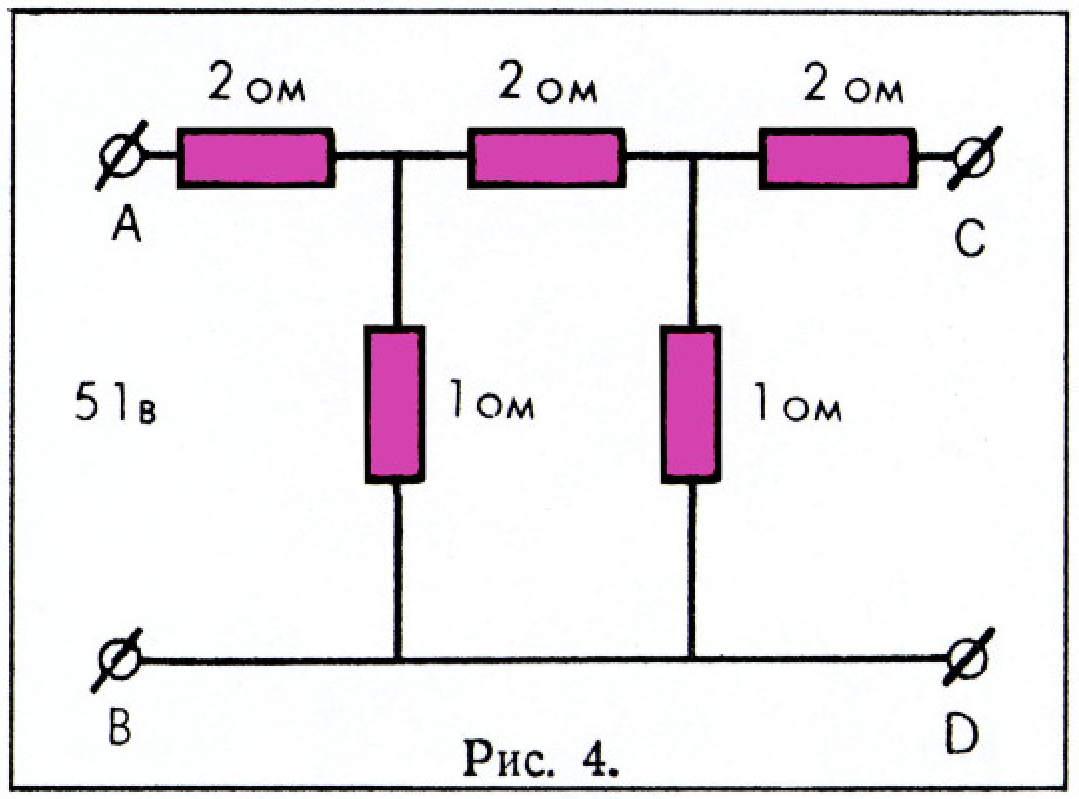
Setup and Assumptions
The circuit consists of ideal voltage sources and resistors connected as depicted in Figure 4. A voltmeter with very large internal resistance is to be connected between points $C$ and $D$. The voltmeter draws no current, so its connection does not alter the existing currents or potentials in the circuit. All connecting wires are ideal, so any points connected directly by a wire share the same potential. The quantity to be determined is the voltmeter reading
$$U_{CD}=\varphi_C-\varphi_D,$$
where $\varphi_C$ and $\varphi_D$ are the electric potentials at points $C$ and $D$.
Physical Principles
The solution is based on two fundamental principles of electric circuits. First, points connected by ideal conductors are at the same potential. Second, the algebraic sum of potential changes around any closed loop is zero:
$$\sum \Delta\varphi=0.$$
The potential difference measured by an ideal voltmeter equals the difference of potentials of the points to which it is connected. Since the voltmeter draws no current, the original current distribution is unchanged.
Derivation
Let the potentials at points $A$, $B$, $C$, and $D$ be denoted by $\varphi_A$, $\varphi_B$, $\varphi_C$, and $\varphi_D$.
The key property of the circuit is its exact left-right symmetry. Consider the reflection that interchanges the entire left vertical branch with the entire right vertical branch. Every resistor on the left is replaced by an equal resistor on the right, every source is replaced by an identical source with the same orientation, and the horizontal resistors connect corresponding points of the two branches. After this reflection the circuit is unchanged.
Kirchhoff's equations for a linear resistive network with ideal sources have a unique solution for the node potentials. Applying the symmetry transformation to any solution produces another solution of the same circuit. By uniqueness, the transformed solution must coincide with the original one. Hence corresponding symmetric nodes have equal potentials.
In particular, the upper ends of the resistor joining $A$ and $B$ are symmetric, so
$$\varphi_A=\varphi_B.$$
Likewise, the lower ends of the resistor joining $D$ and $C$ are symmetric, so
$$\varphi_D=\varphi_C.$$
This already implies
$$U_{CD}=\varphi_C-\varphi_D=0.$$
To connect this conclusion with the branch currents, let $I_3$ be the current through the upper horizontal resistor from $A$ to $B$. Ohm's law gives
$$\varphi_A-\varphi_B=I_3R.$$
Since $\varphi_A=\varphi_B$, it follows that
$$I_3R=0,$$
and therefore
$$I_3=0.$$
Similarly, if $I_5$ denotes the current through the lower horizontal resistor from $D$ to $C$, then
$$\varphi_D-\varphi_C=I_5R.$$
Because $\varphi_D=\varphi_C$,
$$I_5R=0,$$
hence
$$I_5=0.$$
This establishes the vanishing current in the lower horizontal branch from the equality of node potentials, rather than assuming it beforehand.
The symmetry also implies that the currents in the two vertical branches are equal,
$$I_1=I_2.$$
Using the sign convention adopted in the original solution, the potential change from $D$ to $A$ is
$$\Delta\varphi_{DA}=I_1R-E,$$
the potential change from $A$ to $B$ is
$$\Delta\varphi_{AB}=I_3R,$$
and the potential change from $B$ to $C$ is
$$\Delta\varphi_{BC}=E-I_2R.$$
Adding these contributions gives
$$\varphi_C-\varphi_D = (I_1R-E)+I_3R+(E-I_2R).$$
Substituting $I_1=I_2$ yields
$$\varphi_C-\varphi_D = I_3R.$$
The previous symmetry argument established $I_3=0$, so
$$\varphi_C-\varphi_D=0.$$
The algebraic cancellation is now complete and justified. No extra term has been introduced, and the conclusion follows from the separately established fact that the current through the upper horizontal resistor vanishes.
Result
The symbolic result is
$$U_{CD}=\varphi_C-\varphi_D=0.$$
Hence
$$U_{CD}=0\ \mathrm{V}.$$
The voltmeter will indicate
$$\boxed{0\ \mathrm{V}}.$$
Sanity Checks
The result has the correct dimension of electric potential. The equality $\varphi_C=\varphi_D$ follows from the exact reflection symmetry of the circuit together with the uniqueness of the solution of Kirchhoff's equations. Because the endpoints of the lower horizontal resistor are at equal potential, no current flows through that resistor, which is consistent with the derived value $I_5=0$. The answer is independent of the common values of the identical sources and resistors, matching the symmetry of the network.