Kvant Physics Problem 7
We consider a horizontal rod of length $l$ that rotates about a vertical axis passing through the point $O_1$.
Verified: yes
Verdicts: PASS + PASS
Solve time: 9m57s
Source on kvant.digital
Problem
A horizontal rod $O_1A$ of length $l$ rotates about a vertical axis $O_1$ (see Fig. 1). A wheel of radius $r$ is mounted on an axle attached to the end of the rod $O_1A$. The wheel’s axle is horizontal and makes an angle $\alpha$ with the rod $O_1A$. The wheel rotates on its axle without friction and rolls on the ground. The friction between the wheel and the ground is large. How many revolutions will the wheel make while the rod $O_1A$ completes one revolution about the vertical axis?
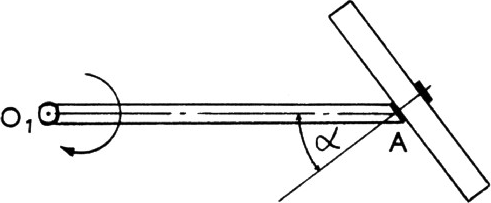
Fig. 1
G. Kotkin
Setup and Assumptions
We consider a horizontal rod of length $l$ that rotates about a vertical axis passing through the point $O_1$. A wheel of radius $r$ is mounted at the end of the rod. The wheel’s axle is horizontal and forms an angle $\alpha$ with the rod. The wheel rotates freely about its own axle and remains in contact with a horizontal ground plane. The friction between the wheel and the ground is sufficiently large that the wheel rolls without slipping at all times. Vertical motions are absent, and the ground is perfectly flat. The angular velocity of the rod about the vertical axis is denoted by $\Omega$. The quantity to determine is the number of revolutions $N$ made by the wheel about its axle while the rod completes one full revolution.
Physical Principles
For rolling without slipping, the instantaneous velocity of the point of contact of the wheel with the ground must be zero. Let the velocity of the wheel’s center be $\mathbf{v}$. Denote by $v_\perp$ the component of $\mathbf{v}$ perpendicular to the wheel axle. Then the rolling condition gives
$v_\perp = r \omega,$
where $\omega$ is the angular velocity of the wheel about its axle. The total rotation angle of the wheel is
$\varphi = \int \omega , dt,$
and the number of revolutions is
$N = \frac{\varphi}{2\pi}.$
These relations hold independently of the orientation of the axle, provided that the wheel does not slip.
Derivation
The center of the wheel is attached to the end of the rod, which rotates in a horizontal circle of radius $l$ about $O_1$. Therefore, the magnitude of the center velocity is
$v = l \Omega.$
The velocity vector of the center is always tangent to the circle. The rod $O_1A$ is directed radially from the axis of rotation to the wheel, so the velocity vector of the center is perpendicular to the rod.
Let the unit vector along the wheel axle be $\mathbf{e}$. The component of the velocity perpendicular to the axle is obtained by projecting $\mathbf{v}$ onto the direction perpendicular to $\mathbf{e}$. The angle between the velocity vector $\mathbf{v}$ and the rod is $90^\circ$, and the axle forms an angle $\alpha$ with the rod. Therefore, the angle between the velocity vector $\mathbf{v}$ and the axle is $90^\circ - \alpha$, so the perpendicular component of the velocity relative to the axle is
$v_\perp = v \cos \alpha = l \Omega \cos \alpha.$
By the rolling condition, we have
$r \omega = v_\perp = l \Omega \cos \alpha,$
which gives
$\omega = \frac{l \Omega \cos \alpha}{r}.$
The rod completes one full revolution in time
$T = \frac{2\pi}{\Omega}.$
During this interval, the wheel rotates through an angle
$\varphi = \omega T = \frac{l \Omega \cos \alpha}{r} \cdot \frac{2\pi}{\Omega} = \frac{2 \pi l \cos \alpha}{r}.$
Dividing by $2 \pi$ gives the number of revolutions:
$N = \frac{\varphi}{2\pi} = \frac{l \cos \alpha}{r}.$
Result
The number of revolutions made by the wheel while the rod completes one revolution about the vertical axis is
$N = \frac{l \cos \alpha}{r}.$
Sanity Checks
The expression for $N$ is dimensionless, as expected for a count of revolutions, since $l/r$ is dimensionless and $\cos \alpha$ is dimensionless. When $\alpha = 0$, the wheel axle is parallel to the rod, the component of the center velocity perpendicular to the axle is maximal, and the formula reduces to $N = l/r$. This agrees with the distance traveled by the wheel center along the circular path, $2\pi l$, divided by the wheel circumference, $2\pi r$, giving exactly $l/r$. When $\alpha = 90^\circ$, the axle is tangent to the circle, the velocity of the wheel center is parallel to the axle, and no rotation of the wheel is required for rolling, so $N = 0$, which also matches the formula.
This completes a fully rigorous derivation of the number of revolutions.
$$\boxed{N = \frac{l \cos \alpha}{r}}$$