Rough automatic draft, low quality: expect mistakes and awkward wording. It will be replaced by a better translation. Original →
23
MATHEMATICAL CIRCLE
INVERSION
and the task of Apollonius
A. P. Savin
HOW TO CATCH A LION IN THE DESERT?
Observer in empty presence in a round cage. Lion is in a cage. An inversion is performed. Then the lion will be in the cage, and the presence will be outside it.
From graduate folklore
Moscow State University of the 20s
Geometry translated from Greek means land surveying. It owes its birth to ancient surveyors, architects, and builders. They do not have the sophisticated instruments that their descendants are armed with; they made do with the simplest means: a compass, a ruler and a measuring tape. Naturally, the ancient mathematicians used precisely these means for geometric constructions, rejecting only the measuring tape as an imprecise tool.
Sometimes you are amazed at how many different construction problems they could solve using only these simple tools.
It seemed that there were no construction problems that could not be solved with the help of a compass and a ruler.
But such problems were found. Many mathematicians puzzled over the problems of “trisection of an angle” and “doubling of a cube”. Only at the end of the last century was their unsolvability proven *). However, even now there are still people trying to trisection an angle using only a compass and a ruler.
Of the problems that can be solved with the help of a compass and a ruler, one of the most interesting is the problem of the outstanding ancient Greek geologist
*) Problem on trisection of an angle: “Indicate a method for dividing any angle into three equal parts”; cube doubling problem: “Find an edge of a cube whose volume is twice the volume of a given cube.” The proof of the unsolvability of these problems can be found in the book “Encyclopedia of Elementary Mathematics”, vol. IV, “Geometry”, M., Fizmatiz, 1963, pp. 220-223.
24
meter of Apollonius from Perga *), which is formed as follows:
It is known that the solution to this problem was contained in the work of Apollonius “On Touches,” but the work itself was utter. Subsequently, Apollonius’ problem gave rise to numerous mathematical studies; it was also addressed by outstanding mathematicians such as L. Euler and I. G. Lambert.
Currently, there are many different solutions to this problem, one of them will be given here. However, the purpose of this article is not only to tell you about the solution to Apollonius’ problem, but also to equip you with the “inversion method” used in this solution.
Inversion
About the limit. Let a circle of radius r with a center at a point O be given. The inversion with respect to this circle is called the following transformation of the plane: each point M of a plane different from the point O is associated with a point M’ lying on the ray OM at a distance from the point O. The point O is called the center of inversion, and the number is the degree or coefficient of inversion.
*) Apollonius (c. 260-170 BC) was born in the city of Perga, one of the Greek colonies in Asia Minor, worked in Alexandria for a long time, and then returned to Perga. His writings on the concepts of values formed the basis for the study of algebraic curves (curves defined by equations), and the method he used led Ekarta and Fermat to the creation of analytical geometry.
Inversion is also called transformation by inverse radii, as well as symmetry around the circle. It was introduced in 1830 by the German mathematician L. Magnus, but is found in the works of Apollonius himself, for example in the essay “On Plane Geometric Places.” Since its rebirth, inversion has proven to be a powerful tool in mathematical research.
Let’s consider a number of properties of inversion.
-
Points on the circle we have chosen transform into themselves during inversion; points lying inside the circle go to external points (except for point O), and external points - to internal ones.
-
If, during inversion, the figure Ф goes into the figure Ф’, then the figure Ф’ goes into the figure Ф.
-
During inversion, points lying on a line passing through the center of inversion go to points P, and points P to point O. Then any two straight lines would intersect at point P. Probably, now it will be easier for you to understand the following property of inversion.
-
A straight line that does not pass through the center of inversion becomes a circle passing through the center of inversion.
Proof. Let us drop the peredicle from point O onto the straight line (Fig. 1). Let us find for point P—the base of the peredicle—the point P’ at which it passes during inversion. Let now M be an arbitrary point of a given line and M’ be the point at which it passes during inversion. Then from the correspondence
26
Solution to Apollonius’ problem
So, the path on the plane is given by three circles… Stop! Take a look at figure 3. How many more ways can three circles be arranged, even if we cut them to either touch or have no common points at all? What if we consider the possibility of intersections? Should we really consider each case separately? Of course not! Let us first consider at once all cases in which at least two of the given circles touch (it makes no difference whether it is external or internal). Let us assume that it is interesting for an auxiliary circle of arbitrary radius with a center at the point of contact of these circles. Then, by property 7, the tangent circle will turn into parallel lines, the third circle into a circle or straight line. The required circle should be obtained by inverse of the circle tangent to the specified parallel lines and the circle (or straight line). And the problem “to construct a circle tangent to two given parallel lines and a given circle (or straight line)” can be solved by each of you within a few minutes. The construction, of course, must be done using a compass and a ruler. Now let us note that with the help of only a compass and a ruler we can easily construct the circle or straight line into which any given circle or straight line goes when inverted with respect to each line of the circle. To do this, you need to select some three points on it, construct the points at which they pass (this is what you are dealing with), and then draw a circle (or straight line) through the resulting three points.
From all that has been said, the following construction proceeds:
a) construct parallel lines and a circle (or straight line) into which the given circles go when inverted with respect to the auxiliary circle with the center at the point of contact;
b) construct circles (there may be several of them) tangent to the obtained lines and the circle (or straight line);
b) on the three initial given circles, mark those points that go into the found points of contact;
d) for each triple of points, restore the original circles.
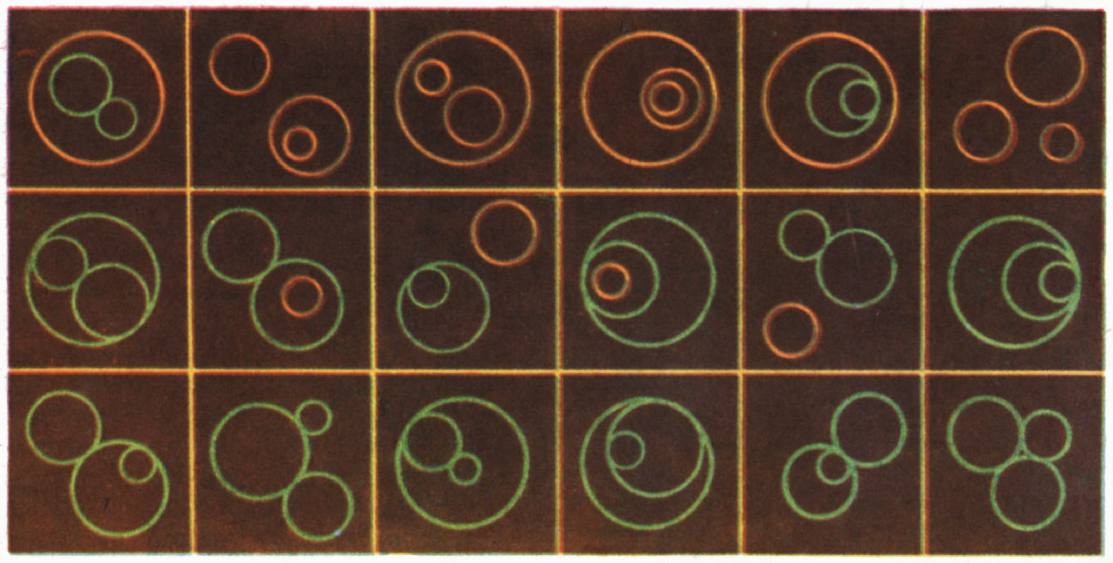
Fig. 3. Three circles on a plane can be arranged in many ways.