Rough automatic draft, low quality: expect mistakes and awkward wording. It will be replaced by a better translation. Original →
29
Professor Everett, discussing the phenomenon of mirage (Nature, November 19, 1874), showed that for the formation of sharply successive mirages, the presence of a horizontal plane with a maximum refractive index is necessary. As you move up and down from this plane, the optical density decreases in proportion to the distance from it.
A horizontal or almost horizontal beam is deflected towards the plane with maximum density and intersects it *). Then it changes its curvature and again deviates towards the plane, which it crosses again and again, passing along a trajectory close to a sinusone.
Observing the trajectory of a light beam in a vessel filled with a salt solution (the optical density of the solution increased with depth), I thought:
*) The nature of the mirage is described in the article by G. Ya. Myakishev “Fermat’s principle and the laws of geometric optics” («Kvant» No. 11, 1970).
that by changing the refractive index of the liquid, it would be possible to make the beam move along a sinusone.
The result is quite beautiful experiments that can be shown in the audience. Apparently, it is worth publishing them, although, as I learned later, similar experiments had already been described by Wiener.
I made a vessel from thick sheet glass approximately 50 cm long, 10 cm high and 2 cm wide. I filled it 3 cm with a concentrated alum solution, and on top I placed a 3 cm thick layer of aqueous alcohol solution (~10%) (The addition of alcohol increases the refractive index of water.) You need to carefully add water to the vessel using a pipette, the shape of which is shown in figure 1.
As a liquid with a high refractive index, the removed weight of which is greater than the remote weight of water, but less than the remote weight of alum solution, I used a mixture
31
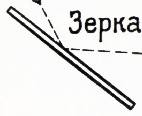
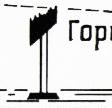

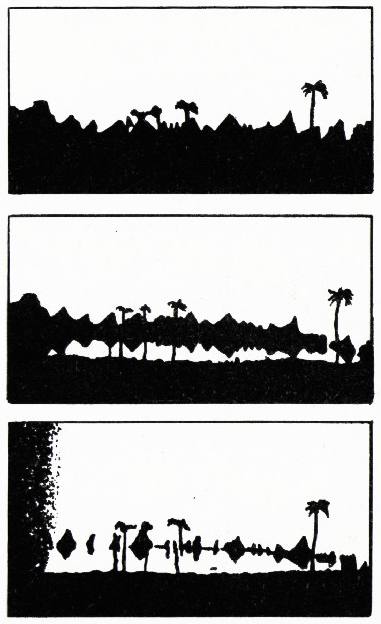
Fig. 5.
beats from heating. I have had great success using gypsum plates cast from alabaster (fired gypsum) on thick sheet glass, although these plates are fragile and short-lived. Perhaps slate (roofing slate) slats would be very good, as they can withstand quite a lot of heat and can be made flat and smooth.
The plates only need to be sprinkled with a layer of sand to establish reflection from the surface. The surface of the sand should appear completely robust. To successfully carry out the experiment, you need a completely flat desert; so don’t feel like you’ve paid too much attention to adjusting the records. At one end of the desert we need to create an artificial sky. It is best to use a large mirror mounted on a window and reflecting the sky.
Between the sky and the desert you need to install a small chain of mountains cut out of cardboard. Individual peaks should have a height of 1 to 2 cm, and the valleys between them should rise only slightly above the desert level. The general arrangement is shown at figure 5.
The plates are then heated using gas burners, which need to be moved from time to time to ensure even heating.
If we now look along the desert a little above the level of the sand, we see the mountains clearly standing out against the sky: as the temperature rises, axero begins to form in front of the mountain range, and
Fig. 6.