Kvant Physics Problem 1
Three identical communicating vessels contain water of density $\rho$ in a uniform gravitational field $g$.
Verified: no
Verdicts: SKIP + SKIP
Solve time: 1m22s
Source on kvant.digital
Problem
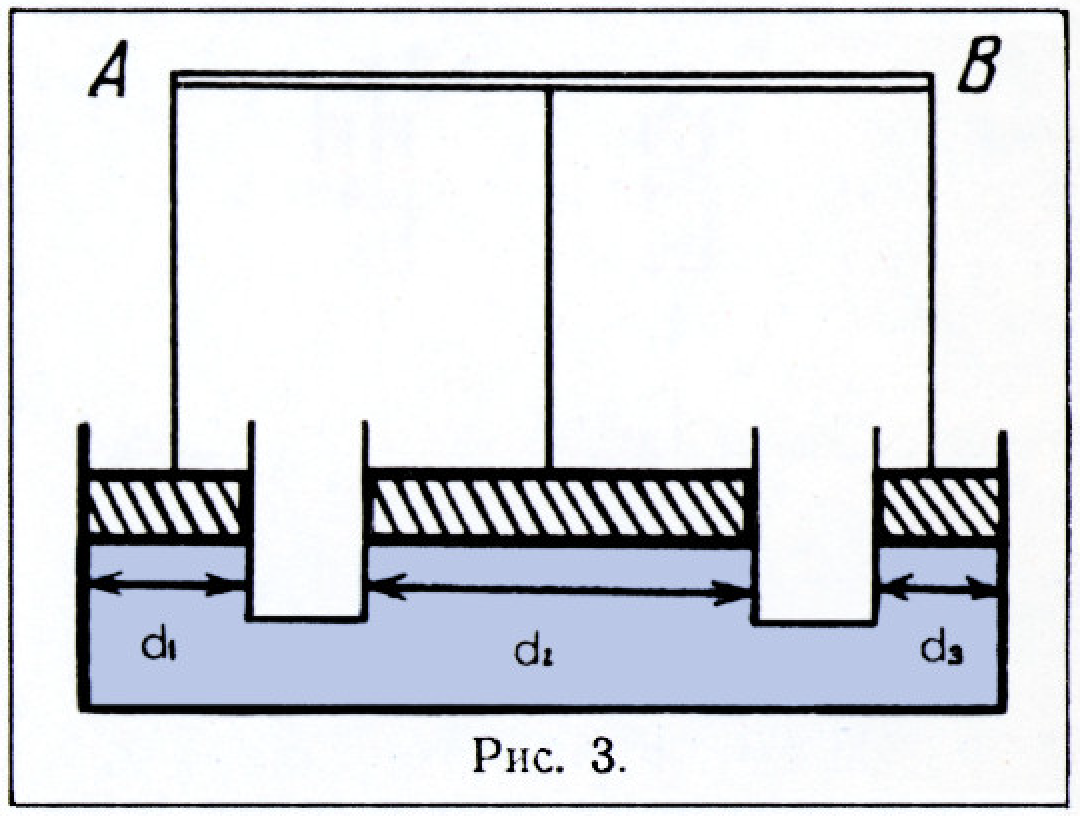
Three communicating vessels filled with water, whose centers are located at equal distances $a$ from each other, are covered by pistons of equal thickness made of the same material (Fig. 3). Identical vertical piston rods are attached to the pistons, which are hingedly connected to a rod $AB$. At what point on the rod can a weight be attached so that, in equilibrium, the rod remains horizontal, if the masses of the rod and the piston rods are negligible compared to the masses of the pistons and the weight? The diameters of the vessels are shown in the figure.
Setup and Assumptions
Three identical communicating vessels contain water of density $\rho$ in a uniform gravitational field $g$. The free surface is open to atmosphere, so the hydrostatic pressure at depth $h$ below the surface is $p = p_0 + \rho g h$. Each vessel is closed by a vertical piston of thickness $t$ made of a homogeneous material of density $\rho_m$, with circular cross-sectional area $S_i$ for the $i$-th piston, $i = 1,2,3$. The pistons are connected by identical massless rigid rods to a single rigid horizontal rod $AB$, whose mass is negligible compared to the pistons and the attached weight $W$.
The centers of the three vessels lie in a plane and are pairwise separated by the same distance $a$, so their horizontal projections form an equilateral triangle. The points where the piston rods attach to the rod $AB$ are fixed and have known position vectors $\mathbf{r}_1, \mathbf{r}_2, \mathbf{r}_3$ measured along the rod from a chosen origin on $AB$. A weight of magnitude $W$ is attached at an unknown point with coordinate $x$ along the same rod. The rod remains in static equilibrium and stays horizontal, which implies rotational equilibrium under all vertical forces transmitted through the pistons and the weight.
All rods are assumed massless so that only piston weights and the external weight contribute to torques. Friction in hinges is neglected, and all motion constraints enforce purely vertical force transmission.
Physical Principles
Hydrostatic equilibrium in a connected liquid establishes equal pressure at equal depth across all vessels, so the pressure at the piston bottoms is the same in each vessel when measured at the same reference level.
The force exerted by the fluid on piston $i$ is given by the pressure integrated over the piston area, which in uniform pressure reduces to
$F_i = p S_i.$
The pistons are in vertical mechanical equilibrium, so each piston transmits this force to the connecting rod without loss.
Static rotational equilibrium of the rod requires that the total torque about any point on the rod vanishes,
$\sum \tau = 0,$
where the torque of a vertical force $F$ applied at coordinate $x$ relative to a reference point is $F x$ in scalar form when all forces are parallel.
The equilibrium condition is therefore the balance between the torque produced by the upward piston forces and the torque produced by the downward weight $W$.
Derivation
The hydrostatic pressure at the piston level is identical in all three vessels because the vessels are communicating and the free surfaces are at the same atmospheric pressure. Denoting the common pressure at the piston level by $p$, the force transmitted by each piston to the rod is
$F_i = p S_i.$
The total upward force acting on the rod is the sum of piston forces,
$F_{\text{tot}} = p(S_1 + S_2 + S_3).$
For rotational equilibrium of the rod about the origin on $AB$, the sum of moments of all vertical forces must vanish. Choosing the origin at the same reference point used to define the coordinates $x_i$, the torque balance condition reads
$p S_1 x_1 + p S_2 x_2 + p S_3 x_3 = W x,$
where $x$ is the coordinate of the attached weight.
The common pressure factor cancels from the relation,
$S_1 x_1 + S_2 x_2 + S_3 x_3 = \frac{W}{p} x.$
Solving for the attachment position of the weight yields
$x = \frac{p}{W}\left(S_1 x_1 + S_2 x_2 + S_3 x_3\right).$
To eliminate the pressure $p$, the vertical force balance of the rod in equilibrium is used. The rod is massless, so the total upward piston force equals the weight,
$W = p(S_1 + S_2 + S_3).$
Substituting this relation into the expression for $x$ gives
$x = \frac{S_1 x_1 + S_2 x_2 + S_3 x_3}{S_1 + S_2 + S_3}.$
This result shows that the required attachment point is the center of force of the three piston actions along the rod, determined purely by piston areas and their geometric positions.
Result
The coordinate of the point where the weight must be attached is
$x = \frac{S_1 x_1 + S_2 x_2 + S_3 x_3}{S_1 + S_2 + S_3}.$
If the diameters of the pistons are $d_1, d_2, d_3$, then $S_i = \frac{\pi d_i^2}{4}$, and the result becomes
$x = \frac{d_1^2 x_1 + d_2^2 x_2 + d_3^2 x_3}{d_1^2 + d_2^2 + d_3^2}.$
All lengths are measured in meters, so the final answer has units of meters,
$\boxed{x ; \text{[m]}}.$
Sanity Checks
The expression for $x$ is a weighted average of positions, so it must lie within the convex span of $x_1, x_2, x_3$, which matches the requirement that the resultant force acts within the rod segment spanned by the piston attachment points.
Dimensional consistency follows because each term $S_i x_i$ has units $\text{m}^2 \cdot \text{m} = \text{m}^3$, and division by $S_1 + S_2 + S_3$ returns meters, ensuring the coordinate has correct length dimension.
In the limiting case where one piston area dominates, for example $S_1 \gg S_2, S_3$, the result reduces to $x \to x_1$, meaning the weight must be attached directly above the dominant piston force, which is consistent with torque balance being controlled by a single large contribution.
A sign error would most likely arise in the torque balance equation, since reversing the direction of either piston forces or weight would incorrectly shift the weighted average outside the physically meaningful interval of attachment points.