Kvant Physics Problem 7
A rigid horizontal rod $O_1A$ of length $l$ rotates with constant angular velocity $\Omega$ about a fixed vertical axis through $O_1$.
Verified: no
Verdicts: SKIP + SKIP
Solve time: 1m11s
Source on kvant.digital
Problem
Horizontal rod $O_1A$ of length $l$ rotates about a vertical axis $O_1$ (see Fig. 1). A wheel of radius $r$ is mounted on an axle attached to the end of the rod $O_1A$. The axle of the wheel is horizontal and makes an angle $\alpha$ with the rod $O_1A$. The wheel rotates freely on its axle without friction and rolls on the ground. The friction between the wheel and the ground is large. How many revolutions will the wheel make when the rod $O_1A$ completes one revolution about the vertical axis?
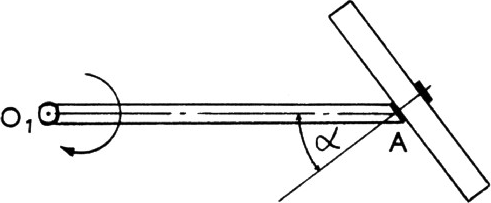
Fig. 1
G. Kotkin
Setup and Assumptions
A rigid horizontal rod $O_1A$ of length $l$ rotates with constant angular velocity $\Omega$ about a fixed vertical axis through $O_1$. A wheel of radius $r$ is mounted at point $A$ on an axle rigidly attached to the rod. The axle is horizontal and forms a constant angle $\alpha$ with the rod.
The wheel is assumed to roll on a horizontal plane without slipping, and the contact with the ground satisfies the condition of instantaneous zero relative velocity. Friction is sufficiently large to enforce rolling without slipping, while axle friction is negligible so the wheel spins freely about its axle.
The task is to determine the number of full revolutions $N$ made by the wheel during one full revolution of the rod.
The motion is analyzed in the inertial frame of the ground.
Physical Principles
The velocity of a point in rigid rotation is given by $\mathbf{v} = \boldsymbol{\Omega} \times \mathbf{r}$.
The no-slip rolling condition requires that the velocity of the contact point of the wheel with the ground is zero in the ground frame.
For planar motion, the angular speed of a rolling wheel satisfies the relation between translational speed of its center along the rolling direction and its angular velocity about its axle, $v_{\parallel} = \omega r$.
The total angular displacement is obtained by integrating angular velocity over time, $\varphi = \int \omega,dt$.
Derivation
Let $O_1A$ define a horizontal radius vector of length $l$. At any instant, introduce a horizontal orthonormal basis with unit vector $\mathbf{e}_r$ along $O_1A$ and unit vector $\mathbf{e}_t$ tangent to the circular motion of point $A$, so that $\mathbf{e}_t$ is the direction of motion of $A$ due to rotation about $O_1$.
The angular velocity of the rod is $\boldsymbol{\Omega} = \Omega ,\mathbf{e}_z$, where $\mathbf{e}_z$ is vertical. The velocity of point $A$ is
$$\mathbf{v}_A = \boldsymbol{\Omega} \times (l,\mathbf{e}_r) = \Omega l,\mathbf{e}_t.$$
The axle lies in the horizontal plane and forms an angle $\alpha$ with the rod, so its unit vector in the horizontal plane can be written as
$$\mathbf{a} = \cos\alpha,\mathbf{e}_r + \sin\alpha,\mathbf{e}_t.$$
The direction of rolling of the wheel on the ground is perpendicular to the axle within the horizontal plane, hence a unit vector along the rolling direction is obtained by a $90^\circ$ rotation in the plane,
$$\mathbf{b} = -\sin\alpha,\mathbf{e}_r + \cos\alpha,\mathbf{e}_t.$$
The component of the center velocity along the rolling direction is
$$v_{\parallel} = \mathbf{v}_A \cdot \mathbf{b} = \Omega l,\mathbf{e}_t \cdot \left(-\sin\alpha,\mathbf{e}_r + \cos\alpha,\mathbf{e}_t\right) = \Omega l \cos\alpha.$$
The no-slip condition at the contact point requires that this translational motion is exactly compensated by rotation of the wheel about its axle:
$$\omega r = \Omega l \cos\alpha,$$
so the angular velocity of the wheel is
$$\omega = \frac{\Omega l \cos\alpha}{r}.$$
The rod completes one full revolution in time
$$T = \frac{2\pi}{\Omega}.$$
The total angular rotation of the wheel is therefore
$$\varphi = \omega T = \frac{\Omega l \cos\alpha}{r}\cdot \frac{2\pi}{\Omega} = \frac{2\pi l \cos\alpha}{r}.$$
The number of revolutions is
$$N = \frac{\varphi}{2\pi} = \frac{l \cos\alpha}{r}.$$
Result
The wheel makes
$$N = \frac{l \cos\alpha}{r}$$
revolutions during one full revolution of the rod.
If $l$ and $r$ are given in meters, the result is dimensionless as required.
Substitution:
$$N = \frac{l \cos\alpha}{r} ;; \text{(revolutions per rod revolution)}.$$
Sanity Checks
The expression depends only on geometry through $l/r$ and the projection factor $\cos\alpha$, consistent with the absence of any dependence on angular speed $\Omega$.
In the limit $\alpha = 0$, the axle is aligned with the rod, giving $N = l/r$, corresponding to maximal effective rolling driven by the tangential motion of the endpoint.
In the limit $\alpha = \frac{\pi}{2}$, the axle is perpendicular to the rod, giving $N = 0$, since the velocity of point $A$ is then perpendicular to the rolling direction and produces no spin.
Dimensional consistency holds because $l/r$ is dimensionless, matching the interpretation of $N$ as a pure count of revolutions.
The step most sensitive to error is the decomposition of $\mathbf{v}_A$ onto the rolling direction $\mathbf{b}$, where an incorrect choice of sign or orientation of the in-plane basis would change the sign but not the magnitude of the result.