About the written exam at the Faculty of Mechanics and Mathematics of Moscow State University in 1969
Rough automatic draft, low quality: expect mistakes and awkward wording. It will be replaced by a better translation. Original →
50
N. S. BAKHVALOV, N. N. KUZNETSOV
The written exam in mathematics is the main exam for applicants to the Faculty of Mechanics and Mathematics of Moscow State University. Often there comes a case about its excessive difficulty, that only graduates of Moscow mathematical schools can get even a “C” on this exam.
These cases are completely unfounded *). The tasks (the so-called “variants”, consisting of 4 problems) offered in the written exam are composed so that in each variant there is one problem
*) In 1969, out of 922 Moskovey applicants, 469 (about 50%) received a positive mark (three or higher) on the written exam, and out of 2,356 nonresidents - 912 people (about 40%).
are quite accessible to those with average mathematical training. Solving such problems already guarantees a three. Therefore, to successfully pass the written exam, you only need a solid knowledge of the school curriculum in mathematics, and only those applicants who have not shown preparation enough to successfully study at the faculty receive an unsatisfactory grade.
Of course, I will break with easy problems; the version also includes tasks whose solutions require sufficient mathematical culture (but not additional knowledge that goes beyond the scope of the program). Therefore, it is impossible to get a high mark on this exam.
Option 1
- Points A and B are on roads intersecting at an angle ACB=60°. You can get from point A to B by bus - first along one road to intersection C, then along the other - spending 11 minutes. If you go from A to B in the right direction, it will take 1 hour. 10 minutes, and if you first take the shortest route to the road on which point B is located, and then take the bus, then even more time, even if there is a bus right away.
What is the distance from point A to the intersection if the pedestrian speed is 3 km/h and the bus speed is 30 km/h? (Roads are considered straight.)
-
In triangle ABC, bissertrices AD and BE are drawn, intersecting at point O. It is known that segment OE has length 1, and vertex C lies on the circle passing through points E, D, O. Find the sides and angles of triangle EDO.
-
Find all values of x that simultaneously satisfy the following conditions:
- The primordial processes of a plane quadrilateral into two mutually perpendicular planes are squares with sides of 2. Find the perimeter of the quadrilateral, knowing that one of its sides is equal to .
51
This requires special preparation and the use of appropriate literature *).
Here we will consider, as an example, one typical set of problems in the version presented in the written exam for MEXMATH in 1969 (varnant 1 on p. 50). He was given 4 hours to decide. To receive a grade of “3” it was enough to solve at least one problem; a score of “5” was given if there was a complete solution to any three problems, and four were in the main solution.
We will analyze these problems in detail and note the characteristic mistakes made by those who arrived when solving them, and in conclusion we will present the readers of Kvanat with another option for independent solution.
TASK ANALYSIS
Task 1
Let’s make a drawing (Fig. 1). is the point of line close to . Note that the location of point relative to is unknown in advance (the drawing shows two location options). Let , (these distances are measured in kilometers). Writing down the conditions of the problem, we obtain a system of two equations:
and inequality:
*) As suitable problem books, we point out, for example, the books by E. B. Vakhovsky and A. A. Ryvkin “Tasks in elementary mathematics of increased difficulty” (about it, see the article “How to solve a problem” on page 60 of this issue of “Kvanat”), N. Kh. Rozov, M. K. Potapov, G. V. Dorofeev, “A manual on mathematics for university applicants”, V. B. Lidsky, P. V. Ovsyannikova, A. N. Tulaikova and M. I. Shabunna “Tasks in elementary mathematics.”
System of equation (1) has two solutions: a) , ; 6) , , and we must choose from them the one that satisfies the additional condition (2). The second solution to this condition does not satisfy, or . The first decision satisfies him. To verify this, you need to check that , or . By squaring the last inequality, we obtain and thereby verify that it is true. So, the solution to the problem is km.
Let us note the typical mistakes that applicants made when solving this problem.
Most of them managed to compile and solve the system of equation (1); however, choosing the desired solution using the additional condition (2) turned out to be an insurmountable obstacle for many. Please, the most convenient way to understand the order is the incorrect visual representation of the relative position of the point and , as a result of which, instead of inequality (2), the incorrect inequality was checked
At the same time, quite often the examiner is limited to checking only one of the solutions found. For example, having established that the second solution of system (1) (; ) does not satisfy inequality (3), they automatically did on this basis
52
the conclusion is that the first solution is the one we are looking for (although it is easy to see that it also does not satisfy inequality (3). Let us note one more mistake that a considerable part of those constructed made: when checking condition (2), the value was replaced by an approximate rational value, for example, 1.7, and the equality was checked incorrectly
(it is easy to check that both solutions of the system of equations (1) also do not satisfy it).
Problem 2
Let’s connect the points and (see Fig. 2). Line is the bisector of angle , or it passes through the intersection point of bisectors and . That’s why
(1)
Angles inscribed in a circle
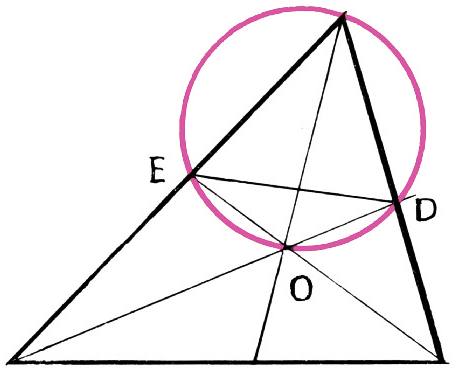
Fig. 2.
and are equal, as if they rest on the same arc. The same is true for angles and . Based on (1) we conclude that
i.e., the triangle is equilateral.
The inscribed angles and are supported by additional arcs; therefore their sum is . On the other hand, we have an integer equality:
Because
where
From the reasoning given above it follows that
so the sides of triangle are 1, 1 and .
Nibaulier’s typical mistake in this problem was to “prove” that is equilateral. Some of the examinees, based on a geometric illusion, assumed that the center of the circle lies on the straight line . It follows that the angles and are right angles, so the bisectors and are simultaneously altitudes, which is only possible in an equilateral triangle.
Another part of those who prove the equilaterality of the triangle , based on the following reasoning: let us drop from the point the perpendiculars and to the sides and , respectively. The distance is two options for the location of the point and relative to the point and (see Fig. 3). In case a) the angles and are obtuse, and in case b) they are both acute. Therefore, the vector of points , , , can describe a circle only when the point coincides with , and with .
This leads to the conclusion that and .
53
We want to leave it as an exercise for readers to find the error in the above reasoning.
It should be noted that the number of examinees who correctly solved this problem (and similar problems of other options) was relatively low: approximately 1 out of 9 people solved it.
Task 3
Solution of the first equation of this system:
or
gives two series of values
a) (),
- ().
Selecting from these values those that satisfy the inequality , we find:
a) , ,
- , .
Now we must choose those values of that satisfy the second equation of the system. This equation can be represented as:
Let us first substitute series (a) into it. Since (), the equality must be satisfied:
Since , then and, therefore, must differ from by an initial multiple of . However, , so must be an integer. Under the constraint this occurs only at . Substituting the value into equation (1), we make sure that it satisfies it. So from series (a) only is a solution.
Let’s now check series (6). Presenting the second equation of this system in the form:
we note that must be non-negative, that is, the angle () is contained in the first two quadruples. Substituting possible integer values from to into the expression , we establish that only six are subject to verification
54
of which: . Calculating the left and right sides of equation (2) with these values, we obtain the table:
from which we obtain the required solutions:
Three values of (3) give a complete solution to the problem, since the solution of series (a) gave the value , already included in (3).
Note that in the same way, by brute force, we can check series (a).
When solving this problem, a typical mistake was the following: many forgot that the solution must satisfy all the conditions of the problem at the same time, and often simply did not understand this. Some limited themselves to solving one of the equations and selecting a solution based on inequality, others combined equations and ultimately solved only one equation that was not equivalent to the proposed system.
Task 4
Let be the given quadrilateral, . The primangular processes of any polygon onto parallel planes are equal to each other; Therefore, we will draw planes and parallel to the original planes through the vertex and in the future we will talk about the processes of the quadrilateral precisely on these planes.
For each point of space we will denote by and
55
Since , then from the right triangle there is . Since in a right-angled triangle the hypotenuse is equal to 2, and the leg , then ; therefore, the acute angle , the sides of which are perpendicular to the sides of the angle (, ), is also equal to ; therefore from the right triangle it is found that
where
And
Receptions and are the lines of intersection of parallel planes and with the plane of a given quadrilateral ; therefore . We similarly conclude that . Therefore, is a parallelogram, and therefore its perimeter is equal to
Please note that we wrote down the solution in such a way that we never had to refer to the drawing to justify the explanations (although in order to understand the solution, it is useful to make figure for yourself like 4 a, 6, c). Often, when solving such problems, they rely heavily on the drawing, forgetting to analyze all possible cases of one of them.
This problem has been solved very little; Therefore, it is impossible to talk about typical mistakes in connection with this task.
In conclusion, we offer the reader another version of the written task for the exercise.
Option 2
- At points and two channels lead away from the river, crossing each other at right angles. The boat travels from to along the river for 1 hour 15 minutes, and along the canals for 1 hour 10 minutes. From point on the river, located between and , one and a half times closer to than to , you can get to the point of intersection of the canals using an automatic route in less than 13 minutes.
How long does it take the boat to travel from to the point of intersection of the channels, if the speed of the boat along the river is one third less, and the speed of the automatic vehicle is twice as high as the speed of the boat along the canal? (The river and canals are considered straight.)
-
In the isosceles triangle the bissertrices , , are drawn. It is known that the vertex lies on the circle drawn through the points , , . Find if .
-
Find all values of satisfying the simultaneous conditions:
- The primugal processes of triangle onto two mutually perpendicular planes are regular triangles with sides equal to 1. The median of triangle is equal to . Find .