Rough automatic draft, low quality: expect mistakes and awkward wording. It will be replaced by a better translation. Original →
29
Entrance exams in mathematics at the Moscow Institute of Steel and Alloys are typical for most technical schools.
At the faculties of MCHMIS (metallurgy of ferrous metals and alloys) and MCRMIS (metallurgy of non-ferrous metals and alloys) the disciplines are written mathematics, physics and chemistry; at the faculties of Physics (physics and chemistry) and PMP (semiconductor materials and devices) - written and oral mathematics and physics. The competition for all faculties is held separately.
Note that about 19% (179 people) of the new student body was recruited in industrial centers: Bekabad, Volgograd, Zaporozhye, Norilsk, Orsk, Cherepovets.
The content of the tickets for written and oral examinations strictly corresponded to the mathematics program for applicants to universities.
Let’s look at one of the options offered at the faculties of MCHMIS and MCRMIS.
Option 1.
Solve the equation sec22x+cos22x=16 ctg x.
Solve inequality lg(x−1)3x2−2x−1<0.
Simplify 4(a+1)+(3a+3bab2+a+36a)31/2
Let E be the midpoint of side AB of the trapezoid ABCD (BC∥AD). Prove that the area of the triangle ECD is equal to half of the trapezoid ABCD.
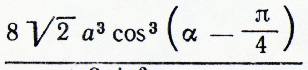
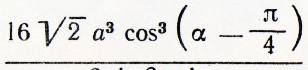
A cube with edge a is inscribed in a regular quadrangular paramid such that four of its vertices are on the side edges, and four other vertices are on the base of the paramid. The lateral faces of the paramid are inclined to the plane of the base at an angle α. Determine the volume of the paramid.
Solution
Let us define the ODZ equation: x=πl(l=0,±1,…).
Let’s start solving the equation. We have cos22x1+sin22x1=16sinxcosx,
where cos22x1sin22x=16sinxcosx
or sin2x4=16sinxcosx.
Since sinx=0, we get 4sinxcosx=1
or sin2x=21,
where 2x=(−1)n6π+πn,
30
or
x=(−1)n12π+2πn (n=0,±1,…).
The resulting solutions are included in the ODZ equations.
Answer: x=(−1)n12π+2πn (n=0,±1,…).
To solve the inequality lg(x−1)3x2−2x−1<0
Note that a fraction will be negative if its numerator and denominator have different signs. Thus, this inequality is equivalent to two systems of inequalities:
{3x2−2x−1>0,lg(x−1)<0
or {3x2−2x−1<0,lg(x−1)>0.
Solving these systems, we find the corresponding
⎩⎨⎧x<−31,x>1,0<x−1<1,x−1>1,
that is ⎩⎨⎧x<−31,x>1,1<x<2,x>2.
The second system has no solution, and the solution to the first is the inverval 1<x<2.
Answer: 1<x<2.
First of all, we find the valid values a and b: a≥0,b≥0,a=−b.
We note further that 6ab2+a=6a(3a+3b).
Considering that a+b=0, and reducing the fraction by 3a+3b, we get
Proof. Let’s draw the middle line EF of the trapezoid.
Then SABCD=EF⋅H, where H is the height of the trapezoid. On the other side,
SECD=SECF+SEFD=21EF⋅2H+ +21EF⋅2H=21EF⋅H.
31
running_head:
folio:
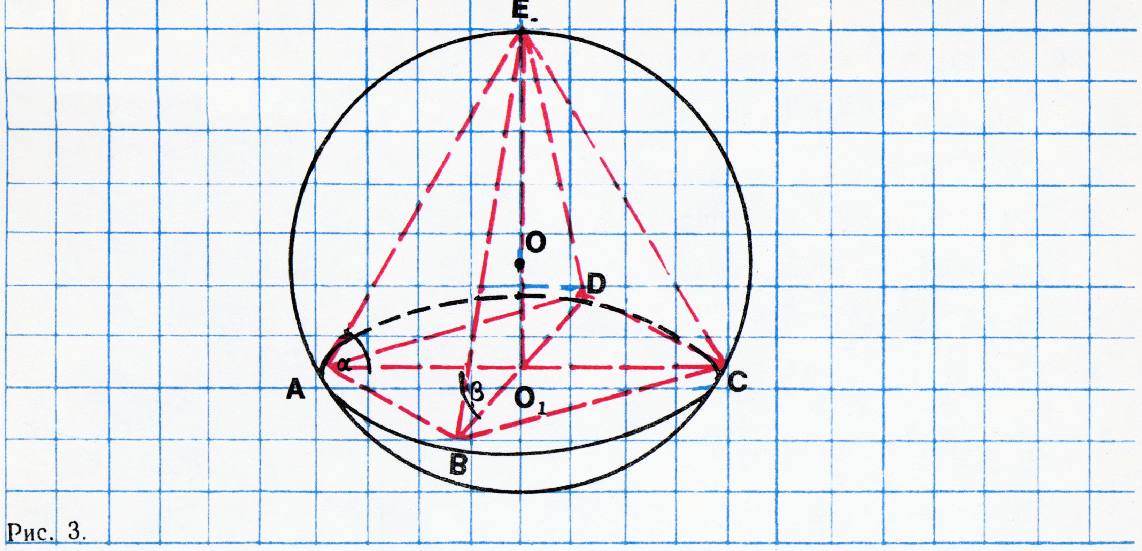
Fig. 3.
Therefore SECD=21SABCD.
First of all, note that the vertices of the lower base of the cube lie on the diagonals of the base of the paramid (projection of the side edges) and that ∠ETO=α (Fig. 2).
Let us denote the side of the base of the paramid by x. From △EOT there is EO paramid:
EO=OT⋅tgα=2xtgα. Next, from the similarity of triangles EO1K1 and EOC we have EO1:EO=O1K1:OC or
Let us now examine one of the options offered in the written exam at the faculties of PH and PMP.
Option 2
A quadrangular paramid is inscribed in a ball of radius R, the lateral edges of which are inclined to the plane of the base at an angle α. Determine the volume of the paramid if at its base lies a rectangle with an angle β between the diagonals.
Solve the equation
2sin10x+sin2x=cos2x.
Solve inequality
log3x+4x2<1.
Simplify an expression
(a+x1/2)−1/2+(a−x1/2)−1/2,
where x=4(a−1), and 1<a<2.
Solution
The plane of the base of the paramid intersects the ball in a circle (Fig. 3) circumscribed near the base ABCD. The height of the paramid will pass through the center O of the ball and through the center O1 of this circle, since all the edges are inclined to the base at equal angles. A plane passing through the diagonal of the base AC and the vertex E will intersect the ball along a great circle circumscribed about the diagonal section of the paramid AEC. From △AEC, where ∠AEC=
32
= 180° - 2α, by the theorem of sines, finding that
AC = 2R sin (180° - 2α) = 2R sin 2α. Because
AO₁ = 21 AC = R sin 2α.
From △ AEO₁ we determine the straightness height:
EO₁ = H = AO₁ · tg α = R sin 2α · tg α.
The area of the base of the straight line is equal to
S_{ABCD} = 2 (S_{AO₁B} + S_{BO₁C}) =
= 2 [21 AO₁² sin β +
21 AO₁² sin (180° - β)] =
= 2R² sin² 2α sin β.
The volume of straight line V will be equal to
V = 31 2R² sin² 2α sin β · R sin 2α · tg α =
= 32 R³ sin³ 2α tg α sin β.
Answer:
V = 32 R³ sin³ 2α tg α sin β.
Noticing that
cos 2x - sin 2x =
= sin (2π - 2x) - sin 2x =
= 2 sin (4π - 2x),
we rewrite the equation in the form 2sin10x=2sin(4π−2x)
or
sin 10x + sin (2x - 4π) = 0,
where
sin (6x - 8π) cos (4x + 8π) = 0.
Equating each of the components to zero, we get
x₁ = 48π (8n + 1) (n = 0, ±1, …),
x₂ = 32π (8k + 1) (k = 0, ±1, …).
Let’s consider two cases: 3x + 4 > 1 and 0 < 3x + 4 < 1.
In the first case we get ⎩⎨⎧3x+4>1,x2<3x+4,x2>0 or ⎩⎨⎧x>−1,−1<x<4,x=0,
where is the location from?
-1 < x < 0, 0 < x < 4.
In the second case we have ⎩⎨⎧0<3x+4<1,x2>3x+4,x2>0
or ⎩⎨⎧−34<x<−1,x<−1,x>4,x=0,
where do we get it from?
34<x<−1.
Answer:
34<x<−1;
-1 < x < 0; 0 < x < 4.
When solving this problem, the conditions x ≠ 0 were not taken into account, and therefore, together with the last two integrals, we obtained -1 < x < 4.
We have (a+x1/2)−1/2=a+x1= =a+2a−11= =(a−1)+2a−1+11= (a−x1/2)−1/2=a−x1= =a−2a−11= =(a−1)+2a−1+11= =(a−1)−1+11=
When solving this problem, they forgot a lot about the condition 1<a<2 and therefore made mistakes when extracting the root.
Written exams showed the following highest places among those who built:
Many mistakes are still made when simplifying algebraic expressions: applicants have poor knowledge of degrees and make mistakes where they need to use a certain argument root (see problem 4 from option 2 discussed above).
Many applicants do not have fluency in trionometric formulas, as a result of which errors arose when solving a trionometric problem, or they chose far from the shortest path to solve such a problem.
When solving inequalities, mistakes were made due to the insignificance of both the properties of inequalities and the properties of functions. Very often, for example, applicants did not take into account the VA of the functions included in the inequality (see task 2 from option 1, task 3 from option 2).
When solving stereometric problems, the stumbling block was often the lack of meaning of the basic concepts of stereometrics. For example, people often incorrectly found the linear angle of the arc angle between adjacent lateral edges parameters. Many people mistakenly believed that the linear angle in this case would be the angle at the vertex of the underlying polygon parameters.
Now try to solve some problems from other entrance exam options yourself.
Problems proposed at the faculties of MCHMIS and MCRMIS.
Convert to work
sin5α⋅sin4α+sin4α⋅sin3α−sin2α⋅sinα.
Find tg2α if sinα+cosα=1,4; 0<α<45∘.
Prove the same gesture
1+tgαtg2α1=sin(2π+2α).
Compute 18sin23xsin2x if cosx=32.
Prove equality
cos10∘sin20∘−2sin70∘=1.
Solve inequality
3x+1+18⋅3−x<29.
Solve the equation
log2(4x−2+1)−x+4=log217.
Solve inequality
log32−x5x−3>0.
Solve inequality
logx1−2x15<−2.
Solve system of equations
{2x+y3=7,5,x7+6y=1,5.
Solve system of equations
{3yx+3xy=2,5,x+y=9.
Solve system of equations
{2logax+logay=3,logbx−logby=1.
Find all real values of a for which the system of equation
{x2−y2=1,y=ax
has valid solutions.
Find all values of a for which trilen
(a2−1)x2+2(a−1)x+2
will be positive for all real values of x.
34
Find for what values of a the solution of the system {x+y=3,ax+4y=6
satisfies the inequalities x>1,y>0.
For what values of a do equations 3x2−x−a=0 and 4x2+8x+a=0 both have real roots?
In what interval should the number m change so that the roots of the equation x2−2mx+m2−1=0 are between -2 and 4?
Prove that if the median and altitude drawn from one vertex of a triangle divide the angle into three equal parts, then the triangle is rectangular.
Prove that in a regular pentagon one of the segments of intersecting diagonals is equal to the side of the pentagon.
Triangle ABC rotates around bisector AD. Prove that the areas of the surfaces described by the sides AB and AC are related as volumes obtained by rotating the parts ABD and ACD.
Prove that if a ball can be inscribed in a truncated cone, then the volume of the cone is equal to the product of its total surface and 1/6 height.
Prove that the volume of a cone is equal to the product of its total surface and 1/3 the radius of the inscribed ball.
Problems proposed at the faculties of PH and PMP.
A rectangular parallelepiped is inscribed in a cylinder, one of the sides of its base is equal to b. The diagonal of the parallelepiped forms an angle α with the plane of the base, and an angle β with the side face passing through this side of the base. Determine the lateral surface of the cylinder.
Determine the volume of a regular quadrangular paramid whose lateral edge is equal to l, and the angle between adjacent lateral faces is equal to β.
Calculate without using a table tg9∘−tg27∘−tg63∘+tg81∘.
Solve the equation sec2x=1−sinx2−cosx−sinx.
Solve inequality x2+25x−23<1.
Solve inequality x−1∣x−2∣−∣x+2∣<0.
Solve inequality (21)log3log2(x2−54)<1.
Solve inequality lg2x+13x−1<0.
Solve inequality log2x2log2x2log2(4x)>1.
Prove that for n2<a<2n2(n>0) (a+2na−n2+a−2na−n2): (a+a+11+a+1+a+21+⋯+a+n−1+a+n1)=10lg2+lg(a+a+n).
Solve the equation a2+bx+a2−bx=2abx
at a>0,b>0.
Simplifying, solve the equation (x+1)3/2+(x−1)(x−1)1/2(x−1+x+1+2)(2x−x2−1)=x2−1(logabxlogax−logab).
Solve system of equations {3∣x∣−5y=3,2x+∣y∣=11.
Prove that [21/4+21/8+11+21/4−21/8+11−2⋅21/2+21/4+121/4−1]⋅221/2+21/4+1=1+lg4+4lg22+lg5−lg8.
For what values of the parameter t the equation 1+x+2lgt=x−1
has valid solutions?