Entrance exams in mathematics at the Moscow Aviation Institute (MAI) 1969
Rough automatic draft, low quality: expect mistakes and awkward wording. It will be replaced by a better translation. Original →
35
running_head:
folio:
Most colleges and universities in the country conduct two entrance exams in mathematics: one oral and the other written. MAI also conducts two exams, but both of them are written.
The first written work contains one theoretical question in geometry or trigonometry, two problems in geometry and two examples, including one equation, in trigonometry.
The second written work contains one theoretical question and four examples or problems from algebra.
Let us now present typical options in geometry, trigonometry and algebra.
Option 1
-
Prove a theorem on the change of an angle whose vertex is inside and outside the circle.
-
Prove point
-
In the trapezoid the sum of the angles at the base is . The lower and upper bases are equal to 7 and 3, respectively. Determine the segment connecting the midpoints of the bases.
-
Two mutually perpendicular generatrices of a right circular cone divide the circumference of the base in a ratio of 1:2. Find the lateral surface of the cone if its height is .
-
Solve the equation
Option 2
-
Derivation of the formula for the sum of terms of a geometric progression.
-
Find the complex number if .
-
Solve the equation
-
The two embroidered simultaneously from and towards each other. They met at m from , and then, having reached and , they went back and met again at m from . Find the distance if it is known that they moved uniformly and continuously.
-
For what real values of the parameter are the roots of the equation
are active and have different signs?
Solutions
Option 1
- Let’s transform the left side as follows:
36
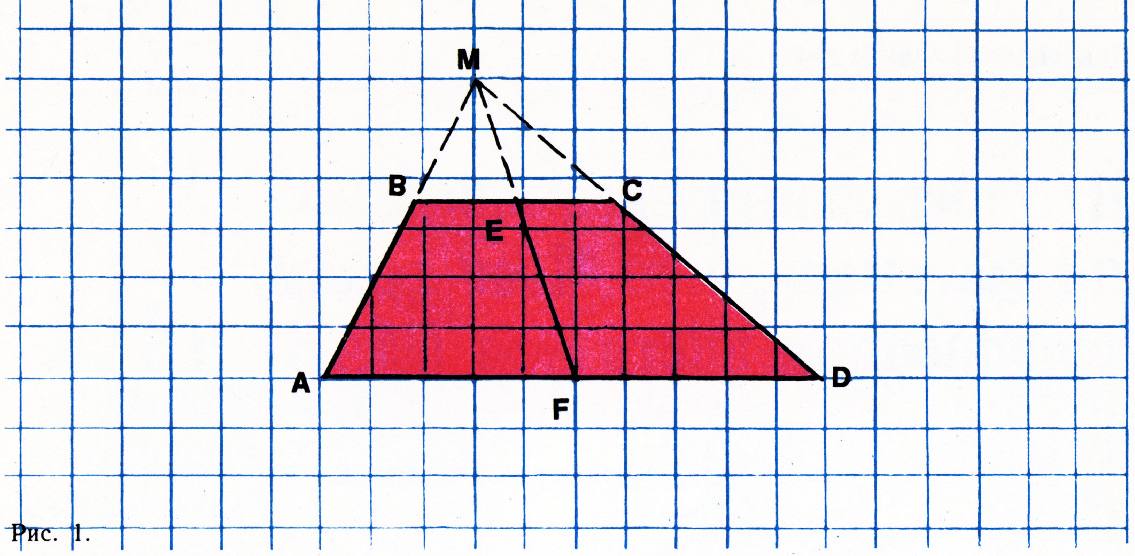
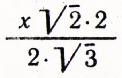
Fig. 1.
- Let us draw a trapezoid with the required segment and extend its sides until they intersect each other at point (Fig. 1). The continuation of line will also pass through point , since will be the median of the resulting . By condition . From the property of the median of a right triangle it follows that
Many did not use this property of the median and had difficulty solving the problem. Meanwhile, it is not difficult to report that the right angle rests on the diameter of the circle circumscribed about the triangle. The center of such a circle lies at the middle of the hypotenuse, i.e. at the base of the median. Therefore, and are equal as radii. This implies the above property. Then it is easy to find the required segment:
- In the notation figure 2 the lateral surface of the cone
Let’s denote it by . Then, since is straight, is, and is.
By condition , therefore and
Cone height
From here we find , and .
The lateral surface of the cone will be
5. We have , where ,
i.e. . Reducing to the general value, we get
or
and then we equate each of the factors to zero. Here, for many things, we did not put the common factor out of brackets, but opened the brackets in the penultimate expression and we come to the cubic equation
which they failed to resolve.
However, simple cubic equations, such as those that can be solved by factoring, may appear in entrance exams and need to be able to solve them.
In this case, we express 1 as the difference between the numbers 4 and 3 and present the equation in the form
Grouping, let’s write
and then
37
running_head:
folio:
.
We got the same as in the first solution. Next,
- and ;
- and .
Option 2
- In this example, the main difficulty lies in writing the model of a complex number correctly. Here the complexLEX number is , and the complexLEX number is . The modulus of the latter is , and its square is . Thus we have .
Two complex numbers are equal if their real parts and coefficients of their minimum parts are equal. Hence,
Solving the system, we find and . From here we get two complexLEX numbers: and .
- Using the basic logarithmic approach, we obtain
Then they made a lot of mistakes, namely, they took the logarithm of the degree, taking the exponent of the bracket 2 out of the sign of the logarithm, and shortened the equation by two. Such a transformation in this case leads to the loss of the root, since the logarithmic expression in parentheses can be positive, while in the original equation it could be both positive and negative.
Correct solution:
or .
Hence , which leads to two solutions:
- and ;
- and .
Both roots are positive and satisfy the ODZ of the unknown .
- Let us denote the distance between and by . Then the path of the first from to the first second meeting will be , and let it from the first second meeting be . The path of the second from to the first second will be , and from the first second meeting . Since they moved uniformly, the ratio of the path of the first and second second meeting and from the first second to the second should be non-negative. From here we get the equation
or .
- First of all, it should be noted that the left side of the given equation, as an argument root of even degree, is non-negative. Consequently, its right side must also be non-negative, i.e. ; from here is the ODZ of the unknown: .
By squaring both sides of the irrational equation, we obtain in the region of admissible values an equation equal to it
or