[Problem M41—M45; F48—F54]
Rough automatic draft, low quality: expect mistakes and awkward wording. It will be replaced by a better translation. Original →
In this and subsequent issues, the section “Kvant’s Problem” is composed of problems proposed at the All-Union Optimization in Physics and Mathematics in 1970. After each problem, the class in which it was offered is indicated in parentheses.
F48. A rope is wound around the armature shaft of the dynamo, to which a weight is attached. As the weight descends, it rotates the anchor. When the armature was sufficiently untwisted, a load resistance was connected to the terminals of the machine. Draw on a graph the dependence of the speed of rotation of the anchor on the time from the moment the load begins to move. (X)
G. I. Kosourov
F49. The U-shaped tube is filled with water. Air has been removed from one elbow; the air pressure in the other leg at temperature is equal to atmospheric pressure. Both ends of the tube are sealed. The difference between the water levels in the elbows is 15 m. What will be the difference in water levels in the elbows if the tube is heated to ? (IX-X)
B. B. Bukhovtsev
F50. On a smooth horizontal table lie two identical cubes with masses , connected by a spring of stiffness and length in an unstretched state. A force , constant in magnitude and direction, will suddenly begin to act on the left cube (Fig. 1). Find the minimum and maximum distance
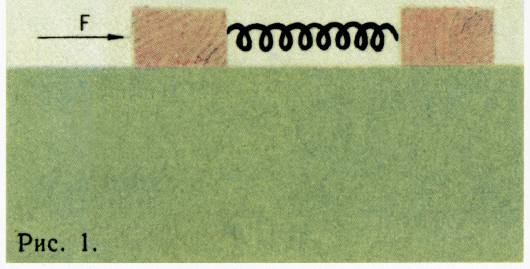

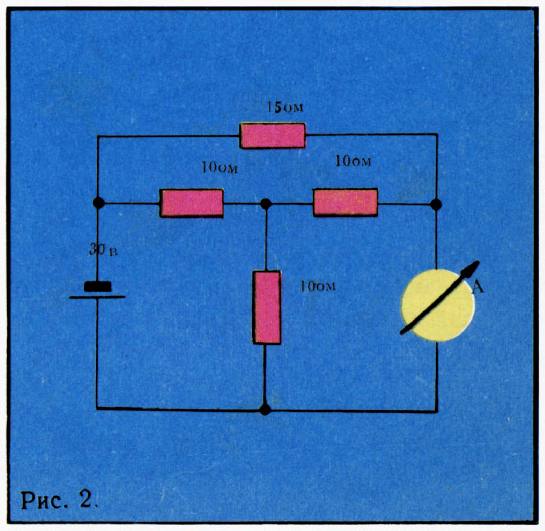

Fig. 1.
Fig. 2.
49
between the cubes as the system moves further. (X)
B. B. Bukhovtsev
F51. Photographing a tiger from a distance of less than 20 meters is dangerous. What size is a camera obscura with a hole 1 mm in diameter so that a tiger in photographs would be striped? The distance between stripes on a tiger’s skin is 20 cm. (X)
A. L. Stasenko
F52. The ball is thrown vertically upward. What is greater: the rise time or the fall time? (VIII)
F53. The vessel contains two immiscible liquids with specific gravities and and layer thicknesses and , respectively. A small object is lowered from the surface of the liquid into a vessel, which reaches the bottom just at the moment when its speed becomes zero. What is the density of the materials from which the body is made? (VIII)
M. M. Balatsov
F54. What will the ampere show in the circuit shown in figure 2? The resistance of the ampere is very small. (VIII-IX)
A. R. Zilberman
M41. Given a circle, its diameter and a point on this diameter. Construct two points and on the circle, symmetrical with respect to the diameter , for which the line is perpendicular to the line . (VIII)
M42. The digits of a certain seventeen-digit number are written in reverse order. The resulting number is added to the original one. Prove that at least one of the digits of their sum is even. (VIII)
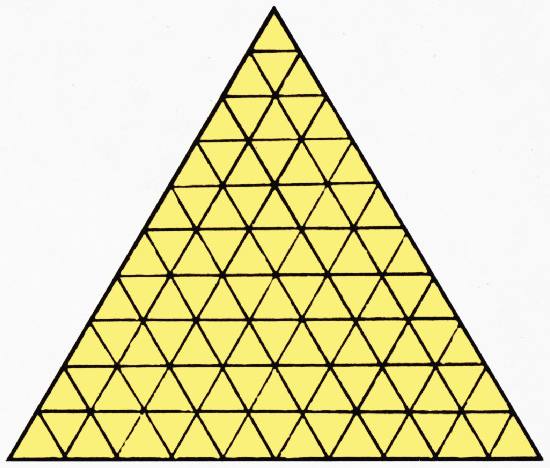
Fig. 3.
M43. Each side of a regular triangle is divided into equal parts. Straight lines parallel to the sides are drawn through the division points. As a result, the triangle was split into small triangles (Fig. 3). Let us create a “chain” of triangles in which none appears twice and each subsequent one has a common side with the previous one. What is the maximum possible number of triangles in the chain? (VIII—X)
M44. Prove that for every natural number there are an infinite number of natural numbers that do not contain zeros in decimal notation and such that and have the same sum of digits. (X)
M45. Prove that from any two cqrt numbers of numbers one can choose , the sum of which is divisible by , where .