Rough automatic draft, low quality: expect mistakes and awkward wording. It will be replaced by a better translation. Original →
52
Yu. V. Sidorov
In application exams at institutes, a lot of space is devoted to geometry problems. The conditions of most problems are formulated quite simply: in some geometric figures, several elements or correspondences between elements are specified and it is required to find an unknown element or an unknown correspondence between elements.
Such “standard” task conditions are understandable to every applicant. However, geometric problems and examples of their solution are so diverse that it is impossible to come up with any convenient classification by which one could find out the solution to each specific problem. That is why there are almost no descriptions of problem solving methods in textbooks and teaching aids. To learn how to solve geometric problems, you need to have a firm knowledge and good understanding of the basic theorems of geometry, the main thing is to constantly practice and regularly solve various problems.
In recent years, most schoolchildren solve geometric problems only in the “algebraic way”, which consists of the following. Unknown elements of a geometric figure are denoted by , , , …, and several correspondences between known and unknown elements are calculated. Then the resulting system of algebraic and trigonometric equations is solved and those elements or correspondence are found according to the conditions of the problem.
This formatted approach to solving geometric problems is often one of the simplest and allows you to quickly get an answer. Naturally, there may be a desire to solve all problems in this way. However, an applicant who has learned, without hesitation, to “transform” any geometric problem into an algebraic one, encounters insurmountable difficulties in the application exams if it turns out that his solution method does not lead to the desired result.
Almost every problem can be solved in different ways. Those works of applicants in which the shortest and most elegant way to solve the problem is found are highly rated. Only extensive and constant training allows you to learn to find the most diverse solution. A successful choice of unknowns, a convenient drawing, additional geometric constructions and a neat design of the solution help to correctly understand the problem and find the easiest way to solve it. Let’s look at specific examples.
At the written exam in mathematics at MIPT, the following problem was proposed.
- The bisectors AM and BN of triangle ABC intersect at point O. It is known that , . Named triangles ABC.
Many applicants tried to solve this problem in the following way.
53
Let , , (Fig. 1). Let us find the length of the segment from the triangle (by the property of the bicsectrix of the interior angle of a triangle and by the theorem of sines):
Similarly, from the triangle we find:
Thus, the system of equations is obtained:
Most of the applicants who solved the problem in this way were unable to find a solution to this rather complex system. But the bad thing is not that they did not solve the resulting system, but that they did not try to find another way to solve this problem. This problem is easier to solve in the following way (also algebraic).
Let , , . From triangles and , by the property of the bicsectrix of the interior angle of a triangle, we obtain:
Hence . From triangle we have:
that is
From this system of equations one finds: . It follows that and by the converse of the Pythagorean theorem, .
Hence,
Let’s consider one more problem.
- On the side of the triangle there is a point , and on the side there is a point such that . It is known that cm, cm. Find the length of the segment .
It is natural to try to solve this problem in the following way. Let us denote by (Fig. 2). Then and from the similarity of triangles we obtain the equation
which can easily be converted to the form .
It is difficult to find a solution to this equation, and therefore we must try to find another way to solve the problem. On-
54
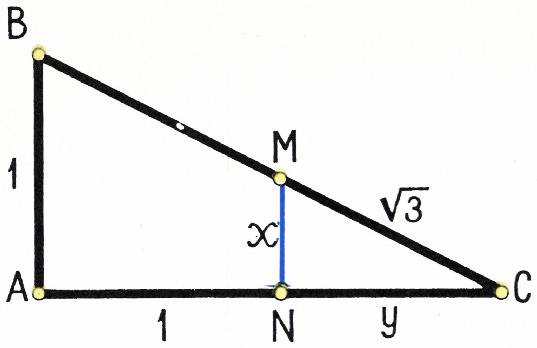
Fig. 2.
For example, problem 2 can be solved as follows.
Let us denote by , by . Then it is easy to obtain the following system of equations:
From the second equation of this system we find:
Subtracting the first equation of the system from this equation, we obtain:
Considering that , we obtain the system
from which we find the answer:
From the examples considered, it is clear how a successful choice of unknowns
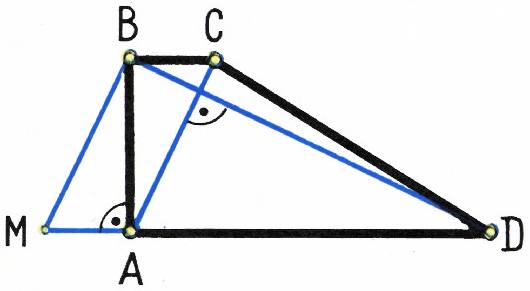
Fig. 3.
quantities helps to simplify the solution of a geometric problem in an algebraic way. Let us give examples of problems for which it is useful to make additional geometric constructions.
- The trapezius lateral side is perpendicular to the base, the diagonals are mutually perpendicular . Find the ratio .
Solved and e. Through the point we draw a line parallel to the diagonal until it intersects with the line at the point (Fig. 3). Then, by the theorem on the property of the perpendicular dropped from the vertex of the right angle of the triangle , we have
Considering that , we find
- On sides and of triangle there are points and , respectively, so that
Lines and intersect at point .
Find relation
Solved and e. Let’s carry out (Fig. 4). From the similarity of triangles and we find :
Hence,