Rough automatic draft, low quality: expect mistakes and awkward wording. It will be replaced by a better translation. Original →
41
About problems in photometry
V. E. Belonuchkin
Photometric problems usually cause great difficulties in constructing them into instruments.
To a large extent, this is due to the inability to correctly apply the law of processing squares.
In order to clearly understand the meaning of a particular law, one must understand from what messages and under what assumptions it was derived, when it is valid and when it is not, how it must be clarified if it cannot be applied immediately.
What is the law of processed squares?
Let’s remember its content: illumination is inversely proportional to the square of the distance from the light source.
What is illumination? As is known, this is the ratio of the luminous flux to the area on which it falls; if light comes from point O (Fig. 1) and spreads evenly in all directions, then, for example, to the area and , which are visible from point O at the same solid angles, there will be equal light fluxes. And the areas are proportional to the squares of the distance from point O. It should be noted that this reasoning is valid for an exact source that uniformly emits light in different directions, that is, equal luminous fluxes are emitted into any two identical solid angles.
If the light source has such properties, then the law of processed squares is simply a specific expression of the law of conservation of energy: due to the rectilinearity of the distance of light, the same energy (the same luminous flux) falls on the area that illuminates a given solid angle, regardless of the distance from the source this area is located.
Therefore, a comprehensive characteristic of a point light source is luminous intensity—the luminous flux emitted by the source into a unit solid angle. If an image is obtained using any optical element (lens, mirror), then it, naturally, is also a light source. What can be said about its luminous power?
Unfortunately, many people tend to believe that the light intensity of the image is always equal to the light intensity of the source. Is this true? Not always. In this case, we do not mean the absorption and scattering of light by the lens -
42
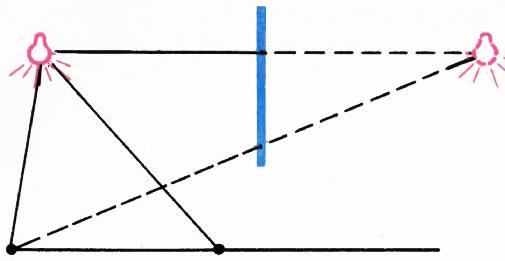
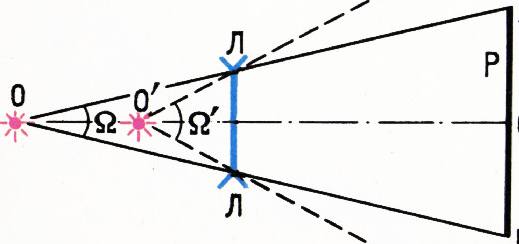
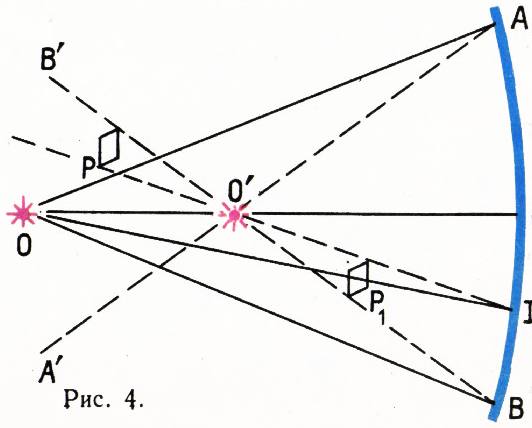
Fig. 2.
mi and mirrors; these losses will not be taken into account. There are other principles of differences in the strength of light sources and their images.
First, an image practically never radiates equally in all directions; This is due, in particular, to the finite dimensions of the line and mirrors. A flat mirror, for example, does not change the luminous intensity: the luminous intensity of the image is equal to the luminous intensity of the source. However, it must be taken into account that the image does not emit light in all directions. Indeed, point (Fig. 2) is illuminated by both the lamp and its image in the mirror, but point cannot be illuminated by the image. The luminous intensity of the image in this direction is zero.
Let’s look at another example.
Source illuminates screen through diverging lens (Fig. 3). The source image is closer to the screen than the source; if its luminous intensity is the same as that of the source, then the screen is illuminated brighter than the lens would be. What does direct consideration of light fluxes give?
Fig. 3.
42
When there was no lens, all the light that came in the cone hit the screen. If there is a lens, some of this light passes through a lot of the screen, and the illumination of the screen should decrease.
Obviously, this is due to the fact that the luminous intensity of the image is less than the luminous intensity of the source . Indeed, the luminous intensity is the ratio of the luminous flux to the solid angle, and we see that after the lens the light spreads to a larger solid angle, and
Therefore, If the illumination of the screen without a lens was , then with a lens
The ratio of the luminous intensity of the image and the source is always equal to the ratio of the squares of their distances from the optical element creating the image. Let us prove this, for example, for an image in a volgut mirror.
Let be the light source, and its image in the mirror (Fig. 4). Then the light flux emitted by the source in the cone , after reflection from the mirror and passing the point , will spread in the cone , equal in magnitude to . (Under the size of the cone, naturally
43
Of course, the corresponding solid angle is implied.)
Let the luminous intensity of the source be equal to . The luminous flux propagates in the cone and is equal to , where is the surface area of the mirror . From the image the luminous flux goes to a solid angle equal to ; means the luminous intensity of the image
And for this case we got the expected match.
It is interesting to note one more fact. Let us consider the illumination of the planes and (Fig. 4). For everything is clear: its left surface is illuminated by the source , and the illumination
the right surface is illuminated by the image , its illumination
What happens on the surface of the planes ? All the light must pass through this plane and be reflected on the section of the mirror between points and . This stream will illuminate the right surface of the planes; its illumination
On the other side,
Thus, the illumination of the right side of the planes , denoted , is equal to , as if that side of the planes were illuminated by the image . This, however, is natural, since the light is already reflected from the mirror.
The left side of the plane is illuminated by the source itself, and its illuminance is .
When does the luminous intensity of the image equal the luminous intensity of the source? If and only if the distances from the source and from the image to the optical element (lens, mirror) that create this image are equal. In particular, the luminous intensity of the image obtained in a plane mirror is always equal to the luminous intensity of the source. In a converging lens and a concave mirror, such equality is achieved when the source is located at double the focal length, but in a diverging lens and a convex mirror, it is impossible to obtain an image of a real light source of the same strength as the source itself.
Why is there a reservation about the actual source? Let’s check whether it is possible to obtain an image in a diverging lens at the same distance from it as the source. If the absolute value of the focal length of the lens is denoted by , then the lens formula in the case of interest to us will look like this: , hence . A minus sign in front of the distance from the lens to the image will indicate the image. Obviously, the minimum must be the source. Simply put, a converging beam of light must fall on the lens. An example of such a situation is shown in figure 5, where and are the correspondence of a collecting and diverging lens with the same focal lengths, and is a light source. If we remove , we get an image with the same luminous intensity as the source.
*) Note that when solving the problem, we considered some distances equal, for example and , which are not exactly equal to each other. The difference between them can be considered small if the distances , etc., are small compared to them.