Problem M91—M95; F103—F107
Rough automatic draft, low quality: expect mistakes and awkward wording. It will be replaced by a better translation. Original →
22
TASKS
M91. Two people play tic-tac-toe on an endless sheet of checkered paper. The beginner puts a cross in any cell. Each next move, he must place a cross in any free cell; any cell adjacent to one is considered to be any cell that has a common side or a common vertex with it. The second player, with each turn, can place three polykkas at once in any three free cells (not necessarily next to each other). Prove that, no matter how the first one plays, the second one can “lock him up”: make sure that the first one has nowhere else to put a cross.
Explore similar games in which the second player is allowed to place not three, but only two or only one polyk in one turn. What will be the result here if the partners play correctly: did the players succeed in
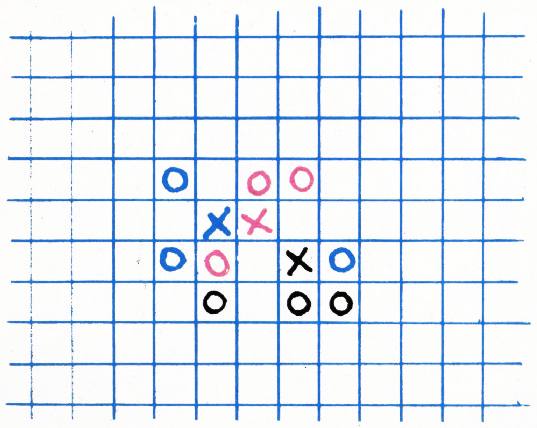

Fig. 1. Here is one of the positions that can arise after the third move (crosses and crosses placed on the first move are highlighted in black, red - on the second, blue - on the third).
crosses (and what is the maximum number of moves that the crosses can last) or can the game continue indefinitely?
Try to study other variants of this game: when only cells that have a common side with it are considered adjacent to a given one; when the plane is divided not into squares, but into regular hexagons; when the first one is allowed to put ru crosses at once, and the second one - q polikk.
A. P. Savin
M92. Petya plans to spend the entire 90 days of his vacation in the village and at the same time strictly adheres to the following schedule: every second day (that is, every other day) he goes swimming in the lake, every third day he goes to the store for groceries, and every fifth day he solves problems in mathematics. (On the first day, Petya did both, and the third, and was very tired.) How many “pleasant” days will Petya have, when he needs to swim, but does not need to go to the store and solve problems? How many “boring” ones are there when there is nothing to do at all?
M93. Each of the numbers is equal to the plane or minus one. It is known that
Prove that is divisible by even.
A. M. Leontovi
M94. Prove that there is no polyhedron with at least four edges attached to each vertex and each face.
L. G. Limanov