[Problem M61—M65; F72—F76]
Rough automatic draft, low quality: expect mistakes and awkward wording. It will be replaced by a better translation. Original →
38
This section of the magazine is maintained from issue to issue. It publishes problems in physics and mathematics, some of which are quite difficult. Further, specialization in physics and mathematicians, solving them is not easy. Therefore, do not check in if you cannot cope with this or that task. Try to bring the words back to her over time.
Solving a problem means understanding what mathematical apparatus, what equations (or theorems) need to be used for this, what factors to take into account, and what factors to take into account; this means also trying to establish where and how the phenomena indicated in the problem are applied in practice. But a solution has been found. You are satisfied. One should not, however, rest on this. Think about how you can generalize the problem.
In the second part of the section (about six months after the start of publication of the problems themselves), we will post their solutions, taking into account the letters sent by readers. We need this time because it takes more than four months to prepare for printing the next issue.
Schoolchildren who regularly submit particularly original and successful solutions will receive the right to participate in the areas of three-weight optimization for schoolchildren on an equal basis with the winners of the Weighted Correspondence Optimization. In addition, the editors of the magazine established several special prizes for the authors of the most interesting solutions.
And one last thing. Coming up with a problem is usually more difficult than solving it. It’s more difficult, but it’s also more interesting. Try to come up with problems and send them to us. We will publish the best of them in the Quantum Problem Book.
Send your solutions and new problems to the following address: Moscow, V-71, Leninsky Prospekt, 15, editorial office of the journal «Kvant», “Problem Book «Kvant»”, mathematics (physics). The solution to each problem (if you send several attempts at once on a separate piece of paper (sheets), the page is readable. At the end, indicate your last name, first name, patronymic, as well as class and school. Solutions are considered only if they are received no later than a month and a half after the publication of the corresponding issue of the journal.
39
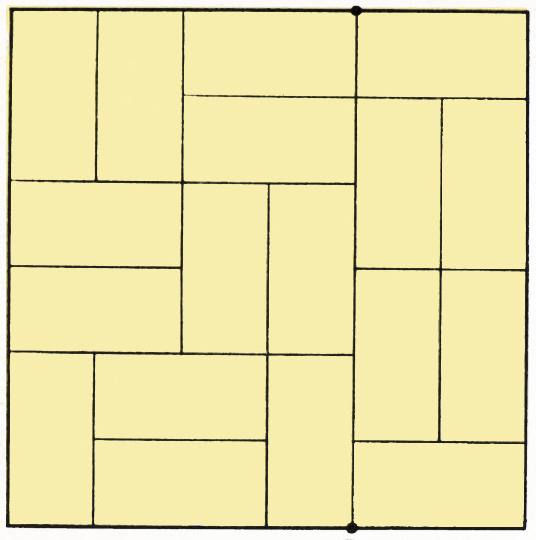
Fig. 1.
M61. Two wise men play a new game, which consists of the following. The numbers 0, 1, 2,…, 1024 are written out. The first sage crosses out 512 numbers of his choice, the second crosses out 256 of the remaining numbers, then again the first crosses out another 128, then the second – another 64 numbers, etc. With his last fifth move, the second crosses out one number. There will be two numbers left, and the second one pays the first one the difference between these numbers. How should you play the first game to get as much as possible? How can the second one lose as little as possible? How much will the second one pay the first one if she plays better?
XXXII Moscow Mathematical Olympiad
M62. Prove that for any odd number there is a natural such that is divisible by .
M63. Is it possible to lay out a square out of 18 tiles of size ?
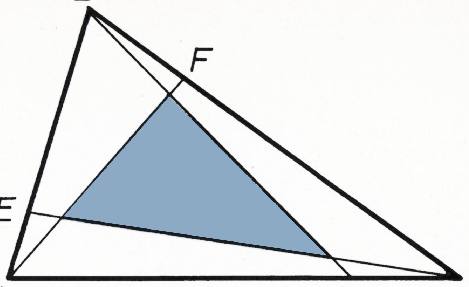
Fig. 2.
So that there is not a single straight “seam” connecting the opposite sides of the square and running along the edges of the tiles? (For example, a tile arrangement like figure 1 would not work because there is a “seam” ).
A. A. Kirillov
M64. On the data plane there is a straight line and two points and lying on one side of it. Find on the line also the points for which the distance between the bases of the altitudes of the triangle , dropped to the sides and , is called.
G. A. Palatnik
M65. a) Let be points on sides and of triangle for which , where . Find the ratio of the area of the triangle formed by lines and to the area of triangle (Fig. 2).
- Cut the triangle into six straight lines into pieces that can be used to form seven equal triangles.
A. L. Soifer
40
F72. Why does the length of the day change faster in March than in December?
G. L. Komkin
F73. Lint the sugar solution inside the glass tube. The lower end of the tube is covered with a film that is permeable to water but impermeable to sugar molecules. The tube is immersed in clean water until the sugar dissolves and secured in this position. At the same time, the liquid level in the tube begins to rise and, after a sufficient period of time, is established at a certain height above the water level (Fig. 3).
What explains this accumulation of water inside the cylinder? Where does the energy to lift liquid come from?
F74. Two capacitors are connected in series. The first has a capacity of and is designed for a maximum voltage of , the second has a capacity of and is designed for a voltage of . To what maximum zero does
Can you connect this bank of capacitors?
A. R. Zilberman
F75. A piston with an area hinged with a washer sliding without friction along the lever . Lever length . What is the minimum force that must be applied to lever in order to increase the pressure in the fluid by (Fig.4)?
B. B. Bukhovtsev, Moscow State University Physics Olympiad, 1970
F76. A heavy hoop with weightless knitting needles is located in a vertical plane and can rotate around a horizontal axis passing through the center. A material point is fixed in the thickness of its rim, having the same mass as the hoop itself. What will be the period of oscillation of the hoop around its axis? How will it change if: a) the motherboard is moved to the Moon, b) placed in a liquid in which it will move without friction?