Rough automatic draft, low quality: expect mistakes and awkward wording. It will be replaced by a better translation. Original →
56
IV INTERNATIONAL PHYSICS OLYMPIAD FOR SCHOOLCHILDREN
From July 5 to July 15, the International Physics Olympiad for schoolchildren was held in Moscow. It is only the fourth time it has been held. Mathematicians have a rich tradition in this sense - their first International Olympiad took place back in 1959, and they are held daily. And yet, the International Physics Olympiads are older than similar Chemistry Olympiads - the International Chemical Olympiad was held for the first time in 1970.
Academician of the Academy of Pedagogical Sciences of the USSR V. A. Fabrikant opens the IV International Physics Olympiad for schoolchildren. Photo by M. V. Alpert (APN).
The current Olympiad was attended by high school students and graduates (who graduated from school in 1970) from the People’s Republic of Bulgaria, the Hungarian People’s Republic, the German Democratic Republic, the Polish People’s Republic, the Socialist Republic of Romania, the USSR, the Czechoslovak Socialist Republic and the Socialist Federal Republic of Yugoslavia.
The supreme body of the Olympiad was the International Commission, which included the scientific supervisors of all delegates. It was headed by Academician of the Academy of Pedagogical Sciences of the USSR V. A. Fabrikant.
The Soviet team included guys who successfully performed at the All-Union Physics Olympiad last year in Sverdlovsk: Igor Bulzhenkov (Ufa), Mikhail Voloshin (Moscow), Sergei Gorbachevsky (Lomonosov, Leningrad region), Vladimir Kravtsov (Gorky), Igor Lyuksitov (Kyiv) and Boris Petrov (Pskov).
The scientific leader of the Soviet team was Moscow State University professor V.I. Iveronova.
It has become a tradition to carry out physical
57
Soviet team. From left to right: I. Bulzhenkov, I. Lyuksyutov, S. Gorbachevsky, V. Kravtsov, V. Petrov, M. Voloshin. Photo by M. V. Alpert (APN).
Russian Olympics in two rounds. It was the same this time. On the first type, the children were asked to solve four problems, on the second - only one, but experimentally. The international commission set the highest score for solving each problem of the first type - 10 points, the maximum number of points for experimental work equal to 20. Theoretical and experimental rounds were held on different days.
But that’s all behind us. On July 13, the results were summed up. Before talking about them, we note that there was no official transfer to the Olympics. Speaking about the goals of the Olympiad, introduce its organizing committee, the vice-president of the Academy of Pedagogical Sciences of the USSR V. G. Zubov said that the Olympiad is, first of all, a friendly state of good friends, and its goal is to compare the knowledge of schoolchildren, compare it with the knowledge of peers from other countries. And the head of the Yugoskov delegation, Dr. Bozhidar Milich, speaking at the closing of the Olympics on behalf of the International Commission, at the suggestion of Soviet scientists, sought to preserve the tradition of the Olympic Games - “not the countries, but the participants.”
To receive the first prize at the Olympiad, it was necessary to score at least 50 points (out of 60 possible), the second - from 45 to 49 points, the third - from 39 to 44. Those who received more than half of all points were awarded with praise.
Let us present the results of the Soviet team: the first prizes were received by M. Voloshin, S. Gorbachevsky and B. Petrov, the second prizes by I. Lyuksyutov and I. Bulzhenkov, the third by V. Kravtsov. M. Voloshin scored the maximum number of points (57). And here is how the prizes and half of those recalled were distributed among the delegation:
| Country | 1st prize | 2nd prize | III Prize | Praiseworthy reviews |
| :— | :— | :— | :— | :— |
| Bulgaria | — | — | — | 2 |
| Hungary | — | 2 | 1 | 1 |
| GDR | — | 1 | — | 2 |
| Poland | 1 | 1 | — | 4 |
| Romania | — | — | 3 | 1 |
| USSR | 3 | 2 | 1 | — |
| Czechoslovakia | — | — | 5 | — |
| Yugoslavia | — | 1 | — | 3 |
A total of 34 people were awarded. The rest received participant diplomas.
Let’s name here a few more successful Olympiad participants. Marek Zyukkowski from Poland received the first prize together with our guys. Ingree Reimann, a girl from the GDR, received a special prize for successful participation in the Olympics, and her teammate Manfred Fischer received the second prize and, in addition, a special prize for the best performance of experimental work. He received the maximum number of points for the experiment.
It’s always a pleasure to win at the Olympics, especially at the International ones. All members of the Soviet team
58
admitted to institutes without exams.
Taking this opportunity, we once again congratulate all the guys who successfully performed in Moscow this summer.
Yu. M. Brook
N. A. Mints
Objectives of the IV International Physics Olympics
Problem 1
A long block of mass is located on a smooth horizontal plane along which it can move without friction. A carriage with a motor can slide along the upper horizontal edge of the block. The mass of the carriage with the motor is e, the friction coefficient is . A motor at a constant speed of cm/sec winds a thread onto a shaft, the second end of which in one case is tied to a sufficiently distant peg mounted on a fixed support, and in the other - to a peg attached to a block (Fig. 1). Keeping the block motionless, allow the carriage to begin moving at a speed of , after which the block is released. By the time the block is released, the front edge of the carriage is at a distance of cm from the front edge of the block. For both cases, determine the nature and speed of movement of the block and carriage after the block begins to move and the time during which the carriage reaches the front edge of the block.
Problem 2
The unit cell of a rock salt (NaCl) crystal is a cube whose edge length is A ( cm) (Fig. 2). The red balls on figure indicate the positions of sodium atoms, and the blue balls indicate the positions of chlorine atoms. The entire rock salt crystal is obtained by repeating such elementary cells. The atomic weight of sodium is 23, the atomic weight of chlorine is 35.5. The density of rock salt is e/cm³. It is necessary to determine the mass of a hydrogen atom from these data.
Problem 3
A concentric metal ball of radius cm is placed inside a thin-walled metal sphere of radius cm. Ball
59
through the responses in the sphere it is connected to the ground using a very long wire (Fig. 3).
A coulomb charge is placed on the outer sphere. It is required to determine the potential of this sphere, the electrical capacitance of the resulting system of conducting bodies, and to design an equivalent electrical circuit.
Task 4
The phone uses a spherical mirror with a radius of curvature . At the main focus of the mirror there is a radiation receiver in the form of a round disk. The disk is located perpendicular to the optical axis of the telescope (Fig. 4). What size should the receiver be so that it receives the entire flux of radiation reflected by the mirror?
The transverse size of the mirror is 50 cm.
How many times will the radiation flux received by the receiver decrease if its size is reduced by eight times?
And I: 1) When calculating for small values of (), you can make the replacement . 2) Ignore diffraction.
Experimental tour assignment
On the table there are three different lenses on stands, a screen with an image of a geometric figure, a vertical wire also mounted on stands, and a measuring tape - a port meter (Fig. 5).
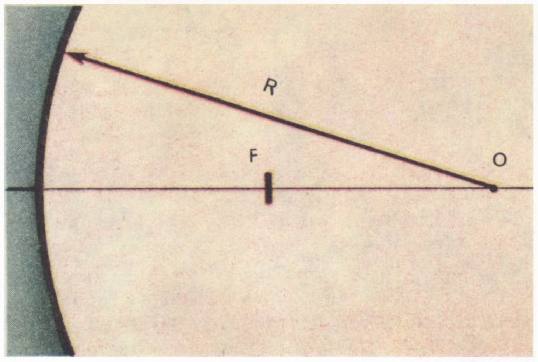
Fig. 4.
It is necessary, using only objects located on the table, to determine the focal lengths of the line and their signs.
We invite readers to try this experiment themselves. How many ways are there to measure focal lengths with the above tools? For each method, draw a diagram of the experiment and the course of the rays. Is it possible to take measurements with any set of lenses (all lenses are positive; two lenses are positive, one is negative, etc.)? If you obtuse several possible methods for each set of lenses, determine the focal lengths of each method and compare the results. What do you see as the sources of errors in your experiments?
Write to the editor about your experimental conditions or failures.
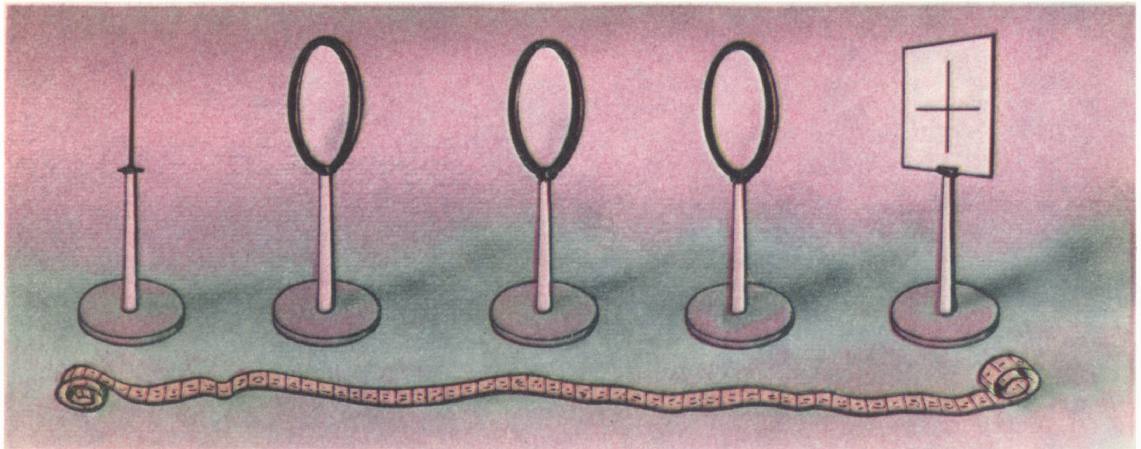
Fig. 5.