Rough automatic draft, low quality: expect mistakes and awkward wording. It will be replaced by a better translation. Original →
12
the body is transferred from hot to cold. In all cases where this does not happen, you can find where the system is “open”. So, in the case of a refrigerator, its cooling occurs due to the energy received from a power plant, or, ultimately, from the cooling Sun.
Reader
Everything you say, in my opinion, is absolutely clear.
Author
I have already warned: the source of the deepest ones - each one is very much driven by the energy received from the power plant, or, ultimately, from the cooling Sun.
Reader
Everything you say, in my opinion, is absolutely very important - everyone is very much driven by the energy received from the power plant, or, ultimately, from the cooling Sun.
Usually, when the results of an experiment contradict a theory, the theory must be corrected. If the experiment contradicts the second law of thermodynamics, or there is an error in the experiment. And it always follows the so-called “second law of thermodynamics” (“the first law” is the law of conservation of energy), or the “law of increasing energy.”
Usually, when the results of an experiment contradict a theory, the theory must be corrected. And it always follows the so-called “second law of thermodynamics” (“the first law” is the law of conservation of energy), or the “law of increasing energy.”
The second law of thermodynamics states: “In a closed system of processes, temperatures are equalized.” In other words, heat transfer from a hot body to a cold one. The first is cooling, and the second is heating.
In order to respond to energy with a more heated body, work must be expended. This means that not only is the “perpetual motion machine of the first city”, which does work from “nothing”, impossible, but also the question of the first law of thermodynamics - the law of conservation of energy. It is also impossible and does not contradict this law of the “perpetual motion machine of the second city”, which we quickly formed by the second law of thermodynamics, did work, cooled the work, cooled the seas, oceans, materials. Their reserves of thermal energy are practically inexhaustible, but, alas, inaccessible. What own processes can be the second beginning!
So, in a closed system of processes, temperatures are equalized.
This process ends when the warm-eastern temperatures are the same. Then a state of equilibrium occurs, but not mechanical, but thermodynamic.
But this immediately leads to the conclusion about the “tellian death of the Universe”, which belongs to the German scientist Clausis. Sooner or later, all the stars will cool down, the same temperature will be established throughout the world, any processes will turn out to be impossible - the world will turn into a lifeless, empty place. All attempts to understand why this will not happen during the existence of the Universe were free until the advent of the general theory of relativity!
Reader
But according to the theory of relative temperature, does it not equalize?
Author
No, the answer is not so straightforward. But in order to understand how the general theory of relativity dealt with heat death, we need to talk a little about the basic concepts of this theory.
Reader
And this, you say now, is inaccessible to a schoolboy…
Author
On the contrary, I’m sure it’s accessible. I believe that the deeper the physical or mathematical idea, the easier it is to present it without using any special knowledge.
Reader
So please tell us about the general theory of relativity.
Author
This should be a topic for a separate conversation. Today we are talking about temperature, and it was important for me to show that by thinking about how a thermometer changes temperature, you can
13
but come to Einstein’s theory; Show me how many problems and perspectives can be seen by reading school physics. As you can see, thinking about temperature turns out to be extremely fruitful. What is temperature?
Reader
From what you said, I understood that temperature is what equalizes when two bodies come into contact. At school we were told that temperature is a quantity proportional to the average kinetic energy of molecules:
where
Temperature equalization occurs because during a collision, energy is transferred from particles with higher energy to particles with lower energy.
Author
What do you think is the potential energy of interaction between particles in a crystal at absolute zero temperature?
Reader
We offer this energy by turning the crystal into gas. This means that for each atom there is an energy equal to approximately , where is the boiling point.
Author
Absolutely correct assessment. So, in your opinion, a crystal located at absolute zero temperature can heat a gas having a temperature below the boiling point of the crystal?
Reader
Of course not. I did not mean total, but kinetic energy, which is higher the higher the temperature.
Author
Fine. Consider, for example, a piece of ice. Above it, of course, there is water vapor. Due to temperature equalization, ice and steam have the same temperatures at equilibrium. This means that the average velocities of molecules in vapor and ice crystal are the same.
Reader (puzzled).
No, this is something strange. After all, in melted ice the molecules are almost immobile, but they move around at enormous speeds. I remember well that when a liquid evaporates, it cools. There is even a way to obtain very low temperatures - evaporation of liquid gel. This is understandable. Only the fastest molecules can fly beyond the boundaries of molecular acceptance in a liquid. The remaining slow ones correspond to a lower temperature.
Author
But wouldn’t some of the energy be spent on pre-molecular absorption in the liquid? Will the molecules fly out of the liquid into vapor at the same speed with which they began their journey?
Reader
Honestly, it’s good to argue. I never thought that in a dispute the truth is actually born! I think I understood everything completely! Indeed, those molecules that were washed away quickly will evaporate, so first the liquid cools. Pre-acceptance, the molecules lose their speed, like a package flying towards the Moon. Therefore, gas also does not consist of record-breakingly fast molecules, and the average speeds of molecules in gas and liquid coincide. Thanks to evaporation, the overall temperature is established. If the escaping, formerly fast molecules are carried away, as during evaporation under pumping, a noticeable decrease in the temperature of the liquid can be achieved.
Author
What about the speeds of molecules in a crystal?
Reader
In a crystal, molecules move with the same average speeds as in a pair above it, but they do not perform a free translational motion, slightly distorted by rare molecules, as in a gas, but oscillate around standard places in the crystal lattice…
14
Author
…which are called lattice nodes. Absolutely right.
But I will continue to pester you. Over time, you will learn to do this on your own. A graphomaniac color susceptible to any of his ideas - the scientist first begins in Japanese with possible refutations.
So, they said that temperature determines the average speed of molecules. This means that the average speeds of molecules in any body, regardless of their composition and state (water, iron, air), at the same temperature are the same. And at absolute zero the velocities are zero. But what then to do with the gel, which remains liquid even at absolute zero temperature?
Reader
But I read that absolute zero is unattainable. By the way, why?
Author
In order to understand why, we need to talk about entropy. This will greatly increase us in the direction. And the fact that zero is unattainable does not exist in our case. In principle, we can get as close to it as we like. The only important thing for us is that at a temperature of several degrees Kelvin, the average speed of the atoms of the gel already weakly depends on temperature, and when the temperature changes from 1 to 10⁻⁶ degrees, it practically does not change, although, it would seem, it should decrease a thousand times.
Reader
Maybe this is due to the special properties of the gel, its superfluidity?
Author
There are some societies between these phenomena. However, remaining liquid at absolute zero is not only a property of a gel. As you know, the good electron conductivity of metals is due to free electrons. Their average kinetic energy practically does not depend on the temperature of the metal, and if we calculate it at the temperature using our formula , we will see that it corresponds to a temperature of 10⁵—10⁶ degrees, that is, the temperature inside the stars!
Reader
Maybe the temperatures of the metal and electrons do not match?
Author
No, in a state of equilibrium, temperatures, as we said, always level out. The point here is different. The definition of temperature that you shared is correct - but only in classical mechanics. Such a “simple”, well-known and fundamental quantity as temperature, strictly speaking, has a quantum nature! This is due to the superfluidity of the gel and the fact that it never replaces at atmospheric pressure - both of these properties are purely quantum. As you can see, in search of significant quantum effects it is not necessary to look for ways into the microworld - these effects are before your eyes.
Unfortunately, in the quantum case the meaning of temperature is not as clear as in the classical case. Let’s start at absolute zero temperature and consider a purely quantum effect - we determine the kinetic energy at absolute zero, that is, a quantity that in classical theory is exactly equal to zero. This allows us to find out whether all substances remain solid at zero temperature, whether an increase in pressure always promotes solidification, and what is the state of matter in the interior of the Earth and in the depths of stars.
All these conclusions can be derived from one very important quantum law—the uncertainty principle.
Reader
I know the principles of uncertainty as applied to the coordinate and momentum of a particle. Position and momentum cannot be measured accurately because they do not have a specific value at the same time. When measuring them
15
pulse particles and coordinates we find out the values of these quantities with some errors and .
The properties of these two quantities are that it is impossible to make the product of these errors (sometimes called “uncertainty”) less than - Planck’s constant divided by 2π
Author
In an object consisting of identical atoms, all of them are also active, and therefore their position cannot be changed with an accuracy greater than the distance between them. If , what is the smallest possible value of momentum?
Reader
Of course, ! If I were to say that the momentum, for example, is less than 0.1 , then this would mean changing it with an accuracy of 0.1 , which is impossible!
Author
This means that the lowest possible kinetic energy…
Reader
…equal to , that is, the smaller the mass, the greater! I wonder what temperature this energy corresponds to in classical mechanics? The average distance between atoms and electrons in metals is m, the mass of an electron is e, the mass of a helium atom is e. From the formula
we find that for electrons the temperature is
Big million degrees! For helium we would get temperatures in the same way.
Author
Exactly the numbers that were discussed earlier. Now it is no longer difficult for you to find out what a substance will be like at zero temperature—solid or not. But first, think about why it is generally difficult for the parietal to harden at low temperatures.
Reader
Obviously, because at low temperatures the kinetic energy of the particle becomes small.
Author
What does small mean? Compared to what?
Reader
Apparently, in comparison with the potential energy of interaction between particles. When potential energy becomes significantly greater than kinetic energy, it forces atoms to occupy certain positions in the crystal lattice. Therefore, in order to say what a substance will be like at zero temperature, you need to know how the potential energy of interaction of particles depends on the distance between them.
Now it is clear to me that a liquid that does not freeze at absolute zero temperature should be sought among substances with light atoms and weakly interacting—further, increased kinetic energy of atoms and placed potential interaction energy . Helium is the lightest inert gas, the atoms of which weakly interact with each other (as, indeed, with other atoms - this is their “inertness”). Obviously, it satisfies the general conditions.
In the case of an electron gas, the potential energy of interaction corresponds to Coulomb’s law: , where is the electron charge, equal to approximately , and
16
At the minimum kinetic energy of electrons
turns out to be approximately the same as the minimum kinetic energy of electrons! Therefore, electron gas cannot solidify.
Author
It is interesting that the uncertainty principle already implies the absence of electrons in the nucleus, the size of which is of the order of . There it would have to have a speed of , that is, 2000 times the speed of light!
Now you can trace what will happen to the substance at as the pressure increases, that is, as the mechanical distance decreases.
Reader
Well, yes, everything is determined by the correspondence between potential and kinetic energy: and . If , you get a crystal; otherwise, you get a liquid or gas.
Author
If a substance is crushed enough to “crush” and lower atoms, then is proportional to .
Reader
Therefore, at it will become more and more gaseous! Pressure causes melting - very interesting!
Author
At very high pressures, when nuclei fall apart, the potential
Fig. 1.
cial energy increases rapidly with decreasing , and the substance solidifies again. Then, in the region of ultra-high densities, corresponding directly to neutron stars, the energy of gravitational interaction becomes decisive, and new melting can occur.
There are stars that change their brightness and have a size of about 10 km and a mass comparable to the mass of the Sun. They have a solid bark (its density varies from to ) and a liquid core with a density of .
Reader
All this is very interesting, but I still don’t understand what temperature is from the point of view of quantum mechanics.
Author
We have so far determined only the minimum energy of an atom or molecule. However, this does not yet determine the kinetic energy of the substance. Something to keep in mind. According to the laws of quantum mechanics, the energy of a particle cannot be any. It can only take on completely defined values, or, as we say, particles can be at certain energy levels. They are usually depicted in the form of horizontal lines located one above the other (Fig. 1). The energy level system is something like a bookcase with shelves. Books can be on shelves, but not between them.
Reader
Is the distribution of particles among the shelf levels purely random and disorderly?
18
science, but also for technology. In famous quantum generators - lasers and masers - they specially create a negative temperature in exactly the sense that you were talking about, and then quickly “highlight” the accumulated energy.
Reader
Does temperature determine the distribution of particles by energy level only in quantum mechanics?
Author
Of course not. This is also true in classical mechanics. For example, the energy distribution of molecules of a “classical” ideal gas is as shown in figure 4. It is determined by the formula
Here is the number of particles in the state from which we start, there is no energy of particle ; is the number of particles with energy ; is the base of natural logarithms, is Boltzmann’s constant, is the gas temperature.
Reader
If we transform this formula, continuing the rhymes of both sides of the equality, then it will take the form
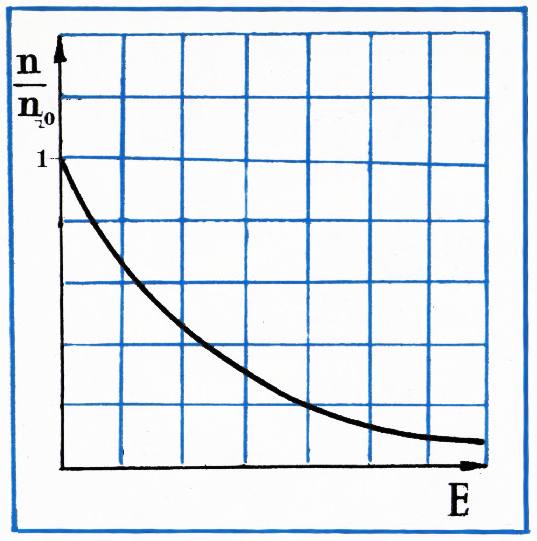
Fig. 4.
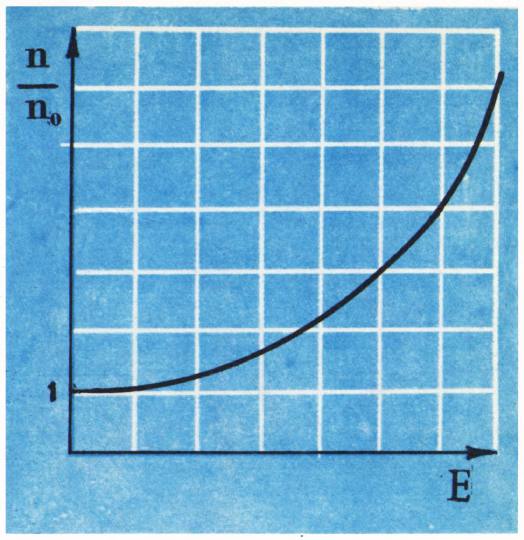
Fig. 5.
From here
If we supply energy to a gas, we will increase its temperature, transferring more and more of it from lower energy levels to upper ones. In doing so, we can ensure that becomes and greater than . This will mean that the gas temperature is negative! It seems to me that we have reached the point of absurdity. Therefore, it makes no sense to talk about the negative temperature of an ideal gas.
Author
If we consider only a few energy levels, then we can make it so that the upper ones will have more gas molecules than the lower ones. However, it is impossible to ensure that the energy distribution of molecules is the same as shown in figure 5: the dependence of the number of a part on energy is exponential and there is more of a part at very high levels than at lower ones.
The whole point is that our conclusion about the possibility of negative temperatures is valid not for any system of particles, but only for such
19
which has a finite number of energy levels. After all, energy usually includes clinical energy as an integral part, and it can be much greater. In quantum language, this means that the number of energy levels is infinitely large. But in this case, it is impossible even to distribute a finite number of particles evenly over an infinitely large number of energy levels, let alone obtain a negative temperature. This means that our calculations are correct for systems whose energy is not related to clinical energy.
Reader
This is very difficult to understand. I have never heard of anything that someone held in their hands or saw a body with a negative temperature.
Author
This is not surprising. In a stable, equilibrium state, negative temperature is impossible. A state with a negative temperature is, as they say, a metastable state. Once it has arisen, it usually does not exist for long (although there are also very long-lasting metastable states, for example glass, which in the equilibrium state is an opaque crystal). For example, when a negative temperature is created in the working substance of a laser, it very quickly transforms into a state with a positive temperature: particles from high energy levels move, as if “falling” to lower levels, and the energy lost in this case is released in the form of a laser beam.
Reader
But I would like to return to the temperature. If I understand you correctly, temperature is a concept that has many different sides. On the one hand, temperature is a quantity that characterizes the state of the body, the replacement of the body, such that when a system transitions to equilibrium, it turns out to be the same in all parts of the system. On the other hand, temperature is related to the average clinical energy of the particles that make up the body. Finally, in quantum mechanics it acts as a quantity that determines the distribution of particles by energy state. It is easy to notice that in all three manifestations, temperature is most closely connected with another physical quantity - energy. But earlier you mentioned another quantity that was completely unfamiliar to me - entropy. Does it also have something to do with temperature?
Author
The most direct thing. And a story about temperature cannot be complete without talking about entropy. But entropy should always take up no less space than the one that is now time to finish.