Rough automatic draft, low quality: expect mistakes and awkward wording. It will be replaced by a better translation. Original →
20
S. A. Kheifets
The craving for something shiny is hidden in the depths of consciousness. A child who sees the light for the first time is drawn to the bright; the natives trade both food and water for shiny trinkets. People call a gifted, deep mind “brilliant.” We will not be interested in whether this attention to the shiny is connected with atavistic memories of the burning fire or with hypnosis, we will try to figure out why the shine appears - be it the shine of gold, amaz or cat’s eyes in the dark.
We judge the rage of an object by the amount of light that was reflected from it and into our eyes *). It is clear that this amount depends on the proportion of reflected light and its direction. A white sheet of paper reflects better than black, and a mirror surface reflects better than a matte one.
The direction of light reflected by a surface is determined by the well-known law: the angle of incidence is equal to the angle of reflection. And the energy of reflected light also depends on the refractive index of the medium . If light is incident normally on the boundary of media with refractive indices and , then the fraction of the reflected
*) Brightness is determined by the luminous flux hitting the retina.
energy is equal to . For glass , for air , so only 4.3% of the incident light is reflected. For a glass plate, the proportion of reflected energy will be approximately twice as large, since part of the transmitted light will be reflected from the second surface of the glass and return back. If the rays do not fall vertically, but at an angle, they are reflected better (Fig. 1). At , not 4.3%, but 9% are reflected from the glass; at already 39%. When the angle of incidence approaches —a grazing ray—almost all the light is reflected (the reflection coefficient approaches 100%). Further, very black bodies, such as graphite, soot, velvet, begin to shine if you look at them at a small angle to the surface.
When light is normally incident on a glass plate, the fraction of reflected energy is close to 8.6%. Is it a little or a lot? It turns out, not much. Fresh snow reflects 80-85% of the incident light, and clouds reflect the same amount.
However, the sedge of glass on the snow is easy to notice, as well as the sparkles of individual snowflakes. This is explained not so much by the reflective properties of the plate, but by the parallelism of the sun’s rays - the
22
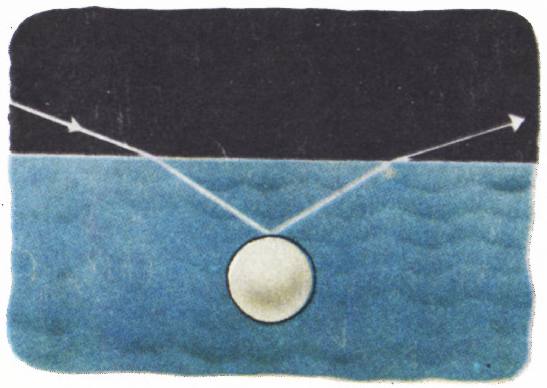
Fig. 3. Reflection from an air bubble.
differed in direction. The exception was “sliding” rays. Then the shine was a consequence of almost 100% reflection of the incident light. A similar situation is observed if the beam hits the interface between two media from a denser medium. If the light is incident normally, then the fraction of reflected light energy is determined by the same formula as before. For water, this means that 98% of the light escapes into the air. As the angle of incidence β increases, the intensity of the refracted beam decreases, and at the refracted beam disappears. In this case, all the incident light is reflected from the boundaries - the so-called total internal reflection occurs. For glass , so that the beam, induzione at an angle to the normal , does not go out. For water , so that the fish can only see the sky through the “hole” with an opening angle of about 45°
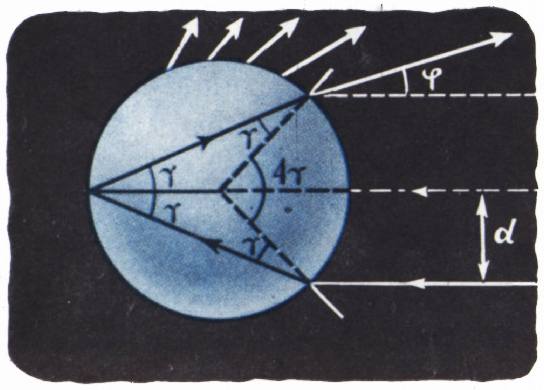
Fig. 4. The path of rays in a drop of water.
(Fig. 2). The rest of the water surface (from the point of view of the fish) is bleibt and reflects only up to the reservoir. The interface with total internal reflection is an ideal mirror.
Another interesting application of this effect is light pipes. If you send a beam inside the fiberglass, then you can gently bend these fibers, even spin the nodes, and the light beam will obediently spin, following the law of total internal reflection.
Dip a leaf of silver neva into the water. The reverse side of the sheet, covered with many bubbles, begins to serbrista. And you’ve probably seen the sparkle of a dew drop. In both cases, the matter is in total internal reflection: in the first case - from the external, in the second - from the internal surface of an air bubble or dew drop (Fig. 3, 4). The angle between the rays that entered the drop and those that exited is easy to determine if we take into account that the radius is perpendicular to the surface of the ball. This angle is . Descartes was the first to make such a calculation. It is more difficult to analyze the dependence of the deviation angle φ on the impact parameter .
If the incident rays are parallel, then, having passed through the drop, they begin to diverge. However, there is a minimum deflection angle. It is close to 42°. Near this direction, the refracted rays are thicker, that is, the bulk of the refracted rays go precisely in this direction. The dewdrop observed from this angle is quickly especially bright. At the same angle to the sun’s rays a rainbow is visible.
Wherever there is a bright source of light (the Sun, a bright sky), you can always observe its spark-image in the dewdrop (Fig. 5). Rays reflected from the surface of the drop can enter the eye, even if the angle is close to 180°. In this sense, a drop of water actually reflects the scales of the world.
Speaking of glitter, one cannot help but think of precious stones. Generally