Rough automatic draft, low quality: expect mistakes and awkward wording. It will be replaced by a better translation. Original →
41
M. S. Atamukas
A square triline is a polynomial of the second degree of general form
In entrance exams in mathematics, problems directly or indirectly related to the square trilen are offered quite often. Yes, this is not surprising - in the school curriculum, a lot of space and time is removed from studying the quadratic equation
finding out the properties of a quadratic function
This function is also found in physics; for example, when describing the movement of materials of a point thrown obliquely to the horizon.
Schoolchildren, of course, are well aware of all the formulas related to the square triangle; they can also draw the graph of a quadratic function - parabolic. However, when it comes to solving a specific problem, most tools try to act purely analytically, using only formulas. Meanwhile, very often the use of geometric considerations allows us to obtain an answer easier and faster.
We will show with several examples how important it is to think simultaneously in both algebraic and geometric languages when solving a problem.
In order to check how well you are familiar with the properties of a square trilen, let’s first consider this problem (it was offered in oral exams at Moscow State University).
- figure 1 shows several graphs of square trilens. Figure approximate, scale not indicated. For each of these parabolas, determine the signs of the corresponding coefficients and .
Take, for example, paraboly 4; it is the graph of some quadratic function
Since the branches of this parabola are directed upward, the coefficient is . (Prove it! Many applicants explained it this way: “The textbook shows
42
It turns out that if , then the parabola is directed upward.” Is such an obligation convincing?). Further, the coefficient is equal to the value of the function at the point , that is, . From figure it is clear that parabola 4 intersects the positive semi-axis ordinat, and then . The abscissa of the vertex of the parabola is ; from figure it is clear that it is positive. We already know that , and therefore .
Answer: , , .
Readers can figure out the remaining cases presented in figure 1 on their own.
In many problems, it is necessary to find out the behavior of the quadratic function on a given interval , to describe the location of the roots of this triangle relative to a fixed point of the abscissa axis, etc. In these problems, the geometric language makes interpretations simple and straightforward (and, moreover, quite strict!).
- Based on the abscissa, the interval is indicated. For what , and the equation
has only one root on this interval?
In other words, we need to find out for which , and the graph of the function intersects the x-axis on the interval exactly once.
If one tries to solve this question analytically, using formulas for the roots and of a square triangle, then the conditions under which only one root lies between the numbers and are written very grammatically. The geometric approach makes it possible to obtain this condition immediately and in a simple form.
Let’s imagine how the graph of a triangle that satisfies the conditions set in the task can behave; Obviously, one of the four positions represented on figure 2 is possible. Note, further, that in each of these cases the values of the function at points and have opposite signs, that is
or, in more detail,
This condition is necessary and sufficient for the equation (for ) to have exactly one root on the interval .
43
So the graphs helped us find this condition. They also suggest how to prove that this condition is necessary and sufficient.
Necessity. Let the equation have two roots and (), with one root lying inside the interval and the other outside it. Then one of the numbers lies inside the interval , and the other one lies outside it. But the school textbook proves that the values of the function outside the interval between the roots and the values of the function inside this interval have opposite signs. Therefore, .
There is enough to eat. Let the numbers and have different symbols. Then , equation has two roots and , and the values of the function inside and outside the interval have opposite signs. Therefore, only one of the numbers lies inside the interval . But this means, in turn, that only one of the numbers lies inside the interval .
It is clear that the square function
has only one root , and it lies on the interval if .
Let us apply the messages just presented to solve the following problem, taken from the practice of oral exams.
- Prove that the quadratic trinomial
has real roots for any real if it is known that exactly one of the numbers lies on the interval and the other outside it.
Looking at the graphs of various quadratic trinomials, it is easy to notice one important property: the maximum and minimum values of the quadratic trinomial on the segment can only be achieved at the following three points: at the point , if, of course, it belongs to the segment ; at point ; at point (at the ends of the segment). Let’s prove it; we will assume that (the case is analyzed in a similar way).
Let us extract a complete square from a quadratic trinomial:
Using this notation, it is easy to show that for the function at the point has an absolute minimum equal to ; on the interval it kills monotically, and on the interval it monotically increases.
*) Check for yourself that implies .
44
Because if
then the function on the segment takes the smallest value at point (see graph 1 on figure 3).
The lowest value, due to monotonicity, is achieved at one of the ends of the interval.
Let now the point be located outside the segment (see graphs 2, 3 on figure 3).
Then the segment takes one of the monotonicity intervals, and, therefore, the minimum value is taken at one of its ends, and the maximum at the other.
Now try to formulate a necessary and sufficient condition under which the quadratic equation has two roots on the given interval .
The noticed property of the quadratic trinomial will make it easier for us to solve the following problems.
- (MSU, mechanism, 1970). For what values of the parameter does the inequality
holds for all ?
Let’s transform the left side of the inequality:
Let us denote by ; Obviously, , the coefficient of is negative, therefore, on the interval , the minimum of the square trinomial is achieved at the ends of the interval.
Therefore the inequality
holds on the entire interval if and only if the trinomial is nonnegative at the ends of the interval:
that is, and .
Answer: this inequality holds for all for .
45
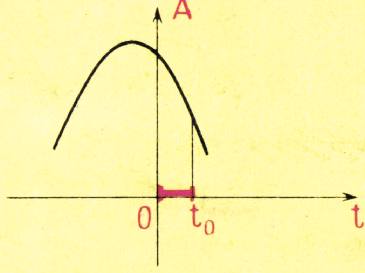
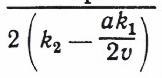
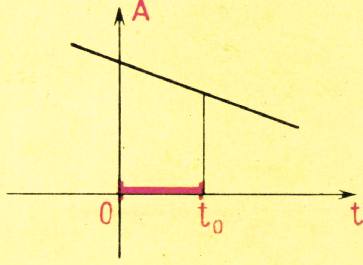
Fig. 4. Minimum at .
Fig. 5. Minimum at .
- (LSU, Mathematics, 1966). The rocket must travel a distance equal to . It starts moving at a constant speed and at any moment can turn on an additional movement that gives constant acceleration () and works until the end of the journey. Fuel consumption on a section of track at a constant speed is proportional to the time of movement, and when additional movement is turned on, it is proportional to the square of time with proportionality coefficients and correspondence (). How long should the rocket move with the additional movement turned on in order for the promised fuel consumption to be the least?
Let be the time of movement of the rocket at a constant speed, be the time of movement with additional movement enabled, be the fuel consumption. From the equation:
we find
Note that , where is the positive root of the equation
(This is the flight time if movement is enabled from the very beginning.) We need to find the minimum of the function (*) defined on the segment .
- . The vertex of parabolas has an abscissa
The parabola is located as indicated at figure 4. Minimum at .
-
; . Minimum at (Fig. 5).
-
. Abscissa of the vertex of parabolas
46
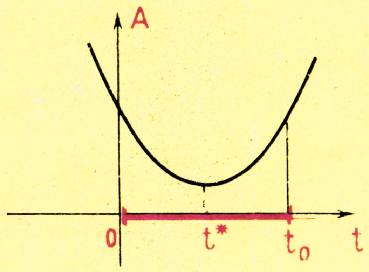
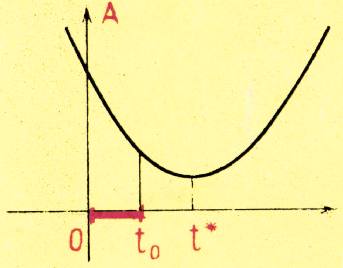
Fig. 6. Minimum at .
If , then the minimum is at (Fig. 6).
If , then the minimum is at (Fig. 7).
Answer: If and
That
If or and
That
Exercises
- Indicate the conditions under which both roots of the trinomial are less than the given number .
- Indicate the conditions under which the given number lies between the roots of the trinomial .
- (MSU, department of structural linearity, 1968). Find all values of the parameter for which both roots of the quadratic equation are real and do not exceed modulus 2.
- (MSU, physicist, 1965). Find all values of for which the equations are valid and greater than .
- (MSU, Department of Biology, 1969). Find all values of for which the system
has a unique solution.
6. The radius of the base of a right circular cone is and its height is . Determine the height of the cylinder inscribed in this cone and having the largest lateral surface.
7. (MSU, department of structural linearity, 1969). List all roots of the equation .
8. (MSU, physicist, 1964). Find all values of for which the expression is negative for all values of satisfying the inequalities .
9. (MSU, physicist, 1963). The projectile leaves the ordium at an angle to the horizon with a speed . At the highest point of the trinomial there are two parts of equal mass outside, and the velocities of the parts immediately after the explosion are horizontal and lie in the plane of the trinomial. One half is outside at a distance of from the shot point. Determine the place where the second half fell, if it is known that it fell further than the first. Assume that the flight of a projectile occurs in airless space.