Rough automatic draft, low quality: expect mistakes and awkward wording. It will be replaced by a better translation. Original →
11
exchange and for all nations." The system was based on two basic units: the meter and the kilogram, with derivatives and decimal divisions. The simplicity of the metric system and the ease of its use fully satisfied the requirements of that time. The system was adopted by many countries, including Russia.
One forty millionth of the earth’s meridine passing through Paris was adopted as a unit of length - the meter. At the end of the 18th - beginning of the 19th centuries, a group of scientists, on behalf of the French Academy of Sciences, worked out the length of the meridine segment from Dunkirk to the island of Formentura *). Based on the measurements taken, a
*) The very first calculation of the circumference of the globe belongs to Eratosthenes (276-194 BC). He knew that in Siena there is a well, which is illuminated by the Sun on the day of the summer solstice, that is, in Siena at this time the Sun is at its zenith. At the same time, in Alexandria, where Eratosthenes lived, the Sun stood south of the plumb line at 1/50 of the circle, that is, at 7°12′. Eratosthenes determined the distance between Syene and Alexandria at 5000 stadia. From these data, he found the circumference of the globe, which Eratosthenes found equal to 39,690 km (in modern units), which differs slightly from the actual value.

Fig. 1. So in the Middle Ages they established what a foot is equal to.
prototype of the meter, which is still kept at the International Bureau of Weights and Measures in Sevres near Paris.
The meter was conceived as a natural unit of length - one forty-millionth of the earth’s meridine. But over time, it ceased to be such a unit. The circumference of the Earth was clarified, the platinum rod was changed, and now the sample meter is not one forty millionth of the circumference of the globe, but simply some fixed length. Therefore, there was a need to return to a natural standard that occurs in nature and is easily reproducible. Otherwise there would be a terrible mess if suddenly the international meter stage was lost, cleaned or damaged for some reason. In addition, the existing stage did not provide length measurements with the accuracy required by science and technology in need.
XI General Conference on Meters and Weights (1960) for a new definition of the meter. Its resolution reads: “…the conference, taking into account that the international prototype does not define the meter with precision sufficient for modern needs, and that, on the other hand, it is desirable to adopt a natural and
12
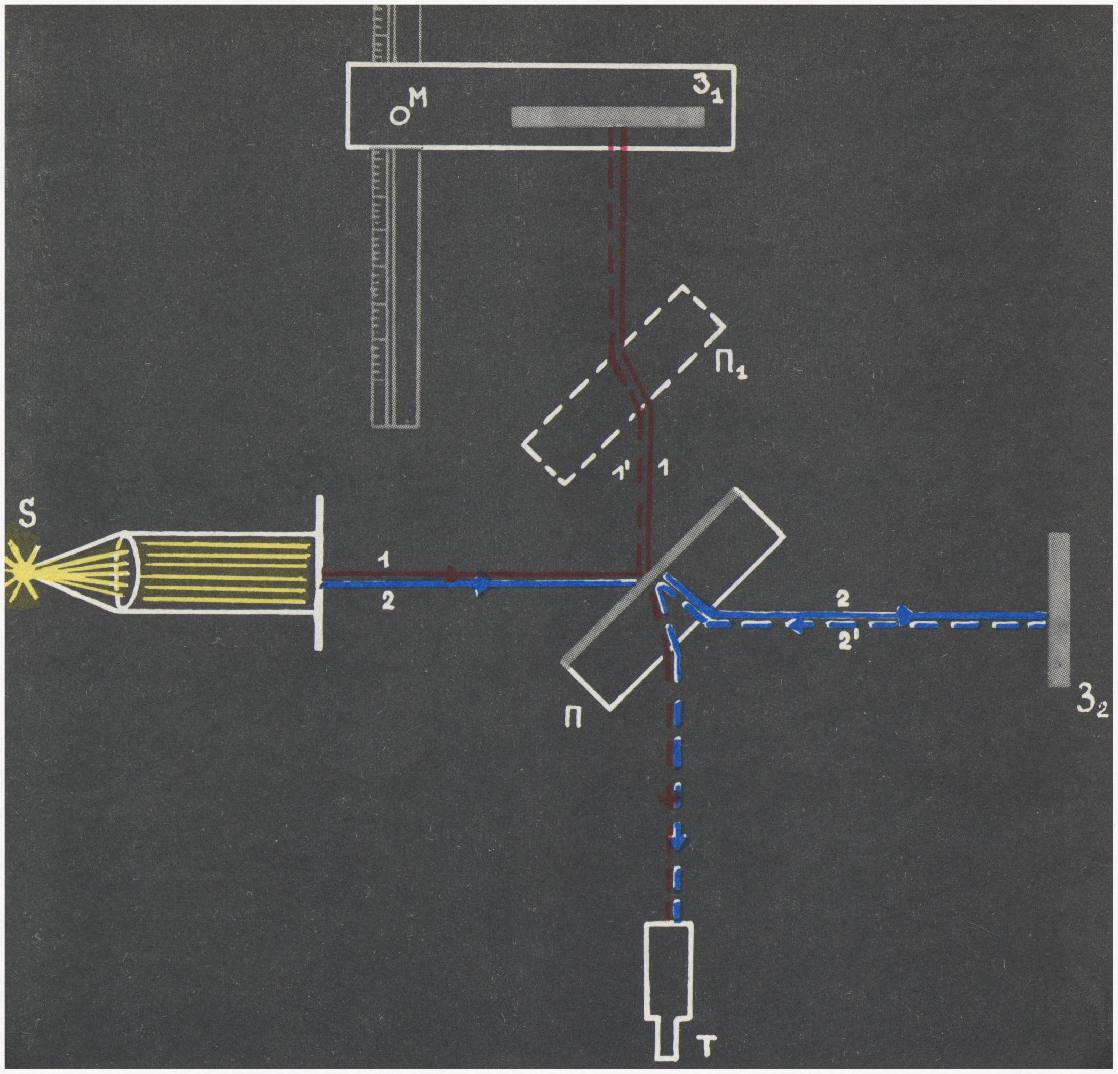
Fig. 2. Comparison of the length of the reference meter with the length of the light wave is carried out using a device called interference comparators. One of the diagrams of such a device is shown in figure. A parallel beam of light rays from a source S falls at an angle of 45° onto a silvered translucent glass plate P, which divides the light flux into two parts. Reflected ray 1 goes to the mirror 3₁, is reflected from it and, having cleared the plate P₁, falls into the telescope T. Beam 2, having cleared the plate P, is reflected from the mirror 3₂, then reflected from the translucent side of the plate P and also falls into the tube T. (For clarity, rays 1 and 2 are depicted in different colors.) Ray 2 passes through the plate P three times, and the ray 1 - only once. To compensate for the difference in the path of the rays that arises because of this, a different plate P₁ is placed on the path of the first ray, made of the same materials as the plate P. The light beams 1′ and 2′ are correct and give an interference pattern in the field of view of the tube T. Depending on the difference in the path of the rays, the field of view of the pipe is light or dark. When the mirror 3₁ is moved by a distance equal to a quarter of the wavelength, the difference in the path of both rays increases by half the wavelength and the illumination of the visual field changes. Instead of a pipe, you can install a photomultiplier, which will produce electrical impulses at each level of illumination. This way you can count the number of waves that have decreased at a given length.
13
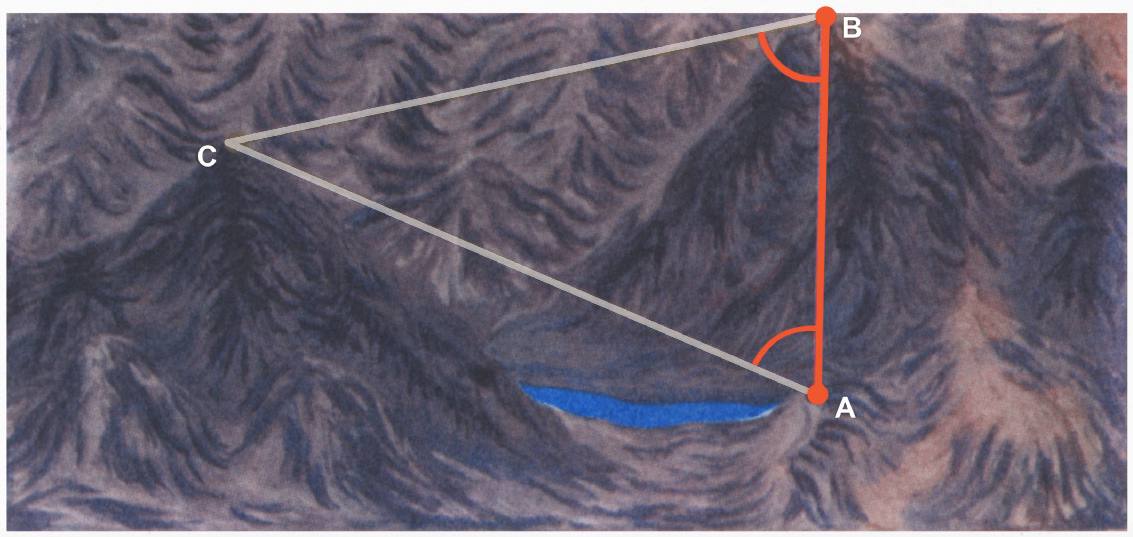
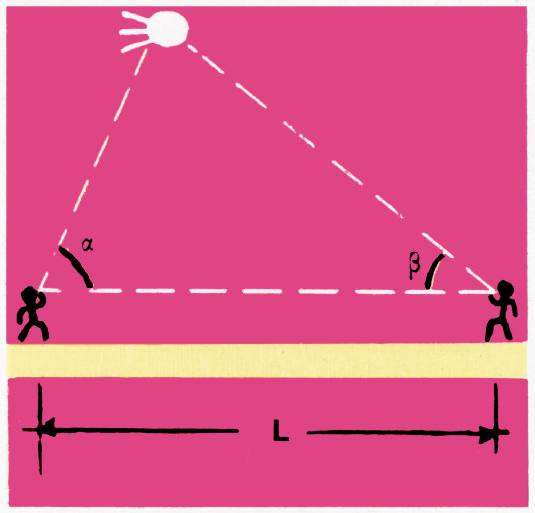
Fig. 3. Triangulation method. Knowing the length and the angles and , we can determine the distance to the object .
destructible standard, solves: meter is a length equal to 1,650,763.73 wavelengths in the vacuum of radiation … of the krypton atom 86.” With the introduction of a new standard, the accuracy of length measurements increased a hundred times.
So, humanity has returned to the natural standard of length. Based on the instructions attached to the definition of the meter, a new standard of length can be reproduced in any country. A special device is used for this purpose: a comparator. With its help you can obtain exemplary meter meters.
How does the length change? Once the unit of measurement has been determined, this is not difficult to do. You just need to see how many times the meter (or any part of it) fits at the measured distance.
But what if you need to measure the distance to an object located in the mountains or on very rough terrain? Then another method of determining length, called triangulation, comes to the rescue. Of two points, the distance between which is known, is located on the object (Fig. 3). From the known distance and the angles and we can calculate all the elements of the triangle.
The exact method of triangulation used the conditions when they measured the length of the meridian from Dunkirk to the island of Formation. Then, knowing the distance between these two points in some units of length and in degrees, it was possible to calculate the length of the entire meridian.
The direct length measurement method and the triangulation method give the same results when used on Earth. Therefore, it is natural to extend the triangulation method to measure the distance to space objects. For example, the flight altitude is determined
14
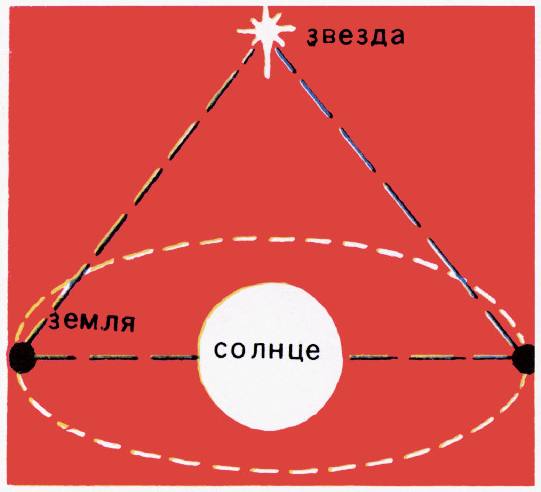
Fig. 5. Determining the distance to the nearest stars using the triangulation method. The known length—the base—is the diameter of the Earth’s orbit.
artificial satellite of the Earth, this is how the distance to the Moon, our natural satellite, was determined at one time. Recently, the distance to the Moon has been clarified by location (first radio, and then laser). Since the speed of distance of radio and light waves is known to us, then by the time that passes from the sending of the signal to its return after reflection from the surface of the Moon, we can determine the distance to our natural satellite (the path is equal to the speed multiplied by the time).
But the triangulation method failed when the question arose of determining the distances to the planets of our solar system and the Sun itself. These space objects are located so far from the Earth that from any point on the surface of our planet they are visible from practically the same angle. We cannot find the distance to the Sun and planets, but we can determine their relative positions. Having then found the distance to the small planet Eros, which at times comes close to the Earth, we can calculate the abscissa distances to the Sun and all the planets of the solar system, including Pluto.
To determine the distance to
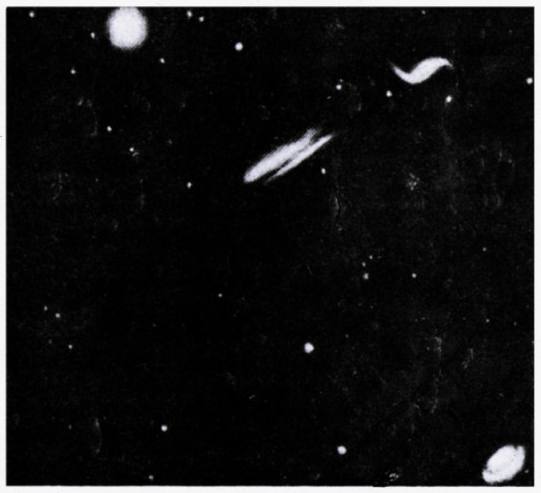
Fig. 6. Photograph of a patch of sky with a spiral galaxy similar to ours. If we assume that its diameter is equal to the diameter of our Galaxy, then, based on each size of this galaxy, we can calculate the distance to it. It turns out to be equal to 30 million light years (3.10²³ m).
To locate the nearest stars, you can again apply the triangulation method, using the annual motion of the Earth around the Sun. If we point the telescope at a celestial star once in winter and another time in summer (Fig. 5), then we can determine the angles, and therefore the distance to the star, with sufficient accuracy.
What about distant stars? Here another method comes to the rescue, due to the fact that the further a star is from us, the dimmer it appears. If for close stars, the distance to which is known, we establish dependences on the distance, then by the degree of brightness of the frontal star, using the resulting law, we can determine how frontally it is located from us.
Data on the diameter of our Galaxy allow us to determine even greater intergalactic distances. The sizes of all galaxies are approximately the same. Therefore, knowing the angular size of a galaxy, that is, the angle it occupies on the firmament, and its diameter, one can calculate
15
Meters
10^28
10^27
10^26
10^25
10^24
10^23
10^22
10^21
10^20
10^19
10^18
10^17
10^16
10^15
10^14
10^13
10^12
10^11
10^10
10^9
10^8
10^7
10^6
10^5
10^4
The distance to the most distant galaxies visible through a telescope is 5 billion light. years
Distance between galaxies
The diameter of our Galaxy is 100,000 light. years
Distance from the Sun to the center of the Galaxy
The distance from the Sun to Sirius is 8.7 light. years
to α Centauri -4.2 light. year
to the borders of the solar system -1 light. year
to Pluto—5929 million km
to Jupiter—777.8 million km
to Earth—149.55 million km
The diameter of the Sun is 1.30 million km
Distance from Earth to Moon—384 thousand km
The diameter of the Earth is 12756 km
Conventional boundary of the Earth’s atmosphere
Average altitude of spacecraft orbits
Nan great depth of the ocean—11034 m
The height of Jomo-lugtma (Everest) is 8848 m
The height of the TV tower in Moscow is 533 m
Whale length - up to 33 m
Human height is 1 meter
Diameters: cherry
peas
pin head
Ciliate length
Diameter of the “blood ball”
Brownian particle diameter
Wavelengths of visible light
ultraviolet rays
x-rays
γ - rays
Nucleus diameter
meters
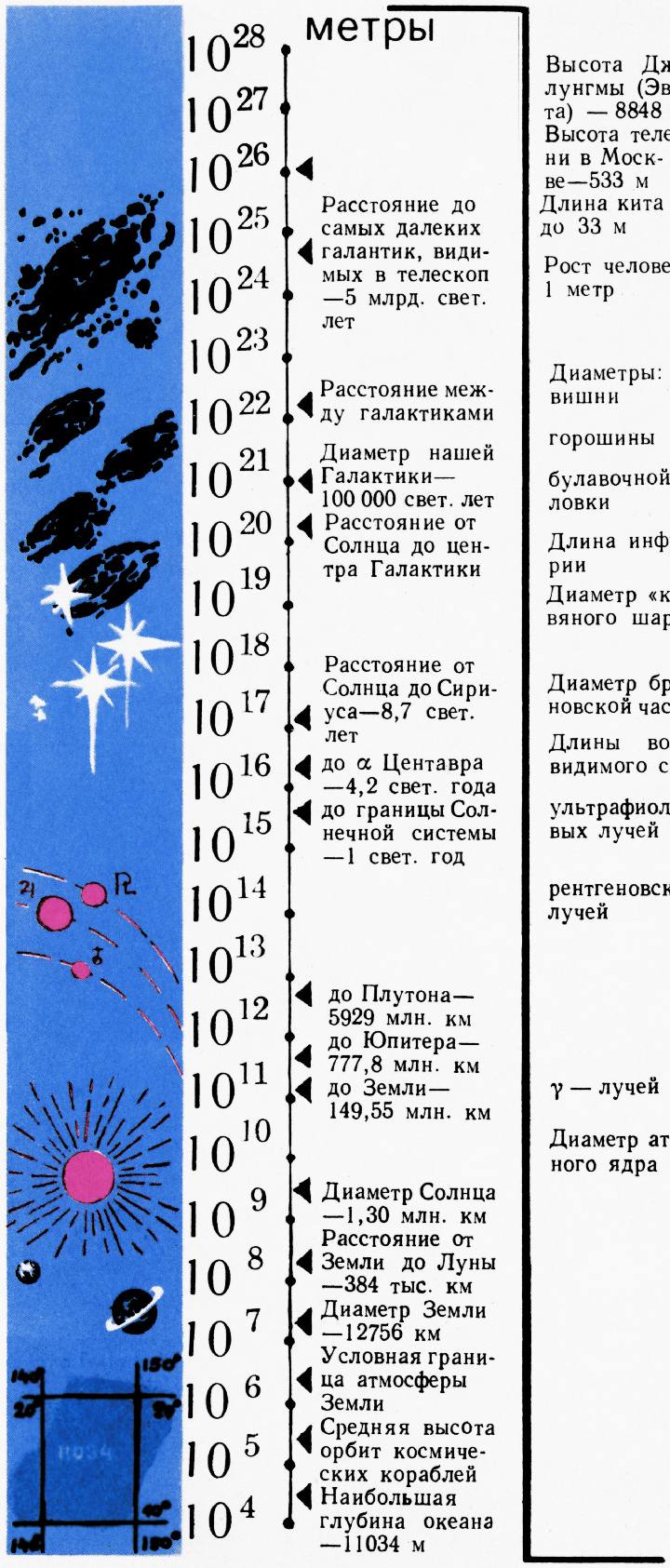
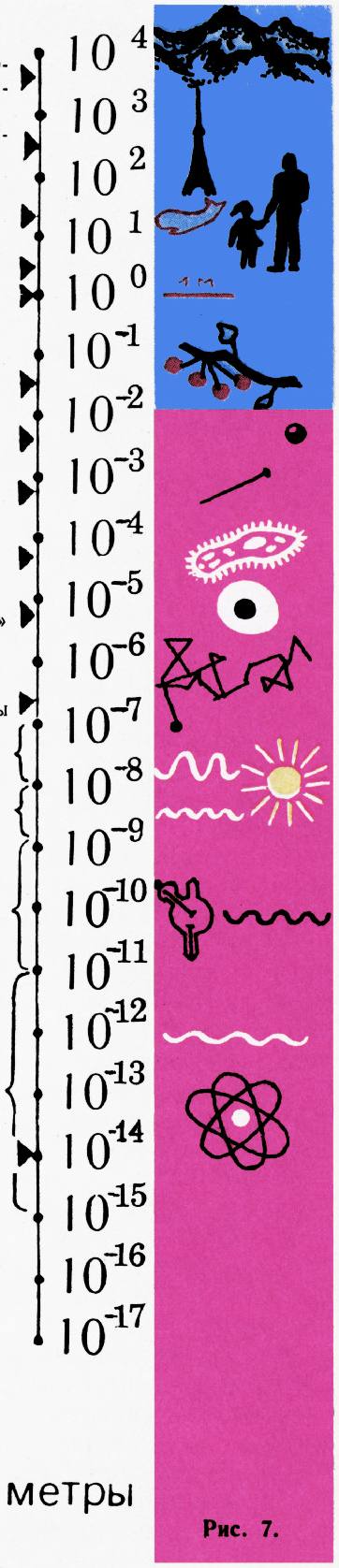
Fig. 7.
16
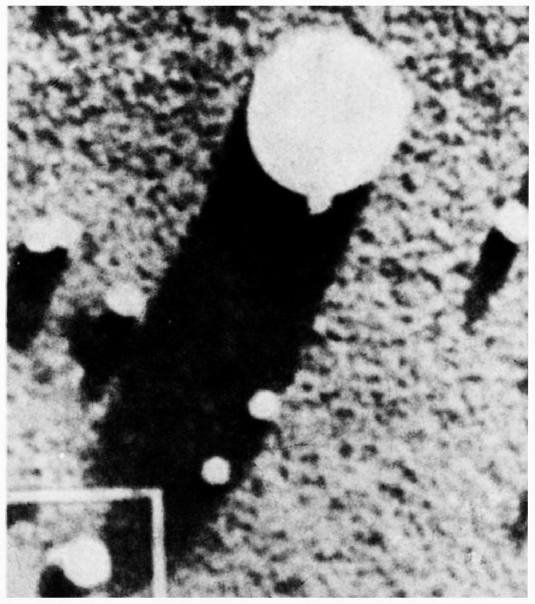
Fig. 8. This photograph of viruses was taken using an electron microcoppe. The “large” sphere has dimensions of 2·10⁻⁷ m (2000Å). It is included for comparison.
LIST THE DISTANCE DO OF THIS GALAXY. It is now believed that the distance to some galaxies is approximately 10²⁶ m.
Let us now see how small extensions are determined.
It is not difficult to divide a meter into a thousand parts. It is a little more difficult to divide a millimeter into a thousand parts. For this you only need a good microcopper. This is how we get a micron - a millionth of a meter. But further division is difficult, since it is impossible to see objects shorter than the wavelength of visible light (about 5·10⁻⁷ m).
With the help of an electron microcoppe, we can see and change objects with dimensions up to 10⁻⁸ m. The shorter the wavelength of electron radiation, the smaller objects we can “see”. For example, gamma rays allow you to “examine” objects whose dimensions do not exceed 10⁻¹¹ m.
To determine nuclear dimensions, completely different methods are used: the so-called effective transverse section is measured.
reading of nuclei. It can be determined by passing a beam of high-energy particles through a thin plate of matter and measuring the number of particles that do not pass through. The ratio of the number of particles that did not pass through to all those emitted is proportional to the ratio of the area occupied by atomic nuclei to the area of the plate. Similar experiments have shown that the radius of the nuclei ranges from 1·10⁻¹⁵ to 6·10⁻¹⁵ m*).
Finally, let’s talk about figure 7, which shows all the dimensional diversity of the world around us. “When solving scientific problems, a scientist always has to clearly imagine quantities in his imagination… those physical quantities that serve to describe the phenomenon being studied… Therefore, it is necessary to teach scientists from a young age so that the symbols in formulas that define physical quantities always represent specific, quantitative values for them. For a physicist, unlike a mathematician, both parameters and variable quantities in a mathematical equation must be specific quantities,” says academician P. L. Kapitsa.
The scale unit figure 7 is meter. Each two adjacent divisions indicate sizes, perfectly exhausted from each other by 10 times. 10° m - one meter, 10¹ m - ten meters, 10² m - one hundred meters, etc. Similarly, 10⁻¹ m is a tenth of a meter (or ten centimeters), 10⁻² m is a hundredth of a meter (one centimeter), etc. Using logarithmic scales, you can show on one graph all sizes found in farming and technology: from the smallest to the largest.
*) A unit of length equal to 10⁻¹⁵ m is called a Fermi, including the famous physicist Enrico Fermi (1901-1954).