Rough automatic draft, low quality: expect mistakes and awkward wording. It will be replaced by a better translation. Original →
35
watch how Albert Einstein, the great scientist, creator of the theory of relative explanation, discovered the lifting force of the wings of airplanes and birds.
The published article is taken from the collection of scientific works of A. Einstein, published by Nauka in 1967 (vol. 4, p. 22). Einstein wrote his work in 1916. He was not familiar with the works of N. E. Zhukovsky, who back in 1910 created theories of the flight of heavier-than-air vehicles.
Where does the lifting force of the wings of our airplanes and birds soaring in the air come from? There is complete uncertainty in these matters. I must admit that I could not find even the simplest answer to them in the specialized literature. I hope, therefore, that the reader will be pleased enough if I tried to take advantage of this gap with the help of the following simple considerations from the theory of fluid motion.
The incompressible fluid, whose internal friction we will neglect, flows along the existing pipe (Fig. 1) in the direction indicated by the arrows. We will be interested in the pressure distribution in the pipe. Since the same amount of liquid must flow through each section per unit time, the flow rate will be greatest where the cross-sectional area is minimal, and least where the cross-sectional area is maximum. Therefore, at figure 1, the velocity of part of the fluid is the smallest at point and continuously increases towards . The reason that causes such acceleration of a part of the liquid is nothing more than the pressure force acting on them. Let us consider a particle of a liquid occupying a cylindrical volume. In order for a fluid particle to have an acceleration directed to the right at a given moment, the pressure on its rear surface must be greater than the pressure on its front surface . The pressure on surface exceeds the pressure on surface . Repeating these arguments, we come to the conclusion that the pressure in the pipe continuously drops from to . We will obtain the same pressure distribution (pressure decrease from to ) using similar reasoning in the case when the direction of fluid flow changes to the opposite.
Summarizing what has been said, we can formulate the following well-known theorem of hydrodynamics of a non-appearing fluid. If we follow the trajectory of any fluid particle in a steady flow, then the pressure will always be greater where its speed is less, and vice versa. As is known, the number of expressions of this theorem for
36
non-removable liquid has the form
where is the density of the liquid.
Let us first consider one well-known example illustrating this theorem—the flow of a liquid under constant pressure from a hole (Torricelli). At point (Fig. 2) the pressure is greater, and the speed, on the contrary, is less than at point , so the expression
constantly in the stream.
As a second example, consider the spray gun (Fig. 3). The air flow passing through the tube , after leaving the hole, expands in all directions, while reducing its speed. Therefore, the pressure at point is less than at point , and, therefore, less than in the air at rest surrounding point . Due to the applied pressure at point , the liquid from the vessel rises upward and is sprayed into small particles by the air flow
droplets. (The fact that in this example we are dealing with a flow of air, and not with a flow of undischarged liquid, does not essentially change anything in our reasoning.)
After these preparations, let us turn to the consideration of waves on water. Let be a solid wall in the form of a wavy cylinder and located perpendicular to the drawing plane, on one side bordering on a fluid flow flowing from left to right (Fig. 4). We will be interested in the force with which the liquid acts on the wall. It is clear that the cross-section of the fluid flow at points is larger than at points . Consequently, near points the liquid will flow slower, and near points - faster than at those points inside the liquid that are located away from the wall . Therefore, near points the fluid flow will create excess pressure, and near points a vacuum will be observed. As a result, the liquid will press on the wall as if it were trying to increase its bend. This means that the flow could not be sustained,
37
if the surface of the liquid were free and, accordingly, if the wall could bend and stretch without limit *).
In these discussions, as before, we proceeded from the assumption that there are no causes causing pressure other than the flow of fluid. If the force of gravity acts in the direction of the arrow S, then it leads to the appearance of pressure in the liquid, returning from top to bottom. If only one gravity acted, then the pressure at points B would be less than at points T.
So, flow and gravity give rise to the prerequisites for the appearance of various pressure differences between points B and T. It is clear that it is possible to select the speed of fluid flow in such a way that the resulting exchange pressure differences between points B and T will be equal to zero. After this, wall W can be removed without introducing any disturbances during
*) It is known that these same messages can explain why the flag will lie in the wind.
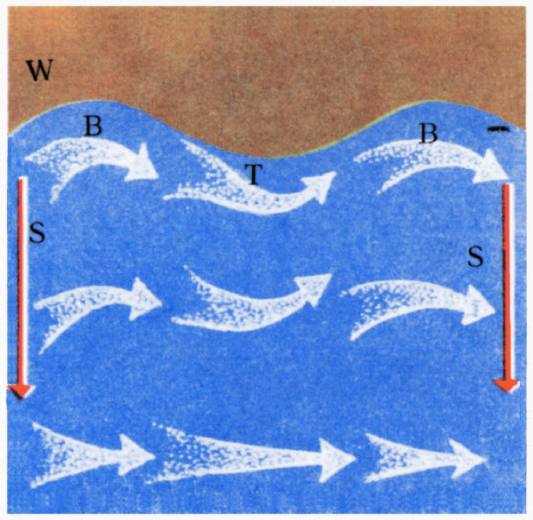
Fig. 4
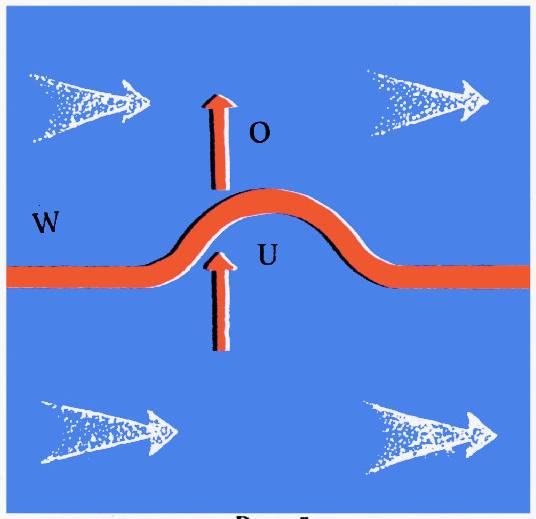
Fig. 5
liquids. As a result, we get a fluid flow with a wave-like excluded surface, which part can be observed when the flow flows around some obstacle. We see this picture when looking from a place into the water if the value is above the support.
If we decide to describe the whole process from the point of view of an observer moving to the right with the speed of the flow away from the walls, then we will come to ordinary waves on the surface of the water. To do this, it is observed at rest, and the crests B and troughs T float back at a constant speed.
Consequently, the possibility of wave-forming processes is based on the fact that static and dynamic pressure differences that arise between points with different heights cancel each other out.
The explanation for the reasons for the appearance of the lifting force of the wing looks completely similar. Let a solid wall be inserted into a flow of liquid or air, located parallel to the
38
ku and perpendicular to the plane of the drawing (Fig. 5), on the upper surface of which it looks like a plane. If this convexity did not exist, then no forces would act on the surface of the wall, except for the inevitable friction. The convexity will affect the flow of fluid at both the upper and lower surfaces of the wall, and thus creates additional pressure.
For a flow flowing around a bluish wall, the bulge creates a local increase in the cross section and, consequently, a slowdown in the flow; as a result of this, the pressure at point U will increase. On the upper surface, on the contrary, convexity means a decrease in the cross section, which means a local increase in the flow velocity and thereby a drop in pressure at point O. Thus, the dynamic forces of pressure, arbitrary by the flow, create a force acting on the wall and directed upward. It is clear that for the appearance of this force it is only necessary that the piece of the wall be as large as required for noticeable bending of the fluid flow. We get a non-existent wing of an airplane or a bird (not flapping its wings in flight).
Already from these simplest arguments it is clear that flight requires only a certain power, since it is necessary to overcome the resistance of inevitable friction. If there were no friction, birds could fly any horizontal distance without expending any work.