Rough automatic draft, low quality: expect mistakes and awkward wording. It will be replaced by a better translation. Original →
51
WRITTEN EXAM
IN PHYSICS AT MOSCOW ROAD ROAD INSTITUTE
A. N. Ageev, Yu. G. Rudoy
This year, a written exam in physics was held for the first time at the Moscow Automobile and Road Institute. Each ticket consists of a theoretical question on one of the sections of the program and four tasks designed to cover all sections of the program.
When answering a theoretical question and solving problems, applicants had to show both the meaning of physical laws and the ability to apply them in a particular physical situation, as well as the meaning of units of measurement of physical quantities and correctness in calculations. Therefore, all problems had to be solved first in general form, and then a numerical answer was obtained.
As the exams showed, answering the theoretical question did not cause any difficulties and the overwhelming majority of applicants answered them well. The tasks were, as a rule, more difficult.
Let us give, as an example, several problems proposed in the exam papers and, describing their solutions, let us briefly dwell on some characteristics of construction errors. For convenience, we have divided these tasks into traditional sections.
In problems on mechanics, errors were mainly due to the fact that the examinee was not always able to identify all the forces that control movement and correctly determine their point of application and direction. This is where the equation of motion is drawn up incorrectly. For example, in this problem:
Task 1 (variant No. 26). Two bodies with masses e and e, connected incredibly by a thread, lie on a smooth horizontal surface. A force is applied to the first body, directed along the plane. Find the tension of the bottom when the bodies move. Will the force change if the same force is applied to the second mass? Neglect friction on the surface (Fig. 1).
The acceleration of the system in the first and second cases is the same. Indeed, applying Newton’s 2nd law to the entire system, we obtain:
in case a) ,
in case b) .
From here
52
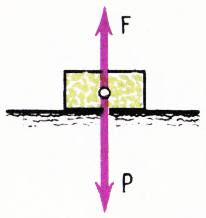
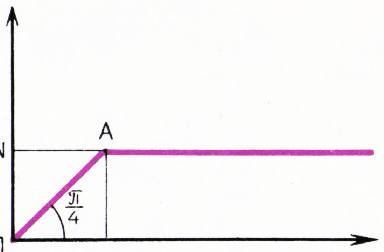
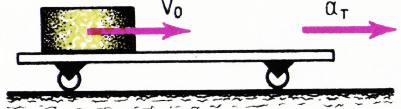
Fig. 2.
The thread tensions, however, are different: the force imparts an acceleration to a body with mass , and therefore
and the force imparts this acceleration to a body with mass , and therefore
There were many errors in this task:
Problem 2 (varnant No. 16). A load with a mass of kg lying on the floor of the lowering elevator car presses on the floor with a force of kg. Determine the magnitude and direction of the elevator acceleration.
Let us assume that the acceleration is directed upward (Fig. 2). Then, based on Newton’s 2nd law, we can write (F is the support reaction force).
From here
According to Newton’s 3rd law . That’s why
So, the acceleration is directed upward and is equal to 0.05 g.
Quite a large number of applicants confuse rest training and sliding training. The resting force is always equal to the tg force, and the sliding force is equal to , where is the normal pressure force. If you attach a diameter gauge to a beam lying on a horizontal surface and slowly increase
Fig. 3.
Liquify the friction until the block begins to slide along the surface, then the dependence of the friction on the friction will be graphically depicted as shown in figure 3. Point corresponds to the beginning of the movement.
There were many mistakes associated with the insufficient importance of conservation laws and the inability to use these extremely powerful methods for solving problems.
In cases where the application of the laws of conservation of energy and implyvas allows one to obtain a simple and elegant solution, applicants usually chose a relatively long solution path using the laws of motion. Let us present for use a problem from the 2nd round of the Physics Olympiad, which was held at MADI in 1970.
Problem 3. A puck of mass moves horizontally with a speed , hits the platform of mass and continues to move along its surface. Determine the speed
53
the growth of the platform by the time the puck stops on it. The friction coefficient between the washer and the platform is . The platform can roll on the rails without friction.
Let us first solve this problem using the laws of motion.
A friction force equal to acts on the washer and platform in the horizontal direction, under the influence of which the platform and washer move with accelerations and relative to the ground. The directions of acceleration are shown in figure, and their magnitudes are determined by Newton’s 2nd law:
The acceleration of the puck relative to the platform is
Since the speed of the puck relative to the platform decreases with time according to the law , then (that is, the puck will stop) after time
By this time the speed of the platform becomes equal
A significant solution to this problem is to use the law of conservation of momentum. Indeed, the frictional force between the puck and the platform is an internal force, and therefore it cannot change the overall momentum of the system. At the same time, external forces in the horizontal direction do not act on the platform-puck system (recall that the platform rolls on rails without friction). Equating them
the pulse of the system at the initial moment, when the platform is still finished, its pulse at the moment when the puck stops on the platform, we get
From here
There were many mistakes when solving the gas laws problem. Here, applicants quite easily coped with those tasks for which only formal knowledge of the laws was sufficient, but in those cases where the solution required somehow transforming the notation of laws or simply consistently applying gas laws for various elementary processes, much was lost. Let’s give an example.
Task 4 (varnant No. 26). Gaz eradicated from volume to volume . The pressure increased by .
What was the initial pressure?
To solve it, it is enough to write the Boyle-Mariotte law in the following form:
From here
The exams showed that applicants were weak in diagrammatic representations of various processes. Therefore, few people correctly solve problems of the following type.

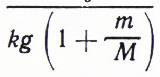
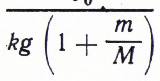
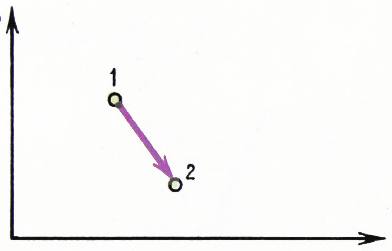
Fig. 5.
55
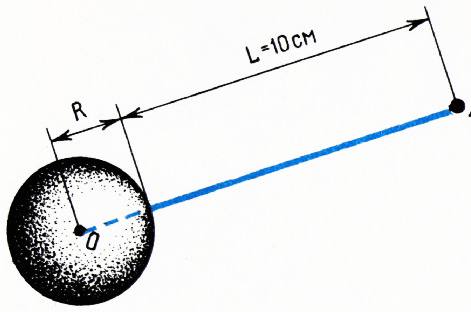
Fig. 9.
Errors in problems of determining the work of moving a charge are mainly associated with a flat polyman of the physical meaning of such a characteristic of the electric field as potential. Many have tried to find work using the formula , whereas in a non-uniform field the force acting on the charge changes as it moves and this formula cannot be used. To solve such problems it is necessary to apply the concept of potential difference. Let’s take the following problem as an example.
Task 7 (varnant 24). What work must be done to move the exact charge units. SGSE from infinity to point , located at a distance of cm from the surface of the metal ball (Fig. 9)? The potential of the ball is , the radius of the ball is cm. The ball is in the air (Fig. 11).
By definition, the potential at point is numerically equal to the work of moving a unit positive charge from infinity to a given point. Therefore, the original work . Since the field of a charged sphere coincides with the field of an exact charge equal to the charge of the sphere and is located at the center of the sphere, the potential at point is equal to . Next, since
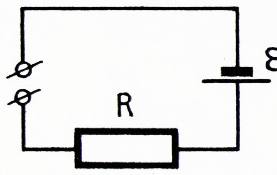
Fig. 10.
In the “Constant Current” section, the greatest difficulty was caused by the tasks of calculating the circuit when charging the battery. Let’s consider, for example, the following problem.
Task 8 (varnant 52). The battery, discharged to , is connected for charging to a network with voltage (Fig. 10). What additional resistance must be connected to the circuit so that the charging current does not exceed ? Internal battery resistance .
In the case when the battery operates as a current source and is connected to the load , the current is determined by Ohm’s law for the complete circuit:
Inside the source, this current is directed from the negative electrode to the positive one (Fig. 10). When charging a battery, the current in it has the opposite direction, that is, from the positive electrode to the negative. If the battery is positively discharged, then the charging current is determined by the formula , where is the network voltage.
In the case when the battery is not completely discharged, as is the case in our case, the total current can be represented as the difference
where is the value of e. d. c. discharged battery.
56
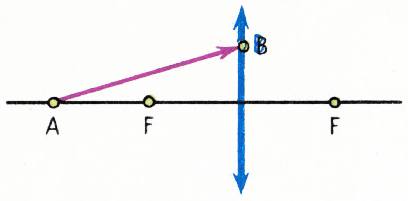
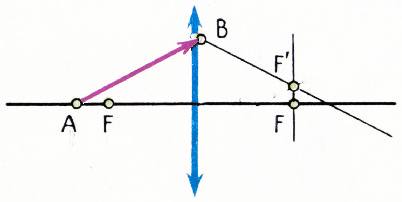
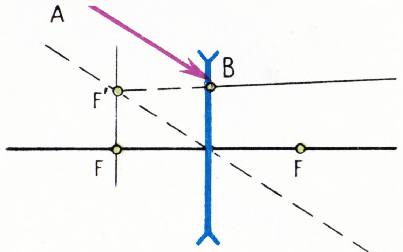
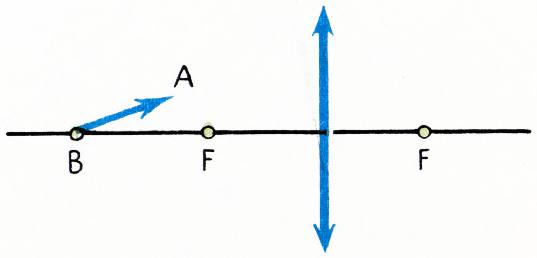
Fig. 11.
Thus, . From here
In the last section of the Optics program, as a rule, problems of constructing an image in lenses were not solved in cases where it was necessary to use a clear focal plane and secondary focus. Let us give examples of such problems.
Task 9 (varnant 78). Find by construction the path of the beam after the collecting line (Fig. 11).
Let us draw a secondary optical axis parallel to and intersecting the focal plane. The point of intersection of the secondary axis with the focal plane () is the secondary focus at which all rays parallel to this axis are collected. Consequently, the ray after the refraction of the line must pass through the point (Fig. 12).
The same problem with a scattering line is solved in a similar way. You just need to remember that the tricks in this case are minimal (Fig. 13).
Fig. 12.
Fig. 13.
In conclusion, we present one of the ticket options that were offered during the entrance exams.
Option 47
- Magnetic interaction of conductors with current. The concept of magnetic field, induction and lines of force (using the example of direct and circular current).
- A car weighing and developing 60 hp climbs a hill at a speed of . Determine the angle of inclination of the mountain . Friction is not taken into account.
- In 480 e water at a temperature of . What is the temperature of the mixture if ice is dropped at 56 e? Ud. The heat capacity of ice is 0.5 cal/e deg, the specific heat of fusion is 80 cal/e.
- What speed does an electron acquire when it passes through a uniform electric field with a strength of 0.01 CGSE units along a field line at a distance of 2 cm?
- Construct an image of the segment in the collecting line (Fig. 14).