Problem M76—M80; F88—F92
Rough automatic draft, low quality: expect mistakes and awkward wording. It will be replaced by a better translation. Original →
33
M76. In a company of people, every two strangers had exactly two mutual acquaintances, and every two acquaintances had no more common acquaintances. Prove that everyone in this company knows the same number of people.
M77. The lengths of the two sides of the triangle are 10 and 15. Prove that the bicsectiras of the angle between them is not greater than 12.
N. B. Vasiliev
M78. Prove that every non-negative integer can be represented as , where and are non-negative integers, and what is the singular representation.
M79. Two points and move along two intersecting straight lines with the same constant speed . Prove that there is a fixed point on the plane, the distances from which to the points and at any time are equal.
I. F. Sharyein
M80. Table contains arbitrary numbers. It is allowed to simultaneously change the sign of all numbers in one column or all numbers in one row. Prove that by repeating this operation several times, you can obtain a table in which the sum of the numbers in any column and the sum of the numbers in any row are non-negative.
A. S. Schwartz
F88. A vessel, partially filled with a structure, moves with horizontal acceleration, resulting in the surface of the path being inclined to the horizon at a certain constant angle.
The top of the vessel is closed with a lid.
How will this angle change if the vessel is filled to the top with water?
F89. The electric field voltage in an electromagnetic wave of frequency , amplitude modulated with frequency , changes with time according to the law , where is a constant. Determine the energy of the electrons knocked out by this wave from the atoms of gaseous hydrogen with an induction energy of .
A. D. Gladun, L. G. Aslamaozov
F90. An ideal gas of mass , located at a temperature , is cooled isochorically so that the pressure drops times. The gas then expands at constant pressure. In the final state its temperature is equal to the initial one. Determine the work done by the gas. The molecular weight of the gas is .
F91. To power the device, the voltage at its input must be set as accurately as possible. For this
34
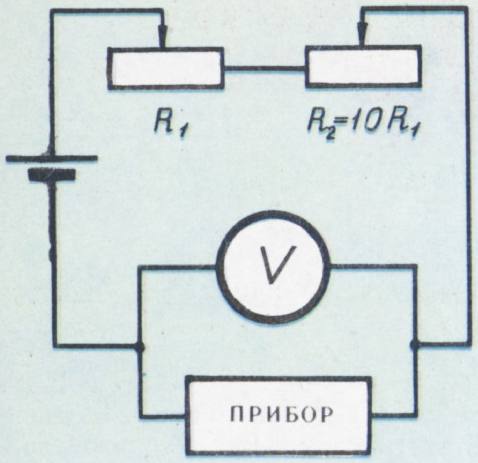
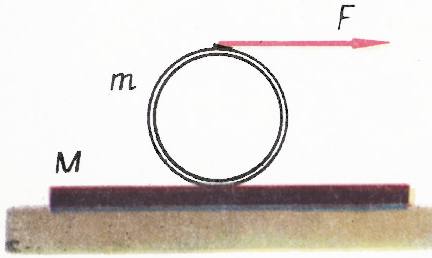
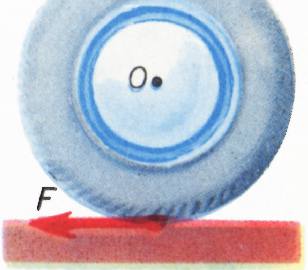

Fig. 1.
It uses two rheostats connected as shown in figure 1. The lengths of the rheostats are the same, and the resistance of one of them is 10 times greater than the resistance of the other. What should I do to set the voltage as accurately as possible? How many times will the accuracy of voltage setting be greater than in the case when only one rheostat is used? How to turn on rheostats if to power the devices you need to set more precisely not the voltage, but the current?
F92. The mass hoop stands on the mass board (Fig. 2). The coefficient of friction between the dock and the hoop is . The board lies on a smooth table. With what acceleration will the board move if the hoop is pulled with a force of ?
S. N. Domozhakov
Fig. 2.
PROBLEMS ABOUT THE WHEEL
(Continued. See page 29 for the beginning.)
- A wheel rolls along a horizontal plane. Since the friction force is directed to the left, the speed of the wheel will decrease. But the moment of this force relative to the center is directed clockwise, and therefore, the speed of rotation of the wheel should increase.
How will the speed of the wheel change?
-
When you press the brake pedal, the brake pads are pressed against the wheels and their rotation slows down. But the interaction forces between wheels and brake pads are internal and, therefore, cannot reduce the speed of automation. Why does it stop automatically?
-
As is well known, the force driving the train is the friction force of the locomotive wheels on the rails, and the friction force between the rails and the wheels of the cars is the braking force. But the wheels of the locomotive and the carriages are made of the same materials, and all the carriages are much larger than the weight of the locomotive.
Why is the locomotive in a state of motion?
(For ending see page 42)