Entrance written exam in mathematics at MIPT in 1970
Rough automatic draft, low quality: expect mistakes and awkward wording. It will be replaced by a better translation. Original →
46
ENTRANCE WRITTEN EXAM IN MATHEMATICS AT MIPT IN 1970
A. P. Savin, B. V. Fedosov
The problems offered at the entrance exam in mathematics at the Moscow Institute of Physics and Technology have always attracted the attention of teachers and school graduates, since the level of these problems is somewhat higher than in many technical universities.
In 1970, the composition of the tasks on the written exam at MIPT changed somewhat. Instead of the four problems usually offered, in 1970 the LET contained five problems (one easy problem was added). This set of tasks apparently continued in the future.
You can get acquainted with the problems of the MIPT entrance exams of previous years in the collection “Problems in Elementary Mathematics”*), which has already been published in several editions.
I would like to note that the difficulty of the entrance exam in mathematics at MIPT is often exaggerated. The fact that after all the exams in mathematics and physics (oral and written) there is still a competition of several people per place speaks for itself.
So that we can get a real idea of the written exam in mathematics in 1970, we will analyze one of the options in detail.
Option 0
-
A subway passenger goes down a moving escalator in 24 seconds. If a passenger walks at the same speed, but on a stationary escalator, then he descends in 42 seconds. How many seconds will it take him to descend while standing on the step of a moving escalator?
-
Solve the equation
tg 5x—2 tg 3x=tg 5x·tg² 3x. -
In triangle ABC the altitudes AD and CE are drawn. Find AC if BC=a, AB=b and DE/AC=k.
-
In a regular tetradir ABCD, two sections are drawn, each of which is parallel to the edge AB and CD. Area of part of face ABC enclosed between secants
planes, s cm² greater than the area of the part of the ACD face enclosed between the same planes. How much is the area of one section greater than the area of the other?
- Find real solutions to the system of equations:
Analysis of problems
- Let us denote by the speed of the escalator, its length and the speed of the passenger. Then the conditions of the problem will be written in the form of equations:
Let’s transform these equations:
47
From the last two equations we immediately find that
and the required time is , that is, 56 seconds.
The “highlight” of the problem is that from system D to equations (1) and (2) with three unknowns, you only need to find the ratio of two unknowns and . Those applicants who tried to find , and , and , naturally, could not do this.
- Let’s transform this equation:
(1)
In the last transformation we divided both sides of equation (1) by . In this case, we can lose the roots of equation (1), which are the roots of equation . Transforming the original equation further, we get
where
or
Let’s check whether we lost any roots when dividing equation (1) by . Let be the root of the equation
Then, substituting into the original equation, we obtain
or
, which is impossible. Therefore, no roots were lost.
Answer:
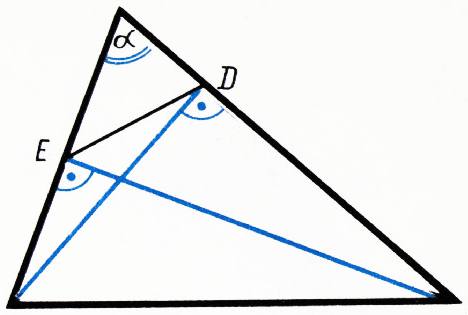
Fig. 1. .
Those applicants who tried to express and through and solve the resulting equation for , rarely succeeded due to the cumbersome calculations and the complexity of the resulting equation.
- Let us denote by , then from the right triangle (Fig. 1)
and from right triangle
From the triangle using the cosine theorem we find the length of the segment :
(1)
From the triangle we also use the cosine theorem to find the length of the segment :
(2)
Now, using the correspondence given in the problem statement, from equations (1) and (2) we obtain
Hence . Solution corresponds to the case of acute angle , and corresponds to the case of angle . It remains to substitute the found values into equation (2),
48
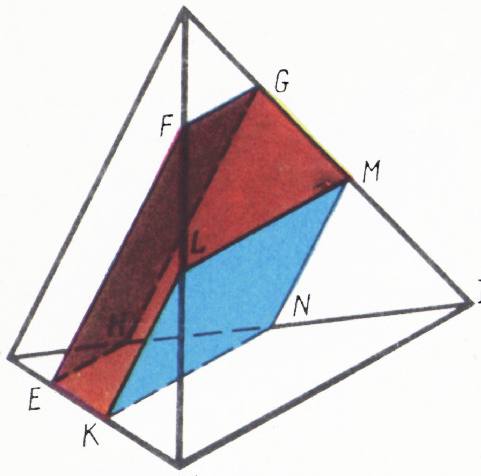
Fig. 2. .
To get both answers to a given problem:
or
.
In this problem, the main difficulty is the remote choice of the unknown. Introducing the angle as an additional unknown gives a short and elegant solution to the problem. If we try to use another element in this role, for example, the values of the segment , then we end up with a more complex system of equations, the solution of which I often find myself unable to solve.
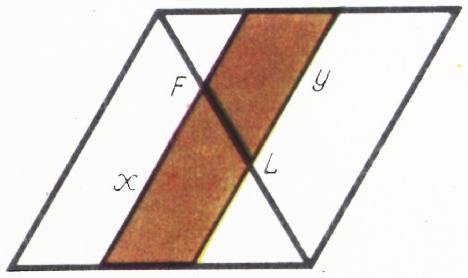
Fig. 3.
- Let us consider the polygons obtained in the section (Fig. 2) of the tetrahedron indicated by the planes. It is easy to show that both the quadrilateral EFGH and the quadrilateral KLMN are rectogenous. Let us turn two angles by planes ABC and ACD onto the plane (Fig. 3) and denote the length of the segment EF by , and the length of the segment LM by . Since both triangles ABC and ACD are regular, and the sides of the rectangular triangles EFGH and KLMN are respectively parallel to the edges AB and CD, the segment KL becomes a continuation of the segment LM, and the segment FG becomes a continuation of the segment EF. If we denote the edge of the tetrahedron by , then it is obvious that , and . The trapezoid EFLK and FGML, as you can easily see, have equal heights. Let’s find them. The height of the trapezoid EFLK is equal to the difference in the heights of regular triangles EFC and KLC, therefore
Let us find the area of the indicated trapezoids. The area of the trapezoid EFLK is
and the area of the trapezoid FGML is equal to
Using the conditions that the difference between the indicated areas is equal to , we obtain
or
Substituting instead of the expression found for it, we get
49
Let’s return to the rectangles EFGH and KLMN. Their areas are equal to and , respectively, and the difference in areas
Comparing the expressions for and , that
In this problem, the choice of unknowns is quite natural. The most difficult part of the solution is the transition from the spatial figure 2 to the development of two adjacent faces onto the plane (Fig. 3); After this, the problem can be solved without much difficulty.
- Let’s add the first and third equations with the notified second. We get
Reducing by 2, we see that on the left side of the equation there is a complete square of the expression , hence . (1)
Subtract the third equation from the second equation of this system and obtain . Let us substitute the found value (1) into it.
After opening the brackets and bringing similar terms, the equation is reduced to the form . Let us express from it through :
So, either or .
Let’s consider the first case: . From equation (1) we obtain . And then from the third equation of the original system it follows that .
From here we find two values for : or .
Thus, in the first case we get two solutions:
Let’s consider the second case: . From the same equation (1) it follows that . Substituting this value for into the third equation of the original system, we obtain that . So, in the second case there are no valid solutions.
It remains to check that the solutions found in the first case satisfy the equations of the initial system. This turns out to be true. Thus, two valid solutions of this system have been found.
The main difficulty of this problem is transforming the equation of a given system to a simpler system. Those applicants who try to solve this problem “at ease” by eliminating the unknowns have encountered insurmountable difficulties. Note that this system can be reduced to other systems that differ from those we have analyzed, but they also allow a simple solution.
According to the information we have, almost all received solutions to at least one problem. The vast majority (about 95%) received at least two tasks, more than half of those received received at least three tasks, and a third received at least four tasks.
We present an option for an independent solution.
-
Solve equation
-
Find the height of an equilibrated trapezoid if its diagonals are mutually perpendicular and the area of the trapezoid is .
-
In Δ ABC, the exterior angle at vertex is three times greater than , and the sides (in that order) form an arithmetic progression. Find the angles of the triangle.
-
Solve the system of equations.
- At the base of the triangular paramid lies the regular triangle . Each of the plane angles and is and . Through vertex a section is drawn perpendicular to edge . Find the dihedral angle between the base plane and the section plane. (Find all solutions.)