Rough automatic draft, low quality: expect mistakes and awkward wording. It will be replaced by a better translation. Original →
17
HOLES
HIPPOCRATES
In the fifth century BC, that is, almost two and a half thousand years ago, a scientist lived in Greece, named Hippocrates of Chios. It was Hippocrates who made the first known attempt to create the “Elements” of geometry. Unfortunately, this book has not reached us.
According to one legend, the unlucky merchant Hippocrates was limited to his ancestors and went to Athens to desire them. Here he met sages who spent their time mainly solving geometric problems. Having not found justice for the robbers, Hippocrates consoled himself with the fact that he surpassed the most skilled sages in geometry. . .
Hippocrates tried to square the circle, in other words, to construct a circle equal in size to a given square using a compass and ruler. And although he, naturally, did not succeed, he managed to construct several figures, which were pieces of a plane, limited by two circles, and nevertheless equal in size to a square.
In the history of geometry, the name of Hippocrates is associated with figures of a special type, the so-called lune. A lunula (in other words, a crescent) can be defined as follows: on a chord of an arbitrary circle, a semicircle is constructed externally, the ends of which coincide with the ends of the chord. Figure bounded by a smaller arc
the circumference of a given circle and the drawn semicircle is the hole.
On figure 1, four holes are also painted in the desired color. Hippocrates noted that their total area is equal to the area of a square, colored blue here. Indeed, the sum of the areas of the semicircles built on the sides of this square is equal to the area of the circle in which the square is inscribed. If you remove the purple-colored segments from the semicircles, then you will be left with four holes; if you remove them from the large circle, then the status remains a square.


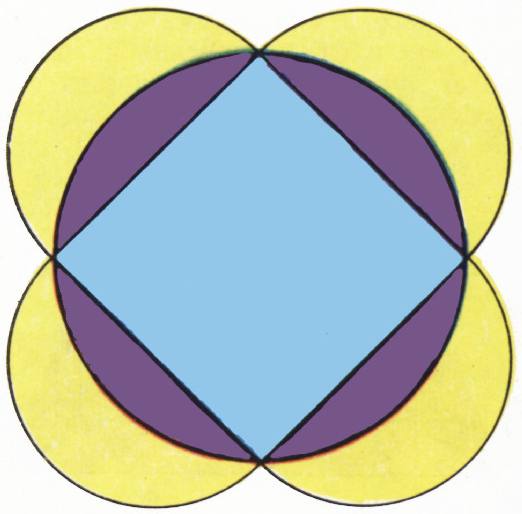
Fig. 1.
17
18
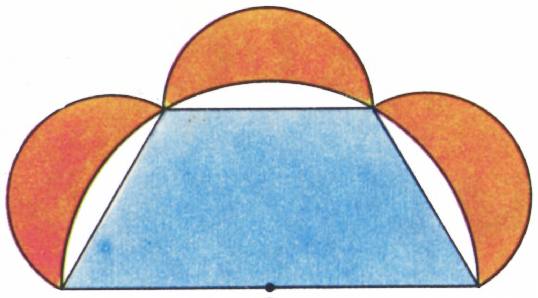
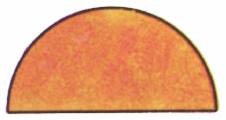
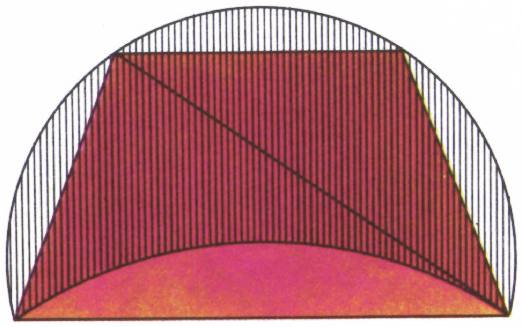
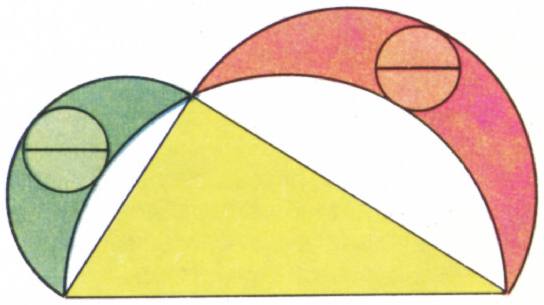
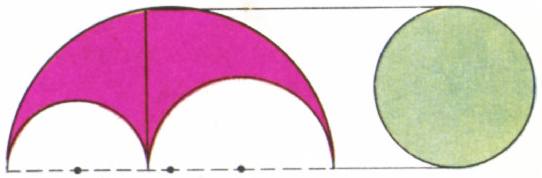
Fig. 2.
Figure 2 illustrates another theorem of Hippocrates. It turns out that the area of a trapezoid inscribed in a circle with a center at point O is equal to the sum of the areas of the orange holes and the orange semicircle (all three holes are equal in construction, the semicircle is equal to the semicircles from which the holes are formed). This theorem is proven in the same way as the previous statement.
At figure 3 there is a figure also compiled by Hippocrates. The two sides and the smaller base of the trapezoid are equal to 1, the larger base is equal to . The lower arc of the figure, protected on figure by black lines and which is naturally called a generalized lone arc, touches the diagonal of the trapezoid. It turns out that the area of the inscribed trapezoid and the lune are equal (prove this by the areas of the lune. The proof of this fact is easy to obtain if you use the Pythagorean theorem. By the way, this figure has another amazing property. The lune has the same width. More precisely, the diameters of the circles most inscribed in them are each equal to half the difference between the sum of the legs and the hypotenuse of the triangle shown in the same figure.
20
the sides of the triangle still serve as the metric.
Since the symmetric segments are equal in size, it is now sufficient to prove (see Fig. 6 f) that the sum of the areas of the quadrilaterals and without the area of the triangle is equal to twice the area of the triangle .
Triangles and are symmetrical about side . Let us now reflect the triangles and first relative to the side . We get triangles and . Then reflect triangle relative to side , and triangle relative to side . A figure is formed from two triangles and .
Both of these triangles are symmetrical
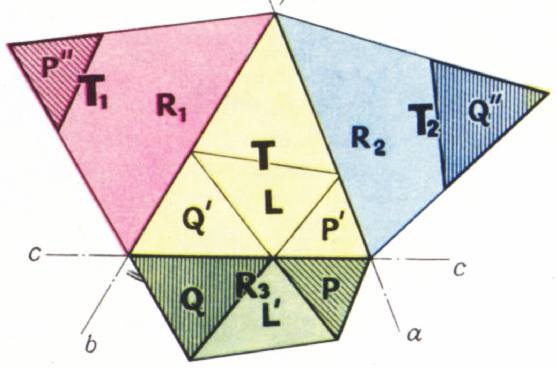
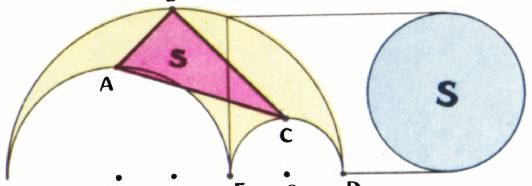
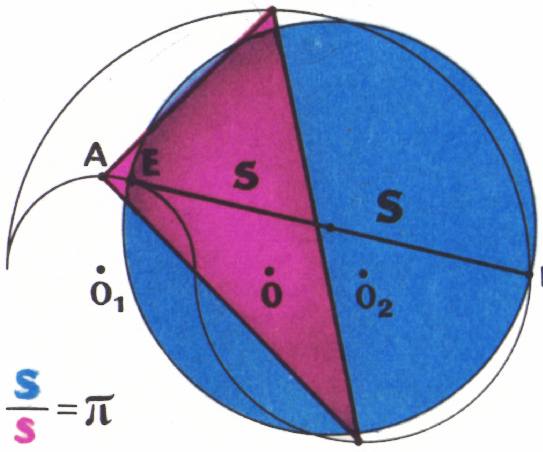
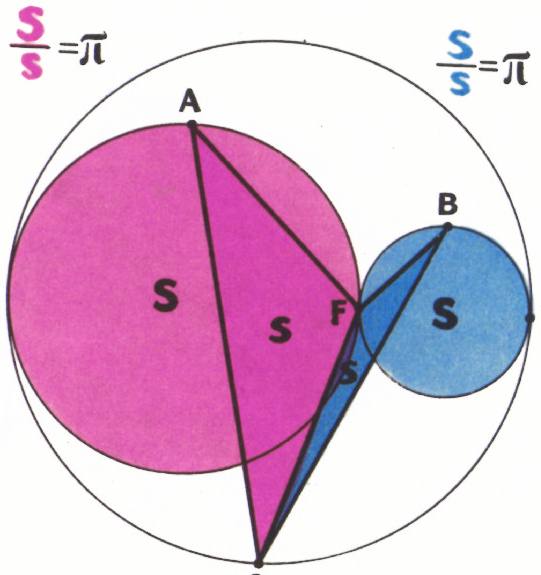
Fig. 62.
Fig. 7
Fig. 8a, b, c.