Rough automatic draft, low quality: expect mistakes and awkward wording. It will be replaced by a better translation. Original →
28
Vortex rings
The questions prepared for the lecture on vortex rings revealed interesting changes.
A typical box for demonstrating good vortices is well known and does not require a detailed description*). Our device is significantly larger than those commonly used. This is a Cubic wooden box about a meter long on the side; one of the walls is made of thin oilcloth, freely suspended, with two diagonals of rubber tubes, firmly attached at the corners. Rubber tubes are needed to ensure that the oilcloth returns to its original position.
Such a box throws out air vortices of great force, and the impact of the ring on the wall of the lecture hall is distinctly loud and similar to the sound of a light blow with a towel. The audience can get an idea of the “hardness” of the rotating air whirlwind by successively releasing invisible pegs into the hall. The blow of a peg in a person’s face is mistaken like a soft push from a down pillow.
In order to make the wells visible, you need to fill the box
*) See the article by N. E. Zhukovsky “Fundamentals of the theory of vortices” in “Kvanit” No. 4, 1971.
I mix ammonia and hydrogen flakes using rubber tubes connected to two flasks in which NH₄OH and HCl are boiling. This method gives good results. Figure 1 was made with photographs of large rings obtained in this way. The side view is interesting: it shows the tail (similar to the tail of a comet), which is formed due to the friction of the outer sections of the ring with the atmosphere as it moves forward.
The power of air rings can be shown in this way. For example, place them on a flat cardboard box, standing at some distance from the installation. In this case, the box immediately turns over or even falls to the floor. By hitting the vortex ring you can extinguish the flame of a gas burner. After some training, you can learn to release two rings quickly in a burst, and so that the second one flies with a few
29
faster than the first. Then the second ring catches up with the first, moves away from it and bounces off; both rings remain intact and turn into vibrating ellipses. This shows that the gas outlet is elastic. All the experiments that I have done with two boxes have produced unsatisfactory results.
Although the large rings produced by the setup described are best suited for lecture demonstration, I find that much more beautiful and symmetrical rings can be obtained by blowing smoke from a paper or glass tube with a diameter of 2.5 cm*). If you look from the side at the blown rings in still air near a lamp or in sunlight, you can see very beautiful spiral streamlines. I managed to form one of these rings as follows. A momentary shutter was mounted on the door of a dark room, and an arc lamp was focused onto its slit using a large concave mirror. The photographic plastic was installed in a dark room so that it was illuminated by a diverging beam of rays coming from the reflection of the arc in the mirror (when the shutter was open). A red lamp was placed in front of the plate, and then the rings were blown out of the tube. As soon as the ring, symmetrical in shape and not moving too quickly, appeared in front of the plate, we held the cord leading to the shutter, and the plate was illuminated by a blinding flash. A clear darkness fell from the ring due to the small size and separation of the light source. Figure 2 taken from the resulting photograph. It can be seen that the ring consists of a layer of smoke and a layer of air, forming a spiral of several terminal turns.
Apparently, the angular velocity of rotation increases as
*) Smoke can be produced, for example, by placing smoldering paper in a closed box.
30
prices with dotted lines. This experiment does not work on a large scale, although I have had some success by spraying ammonia at the upper edge of the hole with a yggago-shaped iron wire heated by a current.
By taking some precautions, it is possible to obtain a smoke half-ring such as in figure 4. This is a brilliant illustration of the fact that the formation of a ring is not dependent on the presence of smoke. The best way to get a half ring is to blow the smoke very lightly into a paper tube, letting it flow down the bottom of the tube until it reaches the end. Then the colcesia is pushed out with a light exhalation. It may be better to conduct the experiment in a large erosive tube with a hole at the bottom, since
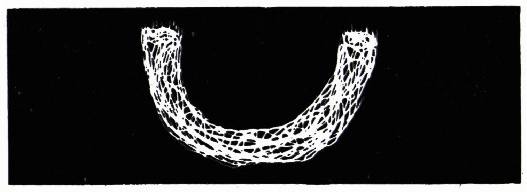
Fig. 4.
in this case, one can observe the phenomena occurring inside. It’s quite easy to get a koltsezu, in which the flash part of the smoke is concentrated in the lower half; but obtaining a ring, one half of which is entirely invisible, and such that the edge of the smoke is sharply judged (as shown in figure 4), requires much practice. I tried various schemes to produce these half rings on a large scale, but none of them produced results worth mentioning. It seemed that the use of a hot wire with ammonia was the most promising method, but I did not get a sharply assessed smoke limit, and this is what distinguishes the small rings obtained using a pipe.
Explaining the formation of output rings, the rotational movement is often
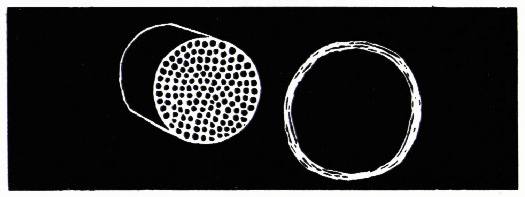
Fig. 5.
attributed to friction between the flowing air streams and the edge of the hole. However, most of the formation of outlets is due to the interaction with atmospheric air. To illustrate this point, I have come up with an outlet box in which the trenne with the edge of the hole is absent or, more correctly, is compensated by equalizing it over the entire cross-section of the exiting jet.
Approximately 200 holes with a diameter of 1.7 mm (Fig. 5) are drilled in the bottom of a cylindrical tin box. If the box is filled with smoke and a strong stream of air is released, a red outlet ring is separated from the surface, which is burnt on the sieve. You can simply cover the end of a paper tube with a piece of tightly stretched linen cloth and blow a smoke ring through it.
When experimenting with a box equipped with two round holes, I observe the merging of two rings moving side by side into one large ring. If the rings rotate at a high speed, they will bounce off each other, but if the rings are rotated slowly, they will connect. At the moment of connection, the emerging form is unstable. The connected rings abruptly change their horizontal position to a vertical position so quickly that it is difficult to notice, and then slowly lose the shape of the ring. The same can be demonstrated by using two paper tubes, holding them at different corners of the mouth and almost parallel to each other. In any case, the air in the room should be practically motionless.
Stramy was published in the journal “Nature” in 1901. The publication was prepared by L. A. Savina