Rough automatic draft, low quality: expect mistakes and awkward wording. It will be replaced by a better translation. Original →
12
No one knows exactly when people learned to create fire and artificially heat bodies to temperatures above ambient. In any case, this happened ten thousand years ago, in an era known as the Stone Age.
But the data on obtaining artificial cold is known quite accurately. Let us conventionally assume that low temperatures are temperatures below those that naturally occur when the weather changes. Faraday first obtained such a low temperature (163°K, or -110°C) in 1840. This is much colder than the bitter cold of Antarctica (the lowest recorded temperature in Antarctica is about -90°C).
Why have people been able to artificially create high temperatures since time immemorial, but they managed to create artificial cold only quite recently?
On the one hand, this is due to the fact that people needed high temperatures more than low ones.
On the other hand, the possible reason for the “lag” in the technology for obtaining low temperatures is too obstructive that high (no need) temperatures are not easier to obtain than low ones. In fact, it is enough to strike a match to get a temperature higher than room temperature. And Faraday, in order to obtain a temperature only half as low as room temperature, had to create something more than just a device.
This “inequality” of methods for obtaining high and low temperatures is not accidental. It reflects one of the basic laws of nature, the so-called second law of thermodynamics (recall that the first law of thermodynamics is the law of conservation of energy).
At first glance, it seems that cooling a body is very simple: you need to bring this body into contact with other bodies of lower temperature. Then the body will naturally move from the cooled body to the cold one, which will lead to the required cooling; If you have ice, it’s easy to make ice cream!
But what if the body needs to be cooled to such a low temperature that there is no suitable other cold body to which the body could naturally transfer? Then, obviously, such a cold body, or, as they say, a refrigerant agent needs to be created, a manufactured refrigerant also needs to provide heat transfer from it to some other body, but not a colder one, because there is no such body, but a warmer one, for example, the environment (air, water, etc.).
First of all, let’s find out what the difficulty is in this.
13
Order and disorder in matter
Let us remember that the temperature of a body is determined by the energies of the random thermal motion of its atoms and molecules. To lower the temperature means to reduce the disorder that reigns among the molecules.
What is disorder? If every item in your apartment is always in a certain place assigned to it and it is always easy to find, then you maintain order in your apartment. If things are classified anywhere, then they cannot be found. Your apartment is a mess.
The larger the size of your apartment, the more time it will take you to find this or that thing; if things are evenly scattered, the more disorder there is in your apartment. Imagine that things in the room can move on their own, changing their position. Then it will become even more difficult to find them, and the more difficult it is, the higher the speed of their movement.
This everyday example helps us understand how to determine what order and disorder are in the molecular world. The degree of disorder is determined by the probability of finding molecules (or another particle) in a certain state, for example, at a certain point in space.
If there is a given number of particles uniformly distributed in a given volume, then the probability of detecting a particle at a given point will be greater, the slower the particles move, the slower they change their position in a given volume. But the speeds of molecules are determined by body temperature. Therefore, the higher the temperature of a body, the greater the degree of disorder among the molecules of which it consists. It is also clear from the above that the greater the volume provided by the particles, the greater the degree of molecular disorder.
Thus, the degree of disorder depends on two factors - the temperature of the body and its volume. An increase in temperature at a given volume, just like an increase in volume at a constant temperature, leads to an increase in the degree of disorder among the molecules.
It turns out that all the processes that occur in nature, in a closed system left to itself (that is, in a system consisting of particles interacting with each other, but not with other bodies), take place in such a way that the degree of disorder increases. And when this degree of disorder reaches its highest value, all processes stop by themselves. A state occurs called the state of equilibrium.
Imagine balls of two colors arranged in a certain order. It took quite a few pages to arrange the balls in the correct sequence. But a slight push is enough for the painstakingly created order to be disrupted and the balls to be randomly mixed. And it is impossible to restore the original order by any means. The probability of such an event means nothing.
And here is an example from the atomic-molecular world. By throwing a piece of sugar into water, we can easily obtain a solution in which sugar molecules are distributed throughout the entire volume of the vessel. But no matter how much we covet, the solvent will not separate into water and sugar by itself. In order to obtain sugar and water separately, you need to expend some energy by heating the solution and evaporating the water.
The physical meaning of the second law of thermodynamics lies in the statement that order and disorder in nature are “unequal”, that all self-inducing processes of establishing equilibrium are accompanied by an increase in disorder. This is the reason why it is so high
14
temperatures are easier to obtain than low temperatures. As body temperature increases (while maintaining its volume), disorder increases. To cool bodies means to increase order, that is, to act, so to speak, “against nature.”
Nevertheless, it turns out that it is still possible to cool bodies. It is therefore possible to make the body move not from a warm body to a cold one, but, for example, from a cooled body to warmer ones. This is how refrigerants are created.
Disorder is a physical quantity
The words “order” and “disorder” that we used here seem at first glance to be somehow unfamiliar, taken from everyday life. In fact, behind these words lies the physical concept of the present, which is important, that it is expressed by a special quantity. This quantity, which expresses the degree of disorder or order (order is simply the absence of disorder), is called entropy. It is denoted by the letter , and it is defined as follows: if a certain amount of the body is supplied to or removed from the body, and the absolute temperature of the body is equal to , then the change in entropy is determined by the equality
In all processes that happen to bodies, it is not entropy that is important, but rather the change in entropy. (In this respect, entropy is similar to the potential energy of a body. In all problems, it is not the potential energy itself that is important, but its change.)
Of particular interest to us is the case when the process occurs in such a way that the body is not supplied to or removed from the body: . Such conditions can be ensured by a well-heat-conducting body or by quickly carrying out the process, when the body does not have time to move from one body to another. Such processes are called adnabate. From expression it follows that during adnabate processes the entropy does not change.
Adnabate change in volume
In the technique of artificially producing cold, we are mainly interested in the processes of changing the volume of the body, the processes of their expansion and rolling. They play a particularly important role here.
Let’s imagine that we have a body that we expand or compress adnabatally, that is, without supplying or withdrawing the body. We already know that increasing the volume of a body with a given number of particles leads to an increase in the degree of disorder, that is, to an increase in entropy. But our process is adnabate, in which and entropy do not change. How to ensure the constancy of entropy, provided that it returns a noble increased volume? If the second law of thermodynamics is correct, then this is only possible if, when the volume of a body changes, some other process occurs, due to which entropy decreases by exactly the same amount as it increases due to an increase in volume. We know that entropy changes when body temperature changes. Therefore, we can expect that with an adnabate increase in the volume of a body, its temperature will decrease. This is what actually happens.
Thus, we immediately have a way to obtain body temperature. It is necessary to expand this body adnabatally, that is, to increase its volume. Adnabate expansion is precisely one of the main ways to obtain cold.
One type of expansion is the evaporation of liquid. Even the ancient Egyptians kept drinks in porous vessels. Pores increase the surface of the evaporating liquid and thereby increase
15
the rate of its evaporation. Evaporation leads to cooling of the liquid. The poor thermal conductivity of materials and the high evaporation rate ensure that the evaporation process is adnabate.
Thus, the question of artificial cooling methods comes down to the question of what to expand and how to expand.
What to expand?
It is clear that solids are unsuitable for expansion - they cannot change their volume in any noticeable way. For the same reasons, liquids are also unsuitable. Although the increase in the volume of liquid during their evaporation is used to cool them, especially low temperatures cannot be obtained in this way, because, as it cools, the liquid eventually solidifies. So the lowest temperature that can be obtained when a liquid evaporates is the temperature at which it solidifies. And for substances that are liquid at room temperature, the solidification temperatures are not so low.
It is best to use gases. Gases are capable of unlimited expansion, and if they are also previously at high pressure, then their mass is quite large and therefore the heat capacity of this gas is also quite large. Gases are also characterized by the greatest disorder in the movement of particles. And since our task is to reduce disorder, it is clear that the best ones are to start with a substance in which the disorder is great, so that there is something to reduce!
So, the most suitable substance for our task is gas. On the other hand, the final product, that is, the finished refrigerant, is best in the form of a liquid: a liquid always creates good thermal contact with the body immersed in it. Therefore, the technical part (but not exclusively) of the liquefaction properties of a particular gas.
As you know, any gas can be converted into a liquid. But for each gas there is a certain temperature, called the criterion , above which it cannot be formed into a liquid state. In order for gas to be liquefied, its temperature must be below . Then to burn it you only need to rock it. And to what extent it depends on how much its temperature is below : the lower it is, the less pressure is needed for combustion. You can cool a gas so much that it becomes liquid at a pressure of 1 atmosphere.
To obtain moderate cold, gases with high values are used. Often used, for example, ammonia, which has . Recently, everyone has been using so-called freons - gases obtained from hydrocarbons by mixing hydrogen with fluorine, chlorine or bromine. In home refrigerators, in particular, freon-12 (), which has , is used.
The lowest temperatures for the production of gases, the critical temperatures of which are much lower than room temperature. These include: oxygen, which has , nitrogen with , hydrogen with , and finally helium, which has the lowest critical temperature in nature. He has .
Burning these gases is not so easy. To do this, they need to be very cool.
How to expand?
Gas can be expanded in different ways. Two methods of evaporation are more “popular” and most often used.
With the first method. Expand the best compressed gas. Therefore, with any method of evaporation, they begin by burning the gas using a special machine - a compressor - to a pressure of tens, and sometimes hundreds of atmospheres. In this case, the gas heats up for the same reason
17
Throttling leads to gas cooling. This is explained by the fact that gas molecules interact with each other. When, during the expansion of a gas, the molecules move away from each other, the arbitrary work against the molecular forces connecting the molecules, and the kinetic energy of the molecules, and, therefore, the temperature of the gas, will decrease. We can say that here too, work is done, but not against external forces, as in detand, but against the internal forces of cohesion between molecules.
The cooling effect of gas during throttling is called the Joule-Thomson effect.
For the Joule-Thomson efficiency, it is important that the gas is not ideal, that is, its molecules interact with each other at a distance, and not just in a direct “head-on” collision. An ideal gas would not cool when throttling. It could be cooled, but it uses detaner.
As already indicated, the cooling during throttling is stronger, the lower the temperature. At room temperature, which is where you start, it is not great. In order, despite this, to achieve significant cooling, resort to a constructive technique, the existence of which is clear from figure 2.
The pipe through which gas flows to the throttle is placed in another, wider pipe. When the gas cools slightly after throttling, it returns from the refrigeration chamber to the compressor through a wide pipe, cooling the oncoming gas “on the way.” Therefore, the next portion of gas will suit the throttle colder. Having passed through the throttle, the gas will cool even more, and returning through the outer pipe, it will cool the oncoming gas even more. After some time, the gas will approach the throttle so cold that throttling will lead to its liquefaction, and the first portion of liquid will appear in chamber X. Now the cold vapor of this liquid will escape through a wide pipe, continuing to cool the oncoming gas.
The cold liquid accumulated in the refrigeration chamber can be immediately used to cool other bodies. Sometimes this “other” body is a salt solution, which then goes to pipes installed in store counters, under an artificial skating rink, etc. But you can do it differently: drain the compressed gas through tap B into special vessels prepared for storing and transporting cold liquids (Dewar vessels). The liquid thus obtained can be used to cool other bodies anywhere and at any time. Common machines that use cooled gas or liquid as a refrigerant in the refrigerating chamber are called refrigerators. A machine designed to dispense a liquid product is called a cooling machine.
Throttling is the most commonly used cooling method. It is, in particular, used in home refrigerators.
One important addition needs to be made here. The fact is that throttling can lead
18
not only to cooling, but also to heating of gas. And for each gas there is a certain temperature, the so-called effective Joule-Thomson inversion temperature (), above which heating occurs. This means that if it is desirable to cool the gas by further expansion, care must be taken to ensure that the gas is pre-cooled below the inversion temperature. For most gases, including nitrogen and oxygen, the inversion temperature is much higher than room temperature, so no difficulties arise. But for hydrogen and gel it is significantly lower than normal temperatures: for hydrogen is 204°K, for gel 40°K. Consequently, when compressing these gases, they require pre-cooling before re-settling can begin. To do this, you can use the detaner method. In many installations for compressing hydrogen and gel, both methods are used at once: in the detaner the gas is cooled below ; further cooling, up to compression, is achieved by further settling. A combination of these methods is used for compression of other gases.
Even closer to absolute zero
The cooling methods described above make it possible to convert any gases, including gels, into liquid. Helicium boils at atmospheric pressure at a temperature of 4.2°K. By intensively pumping out the evaporating gel using a pump, you can lower the vapor pressure above the liquid gel and thereby lower the boiling point to 0.7°K, and if you use a lighter isotope of the gel, its temperature can be raised to 0.3°K. Lower temperatures cannot be obtained in this way.
How to get to temperatures of thousandths of a degree?
Recall that lowering the temperature means reducing that part of the disorder that depends on temperature. To do this, we use a gas whose disorder is high. But at temperatures close to absolute zero, the degree of disorder is already so small that it is very difficult to reduce it. At such temperatures, all substances (except the gel) are solid, so one cannot count on an adabate change in volume. This means that we need to find substances in which, even at these temperatures, disorder still exists; it depends not only on temperature and volume. And physicists also found substances. These are some complex parametric substances.
A paramagnetic substance is a substance containing particles (atoms, ions, molecules) that behave like small magnets. Due to thermal movement, the magnets are oriented in a completely random manner. True, at low temperatures, when thermal movement is very weakened, the interaction forces between the magnets can force them to position themselves correctly. But if the magnets are located at significant distances from one another, then there is no interaction force, and the magnetic disorder persists to the lowest temperatures. This is the case in parametric salts that are very complex in composition, in which, in addition to magnetic particles, there are many other non-magnetic ones, for example, in the salt 2Ce ()₃·3Mg ()₂·24H₂O (cerium-magnetic nitrate). In this substance, only cerium Ce nonones are “magnetic”. But for every nonentity there are about 60 other, non-magnetic atoms. “Magnetics” are so strongly “diluted” with non-magnetic particles that disorder in Ce orientaions persists even at temperatures below 1°K. This is the substance we need: the disorder in it is great and high at absolute zero!
Disorder in a parametric substance can change not only when its temperature changes, but also when its magnetic state changes. And the magnetic state of matter can be controlled in exactly the same way as
19
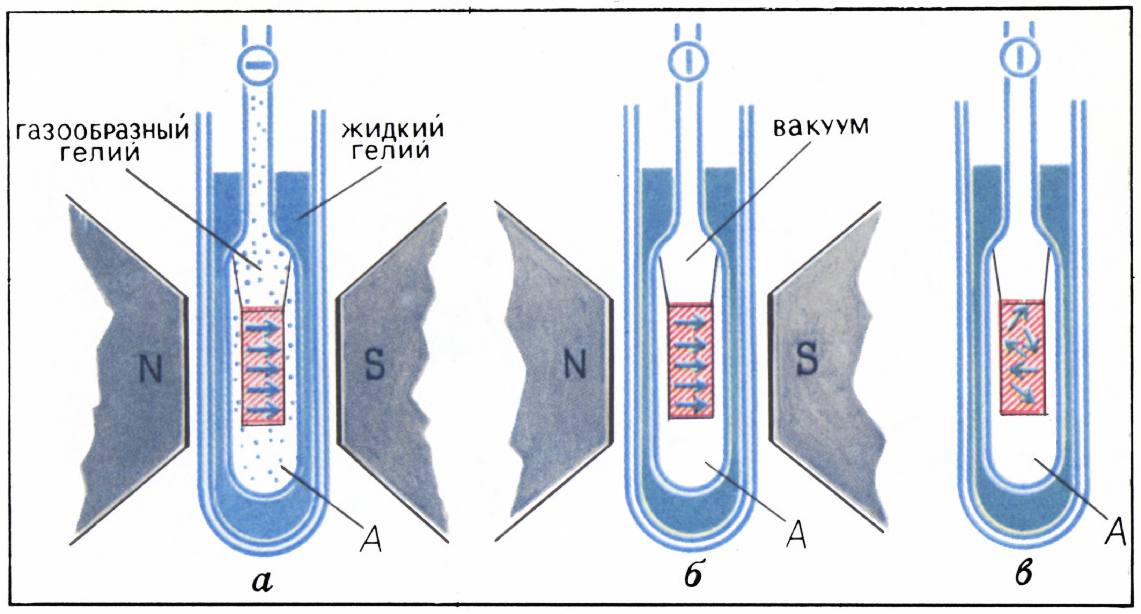
Fig. 3.
and the volume of the substance. This can be done using a magnetic field. If a parameter salt is placed in a constant magnetic field, then all the magnets will line up parallel to the confluent line of the magnetic field. We will bring order to the orientation of the ions. By removing the field, we will create chaos again. This is completely analogous to the rolling and expansion of gas.
To obtain low temperatures proceed in the following way. A paramagnetic salt in an ampoule filled with a gaseous gel and located in a vessel with a liquid gel, the temperature of which is about , is placed in a magnetic field between the electromagnetite strips (Fig. 3, ). The helium gas in the ampoule provides thermal contact with the liquid gel, so that the temperature of the magnetized cols matches the temperature of the surrounding liquid helium. Helium gas is then pumped out of the ampoule, providing heat-conducting salt from the environment (Fig. 3, ). After this, the magnetic field is turned off, that is, adiabatic gas formation cols (Fig. 3, ) is produced. In this case, misorientation of the magnets occurs -
innovations, which should lead to an increase in entropy. And since the demagnetization process is adnabate, the entropy as a whole cannot change and the salt cools.
For almost forty years now, the described method has been used to obtain so-called ultra-low temperatures, that is, temperatures below those that can be obtained using only liquid helium. The lowest temperatures obtained in this way are thousandths of a degree.
Not only atoms, but also atoms cores are magnetic, albeit 1000 times weaker. Nevertheless, if you start not from , but from , you can, by adiabatic demagnetization of not atoms, but nuclei, obtain a temperature of about a millionth of a degree. But this is a topic for a separate article.
Exercises
- Why can expansion in the part and in the process be considered adnabate processes?
- Is it possible to use ferromagnetic rather than parametric substances in the magnetic cooling method?
- In what units is entropy measured? What other physical quantity is measured in such units?