Solutions to problems M77—M83; F89—F91
Rough automatic draft, low quality: expect mistakes and awkward wording. It will be replaced by a better translation. Original →
39
Solutions
In this issue we publish solutions to problems M77—M83
M77
The lengths of the two sides of the triangle are 10 and 15. Prove that the bisector of the angle between them is not greater than 12.
We received a lot of different solutions to this problem from readers. Let’s give just three.
I. Let’s carry out (Fig. 1). Then triangle is equilateral, therefore , and one can find similarities of triangles and :
II. By the property of the bisector . Draw and until they intersect with side (Fig. 2). Then , and , therefore , and
III. (In two stats “Area Method” «Kvant» No. 12, 1971, p. 41). Let , then (Fig. 3)
Fig. 1. Fig. 2. Fig. 3.
40
because
(Many people also used other formulas for the bisector:
Either of these methods can be used to prove that the bisector of a triangle enclosed between the sides and does not exceed (the harmonic mean of the numbers and ). This estimate is unimprovable: for any one can construct a triangle with sides and and a bisector between them (make sure of this!).
Try to prove the following two statements that generalize the problem:
-
If in a triangle , where , the point divides side in relation to , then . (In our problem ).
-
If the segment divides the angle in relation to , then . (In our problem ; here for the proof we can use the following lemma: if , then ).
M78
Prove that every non-negative integer can be represented as , where and are non-negative integers, and what is the singular representation.
Let us denote the sum by and rewrite this formula as follows:
(1)
The conditions that and are integers, and are equivalent to the following: and are integers, , . For a given , the value can take the following values: ; the corresponding value , defined by formula (1), takes the following values: , , , . So, each corresponds to a segment of non-negative integers . Note that the last number of the segment corresponding to is exactly one less than the first number of the segment corresponding to :
Therefore, the segments will also contain all non-negative integers , and each falls into only one segment, that is, it will correspond to exactly one pair of values and (Fig. 4).
Solution problem. We have proven that formula (1) allows us to “inline” all points with non-negative integer coordinates with numbers . figure 5 shows how these numbers are arranged in order.
The correct solution to the addition A. Abdulaev, M. Bukhanov, A. Gritsoryan, A. Zaslavsky, M. Illarionov, N. Kortsenko,
41
L. Knizhnerman, V. Lozinov, V. Krivitsky, G. Makarov, A. Martynov, M. Praeger, M. Perelmuter, M. Rozov, V. Servakh, A. Slinkin, E. Turkevich, A. Udaltsov, V. Faitelevich, G. Filkovsky, A. Chernyak, K. Shilov, I. Sharlinsky. Some of those who prove the statement of the problem by induction point out that it is not always possible to move from the point to : if , then it is necessary to take as the next point after .
E. Turkevich gives in his solution a formula similar to (1), which allows us to enumerate sets not of two, but of non-negative integers :
where ,
For example, for the formula is
Try to generalize the problem in another direction: find a formula that establishes a correspondence between all points on the plane with integer coordinates and all integer (or non-negative integer) numbers . Is it also possible to write the formula as a polynomial of the second degree , like formula (1)?
M79
Two points and move along two intersecting lines with the same constant speed . Prove that there is a fixed point on the plane, the distances from which to the points and at any time are equal.
Let be the point of intersection of these lines; and are the positions of the point at that moment of time , when they are at the same distance from the point ( is exactly in the middle between the moments of time when one and the other point pass through the point ); is the point of intersection of perpendiculars to the given lines, restored respectively at points and .
Fig. 6.
Let us prove that the point is the same fixed point whose existence is stated in the conditions.
The special case where the points (and ) coincide with is very special. In the general case (Fig.6) it is clear that triangles and are equal, so . Let and be the positions of the point at an arbitrary instant (different from ). Then (the points move at the same speed), triangles and are equal along two legs, therefore .
From our solution it is clear that in fact a stronger statement is true than the equality of the distances from the point to the corresponding points and : if you rotate one of the given lines around the point (by an angle ) so that it coincides with the other, then at any moment in time the point coincides with the corresponding point .
M80
Table deals with arbitrary numbers. It is allowed to simultaneously change the sign of all numbers in one column or all numbers in one row. Prove that by repeating this operation several times, you can obtain a table in which the numbers in any column and the sum of the numbers in any row are non-negative.
We will change the signs of rows or columns, in which by changing the signs the total sum of numbers in the table increases. Therefore, one and the other points pass through the point ; is the point of intersection of perpendiculars to the given lines, respectively restored at points and .
42
numbers in each row and in each column is non-negative.
It can be proven that in fact the table can always be bypassed by at most operations.
Correct solutions were sent by: V. Kopylov, E. Rodionov, I. Ivanova, M. Ilarionov, V. Krivitsky, A. Zhumadildaev, A. Chernyak, A. Volbereg, N. Kornienko, E. Turkevich.
M81
An arbitrary point is taken inside the square . From vertex a perpendicular is dropped onto line , from vertex to , from to to . Prove that all four perpendiculars (or their extensions) intersect at one point.
Let’s rotate the square (Fig. 7) around its center at so that the vertex goes to , to , to and . Then each of the lines , , , will go into the corresponding perendlukular (after all, it will turn to !), therefore, all four perpendiculars will go through one point , into which the point goes when turning .
M82
On the ring automatic road there are several identical automatic ones. It is known that if all the gasoline available in these automatic cars were poured into one, then this car
Diagram
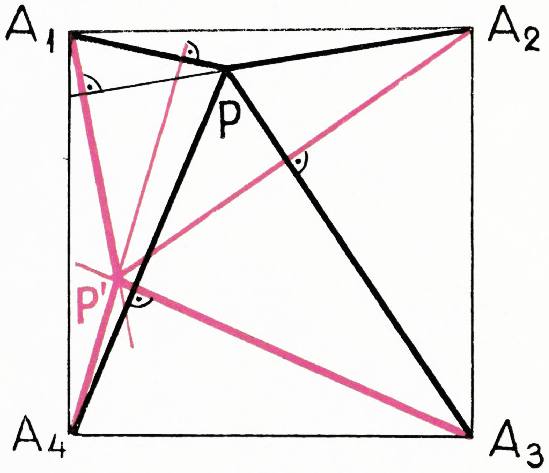
Fig. 7.
M83
Prove that the numbers 1, 2,…, for any cannot be divided into two groups so that the product of numbers in one group is equal to the product of numbers in the other.
As many readers have noticed, the statement of the problem follows from the following theorem: for
) E. B. Dynkin, S. A. Molchanov, A. L. Rosenthal., Mathematical contemporaries. Arithmetic and algebra, “Science”, additional series “Libraries of the Physics and Mathematics School” vol. 3, 1970.
43
Any between and contains at least one prime number. The first proof of this theorem (“Bertrand’s procedure”), obtained by P. L. Chebyshev, was described in «Kvant» No. 5, 1970.
Let us take a prime such that . It can only be included in one group of numbers, and there is nothing to “balance” it, since . The further confirmation of the problem follows from the theorem on the uniqueness of decomposition into prime factors.
We have not received solutions that do not use the Bertrand prostate.
N. V. Vasiliev
In this issue we publish solutions to problems F89—F91
F89
The intense electric field in an electromagnetic wave of frequency , modulated in amplitude with frequency , changes with time according to the law cos , where is a constant. Determine the energy of the electrons knocked out by this wave from the atoms of gaseous hydrogen with energy ionization .
An atom absorbs monochromatic light of frequency in portions (quanta) of energy equal to , where is Planck’s constant divided by .
Since cos , our amplitude-modified wave is the sum of three monochromatic waves with frequencies , and . The energy quanta corresponding to these waves correspond to
At the same time, the nomization energy of the hydrogen atom is
This energy is greater than and . Therefore, the first and second waves cannot change the hydrogen atom. Only the third wave can do this. The energy of the electrons knocked out of it from hydrogen atoms will be equal to the value
The correct solution was sent by . Ros-mozueva (Kokand, Uzbek USSR).
F90
An ideal gas of mass , located at a temperature , is cooled isochorically so that the pressure drops times. The gas then expands at constant pressure. In the final state its temperature is equal to the initial one. Determine the work done by the gas. The molecular weight of the gas is .
The process diagram is shown at figure 8. The work done by the gas is . Since points 1 and 3 lie on the same isotherm, then and .
Pozny
But therefore
This task turns out to be easy and its correct solution was sent in by more than 70 readers of our magazine.
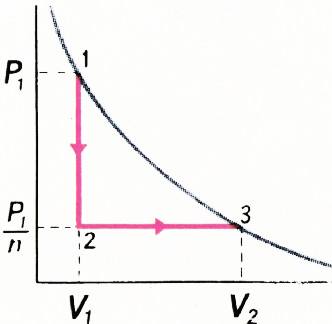
Fig. 8.
To power the device, the voltage at its input must be set as accurately as possible. For this, two rheostats are used, connected as shown in figure 9. The lengths of the rheostats are the same, and the resistance of one of them is 10 times greater than the resistance of the other. What should I do to set the voltage as accurately as possible? How many times will the accuracy of voltage setting be greater than in the case when only a single circuit is used?
How should rheostats be turned on if, to power the device, it is necessary to set not the voltage, but the current as accurately as possible?
Rheostat has little effect on the voltage on the device. Therefore, it is clear that you first need to set the voltage on the device using resistance and then adjust it with rheostat .
Indeed, if the length of the rheostat is equal to , and the accuracy in setting the rheostat is , then the accuracy in the resistance of the rheostat is equal to , and the accuracy
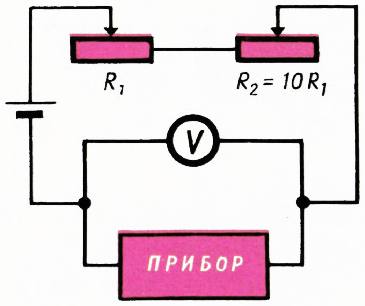
Fig. 9.
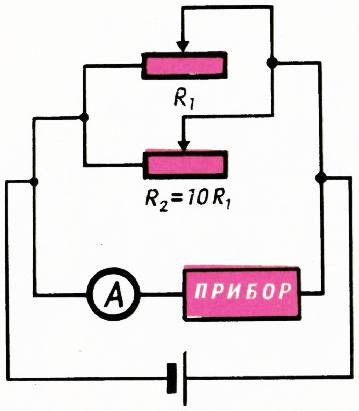
Fig. 10.
The accuracy in setting the resistance of the rheostat is equal to , that is, 10 times less than the accuracy of setting the resistance of the rheostat . Therefore, with the tactics we talked about, it was possible to select the resistance of the rheostats 10 times more accurately than when using only one resistance . The voltage drop across the rheostats and the voltage drop across the device will be determined just as much more accurately.
Since it is not very clear in advance which direction we will go wrong when setting the resistance , that is, what we will have to do with the help of the rheostat - increase or decrease the resistance, then before installing the rheostat rheostat engine we need to install the last rheostat.
If we need to establish as accurately as possible not the voltage on the device, but the current flowing through it, then in this case the rheostats should be connected in parallel to the device as a shunt, and the main one in this case will be the rheostat with the lower resistance: it is through it that the most point will flow.
The second rheostat with high resistance must be connected in parallel with the persim (Fig. 10) and the current setting is as follows: first install the rheostat slider last, then set the current using rheostat and adjust it using rheostat .
Since the current flowing through the rheostat is equal to , then if the rheostat resistance is set inaccurately , the inaccuracy in setting the point is .
Using resistance , we will get the accuracy of setting the point equal to , that is, it will be 10 times less than when using only rheostat .
The correct solution was sent by A. Alexandrov (Glazov, UASSR), V. Kovalev (Kommunarsk, Voroshilovgrad region), A. Demidov (Moscow), N. Fedin (Omsk).
I. Sh. Slovodechkiy
In 1972, on pages «Kvant» the publication of materials will continue under the direction of the “Enrollee Practice”. The receipt of the letter to the editor shows that this section is of keen interest to many readers of the magazine. We are grateful to everyone who gave us their comments and suggestions.
Of course, there is no way to cover all the questions included in the program of entrance exams in mathematics and physics. Yes, there is no need for this - these issues are studied at school and discussed in detail in school textbooks. Therefore, the editors of our text also include topics that, in one form or another, are most often used when solving competitive problems and cause difficulties for applicants.
We propose, for example, to talk about problems involving combinations of spatial bodies, about the requirements for mathematical definition, about solving a problem in stereometry and the reasonable use of drawings in geometric problems. In physics, articles will be published relating to such issues as the law of conservation of momentum, solving the problem of tell processes, current laws and others.
The theoretical issues considered in these articles are accompanied by an analysis of specific examples, taken, as a rule, from versions of entrance exam papers. At the end of each article there will be problems for independent solution, helping readers to check how successful they are in what they read. These tasks are also mainly taken from the entrance exam versions of recent years.
Taking into account the numerous wishes of readers, for information purposes we will continue to include variants of problems offered in written exams at various universities across the country in 1971. Familiarization with these materials will allow applicants to concretely imagine what a written sample exam is, and to try their hand at solving a set of problems in advance in a limited time (usually 4 hours). For example, you can recommend that page applicants take an independent “exam” by solving the entire option in 4 hours and recording it. Such training, as close as possible to the exam conditions, turns out to be especially effective. We only note that you need to attend it having studied the theoretical sections well enough.
47
-
Solve the equation
ODZ: . For such values of both sides of the equation are non-negative. Therefore, according to Theorem 2 (we take the ODZ as the set ), only those roots of the equation that lie in the ODZ serve as solutions to this equation. Since the roots of this quadratic equation satisfy the inequality , then both of them are roots of the original equation. And in this case, checking the obtained values by substituting into the original equation is not necessary. -
Solve the equation
ODZ is determined by a system of inequalities
whence . By squaring both sides of the equation and using formulas for transforming radicals, we arrive at the quadratic equation , whence . Odz determines only the value of ; it is the only root of the original equation. -
Solve the equation
(1)
ODZ: . The left side of this equation is positive (in ODZ), but the right side can take both positive and negative values. Therefore, you should not rush to square both sides of the equation - as a result, roots may appear.
This is easy to avoid - just rewrite equation (1) in the form
Here both sides are already non-negative, and squaring will not lead to the appearance of the constructed solutions. The task, thus, coincides with finding the roots of the equation belonging to the ODZ
(2)
We again have to square both sides of this equation, and again we face the same danger - the construction of a solution may appear (the right side of equation (2) takes on the values of different icons in the ODZ).
One thing we note is that not a single value of for which can serve as a root of equation (2) (any positive number would be equal to a negative one!). In other words, all roots of equation (2) satisfy the inequality ; we are only interested in those roots for which condition is satisfied.
Consequently, we must look for solutions to equation (2) that belong to the interval . Based on Theorem 2, we can be sure that on this interval equation (2) is equivalent to the equation
Only one root of the best quadratic equation satisfies the condition ; it serves as a solution to equation (1). Testing by substitution is obviously not needed.
- Solve the equation
(3)
ODZ is defined as the solution to a system of inequalities
We, however, may not solve this system, but remember that any root of equation (3) must satisfy the general inequalities (4).
Of course, all the conditions of Theorem 2 are satisfied - you can square equation (3) without fear of the appearance of constructed solutions. But alas! In this country this operation
48
inappropriate. Square both sides of equation (3) and you will see how complex the equation becomes.
It is much more convenient to do this: we rewrite equation (3) in the form
and square both of its parts. Of course, now Theorem 2 does not apply, and this transformation can lead to the appearance of constructed roots. Therefore, we will need to do a check - it will eliminate the construction of the solution (if they appear).
So, let’s square both sides of equation (5); we get
We apply the same operations to this equation again. But first we note that all its roots must satisfy the condition , that is, .
As a result, we arrive at the equation
whence . Note that , it remains to check the value of by direct substitution into the original equation (3). It turns out that it is the root of equation (3).
Please note: during the solution, we did not need to solve the system of inequalities (4) describing the ODZ of the original equation.
Introduction of auxiliary unknowns
Successfully introduced auxiliary unknowns sometimes make it possible to obtain a solution faster and easier.
- Solve the equation
Let’s rewrite the equation like this:
It can be seen that if the auxiliary unknown is , then the equation takes the form , hence .
Now the problem reduces to solving equation and equation . The first of these equations has no solution, but from the second we obtain .
- Solve the equation
Raising both sides of this equation to the fourth power does not promise anything good. If we put
then equation (6) is rewritten as follows:
Since we have introduced two new unknown functions, we need to find another equation relating and . To do this, we raise equalities (7) to the fourth power and note that .
So, we need to solve the system of equations
it has two (real) solutions: . It remains to solve the system (of two equations with one unknown!)
and systems
the first of them gives , the second gives .
Multiplying both sides of an equation by a function
Sometimes an irrational equation can be solved quite quickly if both sides are multiplied by a well-chosen function. Of course, when both sides of the equation are multiplied by some function, a solution may appear, or this may turn out to be zeros
49
functions*). Therefore, the proposed method requires mandatory research of the resulting values.
- Solve the equation
(8)
Let’s multiply both sides of the equation by the same function . The expression is called the conjugate of the expression . The purpose of such multiplication, it seems, is clear: to use the fact that the product of two conjugate expressions no longer contains radicals.
As a result of this multiplication and very significant transformations, we arrive at the equation
It has a single root , since the equation has no solutions (check it out!).
Substitution into equation (8) shows that is a root. Otherwise, you can do without substitution: the equation where does not vanish, and therefore multiplying the general equation (8) by this function does not lead to the appearance of the constructed solutions.
- Solve the equation
(9)
Multiply both sides of the equation by the expression
conjugation for the expression on the left side. After estimated transformations we obtain
*) See «Kvant» No. 5, 1970, pp. 49-50.
This equation has a root , but this value does not satisfy the original equation (9). Therefore, we can assume that , and reduce both sides of the last equation by :
(10)
Adding equations (9) and (10), we obtain the equation.
the solution of which does not seem more difficult. It has the root (make sure of this!).
The check required in this case shows that this value satisfies equation (9).
Exercises
Solve equations:
- (MSU, physicist, 1968.) For each active number , find all real solutions to the equation .
- (MSU, physicist, 1968.) For each active number , find all real solutions to the equation .