Problem M121—M125; F133—F137
Rough automatic draft, low quality: expect mistakes and awkward wording. It will be replaced by a better translation. Original →
PROBLEM WORKER
QUANTA
This section of the magazine is maintained from issue to issue. In it, along with relatively easy problems, problems consisting of several, gradually developing questions are published. The most difficult tasks are marked with asterisks. They are often difficult even for specialists in mathematics and physics. Therefore, do not check in if you cannot cope with this or that task. Try to get back to it again over time.
But a solution has been found. One should not, however, rest on this. Think about how you can generalize the task, clarify or strengthen its result.
In the second part of the section we will post the solution to the problems (approximately six months after the publication of the conditions of the problems) taking into account the letters sent by readers. We recommend that even those who do not try to solve these problems on their own get acquainted with the solutions.
In most offices, we indicate the names of the readers who sent the most successful solutions.
Schoolchildren who regularly submit especially original and complete solutions will receive the right to participate in the regional rounds of the All-Union Olympiad for Schoolchildren along with the winners of regional Olympiads. In addition, the editors of «Kvant» have established several special awards for the authors of the most interesting solutions.
And one last thing. Coming up with a problem is usually more difficult than solving it. It’s more difficult, but it’s also more interesting. Try to come up with problems and send them to us. We will publish the best of them in the “Problem Book «Kvant»”.
Send your solutions and new problems to the address: 117071, Moscow, V-71, Leninsky Prospekt 15, editorial office of the magazine «Kvant», “Problem book «Kvant». On the envelope, after the address, indicate the solutions to which problems you are sending (for example: M122, M124, F146). The solution to each problem (if you send it immediately unpenned on a separate sheet(s), the pages are numbered.
At the end, indicate your last name, first name, patronymic, six-digit code, address, as well as class and school. Decisions are considered only if they are received no later than one and a half months after the publication of the corresponding issue of the journal.
37
3GOALS
M121. Prove that for any real numbers there is a natural number such that each of the numbers
does not exceed
M122. The pentagon is inscribed in a circle. It is known that the distances from the point to the lines and are equal to the correspondence . Find the distance from point to line .
M123. Find all natural numbers for which
(the product is denoted by ).
V. P. Beshkarev
M124. Given a triangle . Find a point inside it that has the following property: for any line passing through the point and intersecting the sides of the triangle at the point and at the point , the equality
In general, prove that if and are arbitrary given positive numbers, then inside the triangle one can specify a point such that for any line passing through this point ( lies on , on ),
G. Nomen (10th grade student)
M125. a) Is there an infinite sequence of natural numbers with the following property:
None of these numbers is divisible by the other, but among each three numbers you can choose two whose sum is divisible by the third?
- If not, how many numbers can there be in a set that have this property?
b) Solve the same problem with the additional condition: only odd numbers are allowed to be included in the set.
Here is one example of such a set of four numbers: 3, 5, 7, 107. Here, among the three numbers 3, 5, 7, the sum 5+7 is divisible by 3; in the triple 5, 7, 107, the sum 107+5 is divided by 7; in the triple 3, 7, 107, the sum 7+107 is divided by 3; finally, in the triple 3, 5, 107, the sum 3+107 is divided by 5.
Yu. I. Nonin
F133*. A closed metal chain is connected by a thread to the centering axis of the machine and rotates with an angular velocity (Fig. 1). In this case, the thread makes an angle with the vertical.
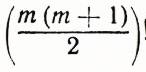
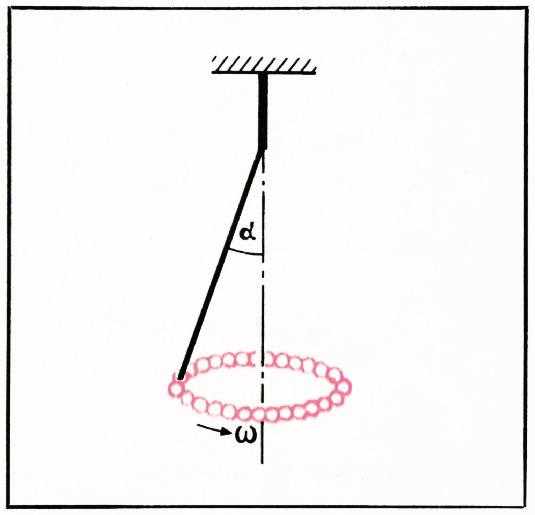
Fig. 1.