Correspondence Olympiad of the Asian part of the USSR
Rough automatic draft, low quality: expect mistakes and awkward wording. It will be replaced by a better translation. Original →
58
Correspondence Olympiad
Aznat part of the USSR
We publish texts of correspondence Olympiad problems in mathematics, physics and chemistry for students of schools and other secondary educational institutions in Siberia, Kazakhstan, the Far East and Central Asia.
Those who successfully cope with the tasks of the correspondence Olympiad will be invited to regional, regional, resource Olympiads on an equal basis with the winner of the regional Olympiads. Invitations will be sent to public education organizations at home addresses. The best of the winners of regional and resource olympids will take part in the final type of the All-Oplympids, and will also be invited to the summer school of the Siberian branch of the USSR Academy of Sciences.
After each problem, the classes for whose students it is intended are indicated in parentheses, but you can also try your hand at problems for older classes. To become an Olympiad winner, you don’t have to solve many problems. Another ingenious solution alone is enough. But solving a problem doesn’t just mean giving an answer; it is necessary to justify it, to give precise evidence. The tasks do not require any knowledge beyond the high school curriculum. Solutions to the problem for each prerequisite must be sent in a separate standard format envelope. Write the name of the item on the envelope. The letter must be enclosed in an envelope with a return home address and a stamp; In this envelope you will be sent a notice of the results of the work. Solutions must be written very legibly. The conditions of the tasks are not rewritten, but their numbers are indicated.
At the beginning of the letter, do not forget to indicate (legibly):
- Your last name, first name and patronymic.
- Postal home address (detailed).
- Class, school, college, technical, etc., address.
- Last name, first name and patronymic of your teacher for this subject.
The last day you can still send a decision is February 1, 1972, postmarked. Letters sent later will not be considered.
Olympida participants send decisions to the address: Novosibirsk, 90, Olympida.
We wish all Olympiad participants the greatest success.
Olympics Committee
Siberian branch
Academy of Sciences of the USSR
59
MATHEMATICS
-
Three points are given on the plane that do not lie on the same line. The fourth point , different from them, is symmetrically reflected with respect to , the resulting point is symmetrically reflected with respect to , the new point is reflected with respect to , then with respect to , and so on. Does the resulting point necessarily coincide with the original point at some step? (10)
-
A quadrilateral is inscribed in the circle, after which a circle is inscribed in each of the four formed segments, touching the corresponding side of the quadrilateral in its middle (Fig. 1). For each quadrilateral, the sum of the lengths of the resulting four circles will be the smallest? (10)
-
It is easy to prove that the square , etc., are covered by figures of the form
Graph
from the heel of the cells, but the square is not (the side of the cell is taken as one).
Is it possible to cover squares , etc. with such figures? (9-10)
-
Five nodes are selected on an infinite sheet of checkered paper (a node is the point where linear lines intersect). Prove that from these five nodes it is certainly possible to choose two such that the segment connecting them passes through another grid node. (9-10)
-
Draw a chord that is divided by two given radii of given
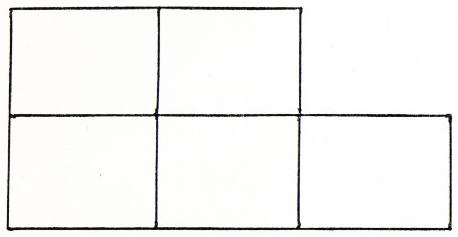
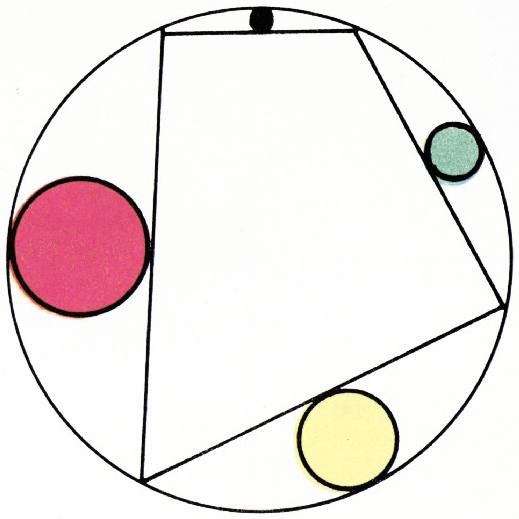
Fig. 1.
of the circle in this relation . (9-10)
-
Inscribe in this triangle a parallelogram so that the points lie on the sides and , respectively, and so that the diagonal has the given length. (9)
-
Prove that the number 11…11, written in units, has at least different divisors (including 1 and the number itself). (8-9)
-
Prove that in a right-angled triangle the ratio of the square of the sunny circle to the sum of the squares of the lengths of the medians drawn from the acute angles does not exceed 1/5. (8-9)
-
Ten backpacks contain 50 cans of canned food, and different backpacks contain different numbers of cans. It is allowed to “equalize” the number of cans in two backpacks, that is, transfer several cans from a backpack with a large number of cans to a backpack with a smaller number so that the difference in the number of cans in them becomes minimal. Prove that after a certain number of such “equalizations” it is possible to achieve that there are equal to 5 cans in each backpack. (8)
60
- In one of the two isolated rooms there is an electric light bulb, and in the other there are five switches, one of which is connected to the light bulb. Two experimenters need to find out which switch is connected to a light bulb that operates as follows. They go to different rooms, one switches (whatever) the switches, the other watches the light bulb, and then they meet.
How can they solve the problem (they don’t have a clock)? (8)
- Prove that is not divisible by 19 or any integer . (8)
PHYSICS
- A straw of length , mass falls, maintaining a vertical position. An ant of mass flies along it with a constant speed . How much work will an ant do by sifting from one end of a straw to the other?
Neglect air compliance. (8)
- Is the equilibrium of a ruler lying symmetrically on a fixed cylinder stable?
There is no slippage. All sizes are given. (8-9)
-
Boil water in a saucepan with a heavy lid. The pan was taken off the stove, after which the tea leaves were poured into the calm water. The water boiled violently. Explain this phenomenon. (8-9)
-
A flat figure was cut into two parts along a straight line passing through the center of gravity. Are the masses of these parts equal? (8)
-
He brought it in on a nail, and then began to slide off a uniform rope of length . The weight of a piece of rope of a single length is . Find the force of pressure of the rope on the nail when the distance between its ends is . Ignore friction. (8-10)
-
Why are the spokes of a bicycle wheel not arranged radially, but slightly obliquely? (Fig. 2) (9)
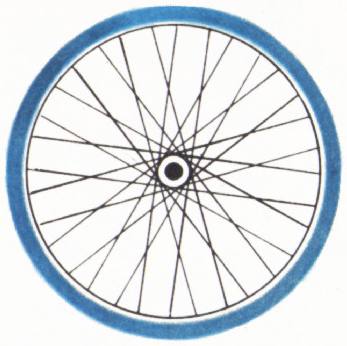
Fig. 2.
-
Indicate the direction of the friction forces acting on the front and rear wheels of an automatic vehicle, if only the rear wheels are driven. (8)
-
At the bottom of a hermetic sealed vessel, directed to the top with water, finding two identical
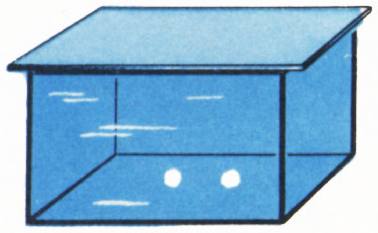
Fig. 3.
air bubble (Fig. 3). The pressure at the bottom is . One of the bubbles floats up. What will the pressure be at the bottom? (9-10)
-
Why does a skater bring the toes of his skates together when braking, and not his heels? (9-10)
-
A box is attached to the cart of mass , the mass of which is neglected.
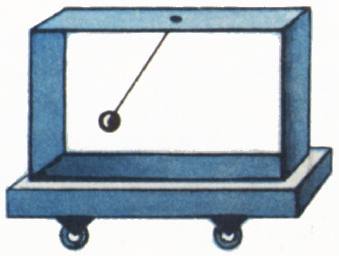
Fig. 4.
61
mode is small. To the upper edge of the
shyly attached pendulum (Fig. 4).
The length of the pendulum is , the weight of the load is .
Neglecting the friction of the cart on the horizontal plane, find the peri-
odes of small vibrations of the pendulum. (9-10)
- Two concentric spheres with
radiuses and are grounded (Fig. 5).
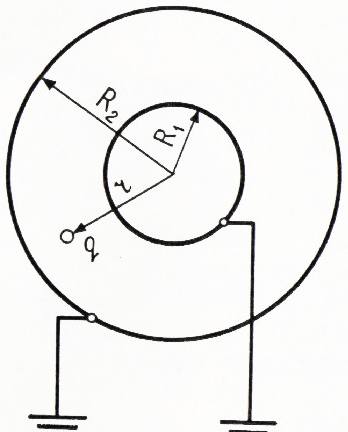
Fig. 5.
Between spheres at a distance from
their common center is the charge .
Find the total charges on each
sphere. (10)
- On ande triode with flat
electrodes hold the direction (Fig. 6). The lamp cathode is grounded and the grid is insulated. Square
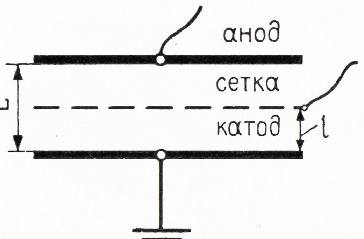
Fig. 6.
plates , the distance between the anomer and the cathode , between the cathode and the grid - . At what charge on the grid will the current through the lamp stop? (10)
CHEMISTRY
8th grade
-
During synthesis from ammonia elements, 11 kcal/mol is released, and during synthesis from hydrazine elements 10 kcal/mol is absorbed.
Determine the binding energy - and - , if the binding energy in molecular hydrogen is 104 kcal/mol, and in molecular nitrogen 170 kcal/mol. -
It is known that in some natural silicate minerals the anions have structures in which the terzadras form infinite two-dimensional chains in such a way that some of the oxygen atoms belong simultaneously to two tetradras. (Such oxygen atoms are called bridging.) What will be the formula of a mineral anion in which three oxygen atoms in any tetra are bridging? Draw a fragment of the structure of this anion. What minerals with this anion do you know? What are their mechanical properties and how are they related to the structure of the mineral?
-
It is known that sodium acetate forms supersaturated solutions much more easily than sodium chloride. Suggest an explanation for this phenomenon.
-
A sample of magnesium structure in air and the ash were dissolved in 60 ml of 1 M hydrochloric acid. To neutralize this solution, 12 ml of 1 M sodium hydroxide solution was used. After adding the excess, the solution was boiled, and the gas released was passed into a flask with 10 ml of 1 M hydrochloric acid. To neutralize the solution in the flask, 6 ml of 1 M sodium hydroxide solution was used. Determine the weight of the magnesium sample and the percentage composition of the ash.
9th grade
- The solubility of iodine in water is 0.00134 mol/l, and in 0.0070 M potassium dissolver it is 0.0048 mol/l. Calculate the solubility of iodine in 0.1 M iodide solution