Rough automatic draft, low quality: expect mistakes and awkward wording. It will be replaced by a better translation. Original →
14
Starting to study physics, we immediately encounter an important, fundamental concept: the mass of a body or the mass of the materials of a point.
What is mass?
Answering questions related to basic concepts in physics is always difficult. Newton (1642-1727), in his classic work “Mathematical Principles of Natural Physification,” began his presentation of mechanics with the definition of mass. He, however, wrote “quantity of materials” together with the word “mass” and defined it as follows: the quantity of materials is a measure of such, established depending on its density and volume.
This definition, unfortunately, says little. In fact, in order to define mass in this way, we must first define density, and we cannot do this unless we introduce new concepts.
Mass physicalizes in different ways, and we do not always realize that mass, strictly speaking, characterizes different properties of the body. There are at least three different cases in which we can think of mass, and in each case we have a different concept in mind.
I. When buying something in a retail store, we talk, for example, about a kilogram of sugar, knowing that the mass of different portions of sugar adds up (as they say, the mass is additive). Here we study the quantity of substances by mass.
II. When meeting at a place with an expensive sign that says “10 tons,” the driver knows that it is forbidden for a car with a total weight of more than 10 tons to pass through this place. In this case, the mass changes the force of attraction to the earth.
III. When calculating the trajectory of the proto-accelerator, we write down an equation of motion that relates acceleration to mass. In this case, the mass acts as a measure of the inertia of the protor—as an inert mass.
The fact that in all three cases we can use the same value is an amazing property of nature, which we want to talk about here.
Under general conditions, all three cases are indeed described by the same mass. This statement is only true as long as we consider physical bodies consisting of particles that move at speeds much less than the speed of light.
If the speed of particles is high, such as for protons and neutrons that make up the atomic nucleus, then the situation changes. The mass of the system will no longer be equal to the sum of the masses of its parts (as they say, the mass will cross to be an additive quantity). Acceleration is not proportional to force and the very concept of mass becomes complex.
We will consider methods for determining mass not in order of their importance, but in a way that is convenient for consistent presentation.
15
Quantity of substances
Let’s start with a simple question. What does it mean when we buy a kilogram of sugar or take 0.5 grams of aspirin? We are, of course, not interested in the root that can be given to this amount of sugar or aspirin. We are not interested in the strength of their attraction to the Earth.
We are interested in a certain amount, the number of servings of sugar or aspirin, and not at all in mass. We simply use the fact that a kilogram can be determined by weighing. In this case, the edentulousness of the mass and its proportionality to the force of earthly tension is used. In this case, this mass can be, for example, a piece of sugar, so you can simply count the mass of any amount of sugar. The only condition is that all the pieces of sugar are the same.
How do you know if two lumps of sugar are the same? We can count how many sugar molecules are in each piece (this is difficult to do, but let’s say we can do it). If both pieces contain an equal number of molecules, then their mass is the same. But at the same time, we assume that all sugar molecules are the same, that is, we will use a new physical property - the identity of the molecules. By postulating this property and the edentulous nature of the mass, we are able to compare the masses of different portions of the same substance.
This way you can set a mass scale for sugar, for oil, for copper, for iron. However, we still need to have a way to compare the masses of samples made from different substances. How, for example, can we compare the masses of copper and iron balls?
This can be done by studying the stability of elastic balls.
This is exactly what Christan Huygens (1629-1695) did even before Newton discovered his laws *).
*) These messages appeared in print only after the death of Huygens in 1703 in the memoir “On the Movement of Bodies and Centennials.” But the results were obtained in 1652.
Huygens considered the central collision of two elastic balls of equal mass.
Let us assume that two elastic balls of equal masses fly towards each other with the same absolute speed (Fig. 1). After the collision, the balls will scatter in different directions. Each next, that the speeds with which the balls fly apart are also the same in absolute value. Why?
The speed of the flying masses of balls and the speed of their merger. Consequently, none of the balls has priority over the other, and their movement must remain symmetrical. This means that they will fly apart at the same speed. And vice versa, from the fact that the balls fly away at the same speeds, it follows that their masses are equal.
In fact, the fact that the velocities after the collision are determined entirely by the initial speed and masses of the balls, and does not depend, for example, on the size of the balls, temperature or some other quantity, does not follow from anywhere. Only because experience has confirmed such a precedence can we use the outlined method of comparing the masses of bodies made of different materials.
Huygens’s method makes it possible to compare what can be called mass scales for different substances. Huygens himself did not develop this idea. He reasons simply: “…I will consider bodies made of one substance, or we will accept that the size of bodies is determined by their weight…”. By “magnitude” Huygens meant “mass”.
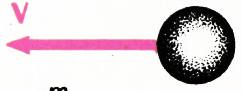
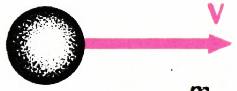


Fig. 1.
16
Law of conservation of momentum
Let us write the law of conservation of momentum in the case of a collision between two bodies (momentum is equal to the product of mass and speed ). Let two bodies before the collision have impulses and . Their impulses after the collision are denoted by and .
Then the law of conservation of momentum .
Noting the masses and velocities of bodies with indices 1 and 2, we can write
or
Denoting the absolute values of the vector change in speed through and , we obtain
Thus, by changing the velocities of moving bodies, their masses can be compared. This is how the French mechanic Barré de Cen-Benan (1797-1886) defined the concept of mass.
Mass can also be determined from the acceleration ratio:
The connection between the mass ratio and the acceleration ratio can be taken as a way to compare masses, as is done *).
This definition of mass becomes more incorrect as soon as velocities approach the speed of light . The matter can be improved if in the definition of momentum we replace the speed with the “relativistic” speed according to the formula
and write together the differences and , respectively and . The mass in this case is called the rest mass.
**) This definition can be obtained from the previous one, if there is a difference in speed at two very close points in time.
However, in this form, the formula is correct only for bodies that move at low (compared to ) speeds.
barks in the textbook. Just remember that this method is not the only one.
Centripetal acceleration
We have already said that Huygens, before Newton, understood some laws of motion (by studying the laws of motion of elastic balls). How well Huygens understood mechanics is evident from the fact that he was the first to correctly formulate the laws of circular motion and introduce the concept of centripetal acceleration. After all, if we know how to measure force (for example, using Hooke’s law), then we can change the mass without the help of gravitational forces, changing the centripetal acceleration of the rotating body.
Huygens himself considered motion in a coordinate system associated with a rotating body. In this system, it is necessary to take into account the centrifugal force of inertia, so Huygen’s formulation was as follows: “When two equal bodies move in equal circles with unequal speed, but both are uniform, then the centrifugal force of the faster one is related to the centrifugal force of the slower ones, as the squares of their speeds.”
Standard mass
The standards of length and time are now accepted for a wave of a certain line in the spectrum of krypton and the oscillation frequency of a hydrogen maser. Such standards are better than artificial ones, since they can be reproduced in any good laboratory, and they cannot be lost or deteriorated. Why can’t we use, for example, the mass of a proton as an eton of mass? We know that this is almost exactly what is done in chemistry and nuclear physics. The atomic mass unit equal to mass of the carbon isotope is accepted as mass units. By measuring the proton mass in these units, very precise values were obtained.
17
The number in brackets means that the possible inaccuracy in this value is estimated at 8 units in the last, eighth digit.
Thus, the proton mass is known with very high accuracy. Unfortunately, this greater precision is only achievable in atomic units. The proton mass in common units (kg) is much less known:
Here a possible error affects already the sixth character! Although this is great accuracy, it is still insufficient to approve the proton as a mass standard.
Why does this happen? The difficulty is that physicists are not able to calculate with sufficient accuracy the number of protons in a given amount of hydrogen (for example, 1 kilomole). This is due to the fact that the number of molecules in 1 kilomole is relatively poorly changed:
The possible error here is almost 7 millionths of the measured value. This is too bad for a standard! Only with greater measurement accuracy can the proton take its place as a natural standard of mass.
Mass defect
Let’s talk a little more about the aditivity of mass.
If all bodies consisted of identical parts, some kind of corpuscles (or monads, as the ancients called them), differing from each other only in density - the number of corpuscles per unit volume, then the question of the mass of bodies would be solved simply. The masses of all bodies would be determined by the number of such corpuscles, and this would be the end of all difficulties. Could this be exactly what Newton was thinking about when he believed that the density of a body is a simpler concept than its mass?
But the world is more complicated. Atoms are built from different particle elements: electrons, protons, neutrons. Therefore, from molecules to their constituent parts, we will only replace the question of comparing the masses of different atoms with the question of comparing the masses of different elements of particles.
In addition, as is known from the theory of relativity, the masses of protons and neutrons cannot simply be added to each other when these particles are part of the nucleus. When a nucleus is processed, energy is released and the mass of the nucleus decreases in comparison with the sum of the masses of all protons and neutrons by amounts
It is impossible, strictly speaking, even in principle to determine the mass of atoms from the number of particles. The mass in this case is not additive, that is, the mass of the nucleus is not equal to the sum of the masses of its constituent particles. The aditivity of mass is valid as long as we divide the body into parts that almost do not interact with each other, for example, when we saw an iron bar.
Let us estimate, for example, the error that we will make if we assume that the mass of hydrogen atoms is equal to the sum of the masses of the proton and the mass of the electron. In order to remove an electron—to ionize an atom—you need to expend 13.5 electron volts of energy. (In other words, it is necessary to apply a potential difference of 13.5 points to the proton-electron system.) 1 electron-volt is equal to 1.6·10^{-19} joules. From here we get
Let’s compare this number with the proton mass of 1.7·10^{-27} kg. We see that the error (if we consider the mass of hydrogen atoms as the sum of the masses of a proton and an electron) is very small and will affect only the eighth digit. This amendment can be neglected. For nuclear reactions, this effect makes a sufficiently large contribution and cannot be neglected.
*) there is, of course, also energy that must be imparted to the nucleus so that it “breaks apart” into protons and neutrons.