Rough automatic draft, low quality: expect mistakes and awkward wording. It will be replaced by a better translation. Original →
24
Geskanma environment
A. P. Savin
Playing tic-tac-toe on checkered paper has long become one of the favorite pastimes of schoolchildren and students, since they always have a pen or pencil and a piece of checkered paper at hand.
In problem M91 a new version of this game was proposed.
M91. Two people play tic-tac-toe on an endless sheet of checkered paper. The beginner puts a cross in any cell. Each of his next moves must place a cross in any free cell; any cell adjacent to one is considered to be any cell that has a common side or a common vertex with it. The second player, with each turn, can place three polykkas at once in any three free cells (not necessarily next to each other). Prove that, no matter how the first one plays, the second one can “lock him up”: make sure that the first one has nowhere else to put a cross.
Explore similar games in which the second player is allowed to place not three, but only two or only one polyk in one turn. What will be the result here if the partners play correctly: will the players be able to “lock” the crosses (and what is the cleanest move that the crosses can “hold out”) or can the game continue indefinitely?
Try to study other variants of this game: when only cells that have a common side with it are considered adjacent to a given one; when the plane is divided not into squares, but into regular hexagons; when the first one is allowed to put p crosses at once, and the second one - q crosses.
The actions of the crosses are very similar to the actions of the ten trying to avoid being surrounded, which is why we called this game “surrounding the ten.”
The simplest version of this game is this: the beginner puts a cross, the second one puts three tiles on any three free fields, then the first one puts

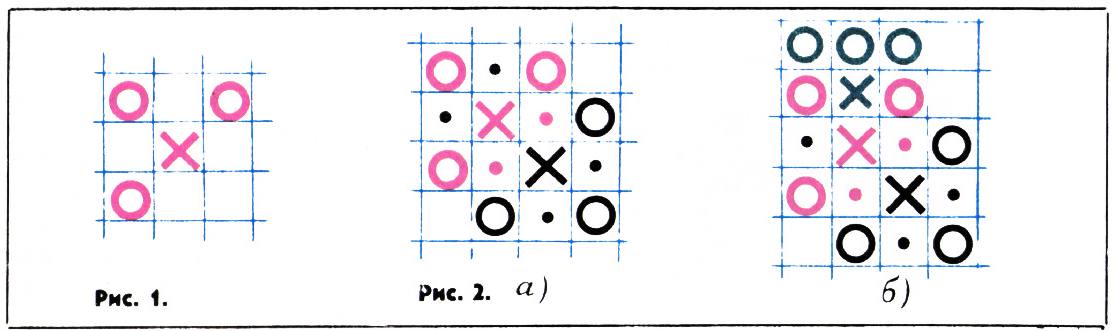
Fig. 1. Fig. 2. a) Fig. 6)
25
one more cross on the free field adjacent to the one where the cross already stands, and the second - three more regiments on the free fields. And so on, each time the crosses are placed on the free fields adjacent to the one where the crosses already stand, and the shelves are placed on any free fields. The beginner is asked to put as many crosses as possible, and the second one is asked to do this.
In this version, our readers solved a lot of the problem. They showed that a beginner can put no more than 7 crosses. figure 1 shows the regimental strategy on the first move that achieves this result. Indeed, after this the beginner can put a cross on one of the five fields. It is not difficult to see that only by placing it on the south-eastern field, the first can hope to put seven crosses in a fair game, because with the response of the regiments shown in figure 2, a, he can only hope to put crosses on the fields marked with dots, and of the two fields marked with red dots, he will be able to put a cross on no more than one. How the second one should place the shelves is clear from figure 2, 6.
If the beginner puts a second cross on another field, then after the second move, one of the situations shown in figure 3 occurs, where there are only 4 fields (they are also marked with dots) on which the beginner can put a cross if the second one plays correctly. It consists in cutting off all the advancement fields from the cross point placed together, similar to how it was done in the first case (Fig. 2, 6).
Let us now try the conditions of the regiment problem. Let’s allow the second one to place not 3 tiles each, but only 2. It is interesting that if from the very beginning he tries to place shelves on the cells adjacent to the crosses, then the second one will not be able to delay the movement of the crosses. Look at figure 4. Here the shelves cannot place crosses moving up (red signs - first move, black - second, green - third).
This is clear, since with each move the regiments cover only two of the three fields leading up.
26
It would seem that here the polyknei will no longer be able to surround the crosses, and especially if the second one puts only one polykne on each cross. The last statement is contained in the vast majority of letters.
What if the second one tries to organize a defense far from the first cross? Will he be able to at least put the crosses up? It turns out yes! And even if the second one answers each cross with only one answer. This strategy of the second (we will also need it for the final solution of the problem) is called “reflecting a love attack.”
So, we are trying to keep the crosses moving upward. Look at figure 5. It would seem impossible not to miss the crosses above the horizontal line, because after six moves the crosses can end up on any of the 13 squares marked with dots, and the second one can only place 6 crosses during this time. Now let’s look at figure 6. The game has begun, and with each move the crosses threaten fewer and fewer fields behind the horizontal line.
After the second move there will be one square, after the third - nine, after four - seven. But the second one manages to place the polikki in even moves so that on the threatened fields they stand across the field. (Try to prove on your own that with any game of the first, the second can do this.)
Now, after the fifth move of the crosses, one of the two situations shown in figure 7 will result. In case a) the second one can place polykki in the two remaining unfilled cells in any order, and in case b) he first puts the polyk in the middle cell, and then, depending on the move of the first, to the left or to the right, and the path is blocked for the crosses.
So, the “love attack” has been repulsed! the second one may not miss the crosses
above the sixth horizontal line (from the one where the first cross is).
It would seem that the problem has already been solved. After all, in the same way we can not miss crosses in any of the directions, that is, limit, for example, all the crosses inside a certain square. However, this conclusion