Problem M131—M135; F143—F147
Rough automatic draft, low quality: expect mistakes and awkward wording. It will be replaced by a better translation. Original →
38
QUANTA PROBLEM
Tasks
Please send solutions to problems from the “Problem Book «Kvant»” no later than one and a half months after the corresponding issue goes out of print. On the envelope after the address of the journal, write the solutions to which problems you are sending (for example, 117071, Moscow, V-71, Leninsky Prospekt, 15, “Science”, editorial office of the journal «Kvant», “Problem book «Kvant» M131, F134). At the beginning of the letter, please include your last name, first name, middle name, six-digit zip code, and address (as well as your school and grade level).
Star excellent more difficult tasks.
M131. Prove that the four points at which the bissertis of the angles between the extensions of opposite sides of a cyclic quadrilateral intersect its sides are the vertices of the rhombus (Fig. 1).
Muram Urtembaev, 10th grade student, school No. 56, Almaty
M132. Let numbers be written around a circle, each of which is equal to or , and the sum of pairwise reactions is 0 (as in the given)
M93, p. 42) and in general for each the sum of pairwise opposites of numbers separated by places is equal to 0 (that is, , etc.); example for dan in Fig. 2).
a) Prove that is the square of an integer.
6)* Is there such a set of numbers for ?
(We do not know the complete solution to the question: for what does this set of numbers exist.)
M133. One of the simplest multicellular organisms, the Volvox algae, is a spherical shell composed mainly of heptagonal, hexagonal and pentagonal cells (that is, cells with seven, six or five connected; each
39
Three cells converge at the “vertex” (Fig. 3). There are specimens that have both quadrangular and octagonal cells, but biologists have noticed that if there are no such “non-standard” cells (with less than five and more than seven sides), then the pentagonal cells are always exactly 12 larger than the heptagonal ones (there can be several hundred or even thousands of cells in total). Can you explain this fact?
V. Maresin
M134. What set of points fill the centers of gravity of triangles whose three vertices lie respectively on the three sides AB, BC and AC of a given triangle ABC?
L. G. Makarov
M135*. Prove that for every natural number the identity
where is some number (depending on ), and find .
V. Maresin
F143*. The plane lands on the aircraft carrier’s gunfire at a speed of 100 km/h. Having caught the braking rope, the plane runs 50 m until it comes to a complete stop. Determine the overloads during landing if the elasticity coefficient of the rope does not change as it stretches. Pilot weight 70 kg.
F144. What must be the ratio of the triangle to the floor in order for it to stand as shown in figure 4? The length of the thread holding the rod is equal to the length of the rod.
I. A. Zaitsev
F145. An ideal gas first transitions from state 1 () to state 2 (). Then from state 2 the gas slowly and adnabatically (without body supply) transitions to state 3 (). It is known that during the transition 2→3 the gas performs work equal to the amount of body imparted to the gas during the transition 1→2.
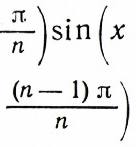
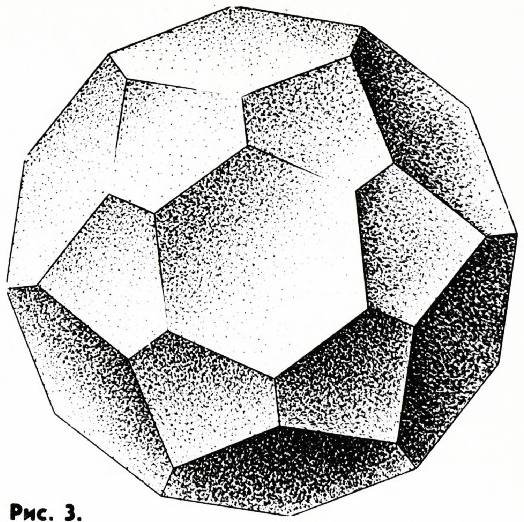
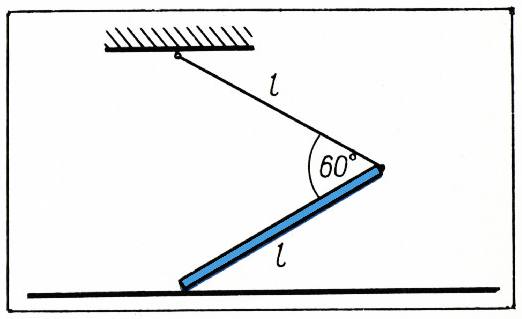
Fig. 3.
Show that . Draw processes 1→2 and 2→3 on the VT plane.
F146. There is a battery with e. d.s. 100 V and internal resistance 2 ohm. At the load you need to get a voltage of 20 V, and when the load resistance changes from 50 to 100 ohm, the voltage on it should change by no more than 2%. Come up with a simple circuit to power the load and calculate the parameters of this circuit.
A. R. Zilberman
F147 *. In the Rutherford and Bohr model of the atom, electrons spin around the nucleus in specific circular orbits. When moving from one orbit to another, closer to the nucleus, the atom emits a photon. What is the energy and frequency emitted by a hydrogen atom during the transition of an electron from an orbit of radius cm to an orbit of radius cm?
S. M. Kozel