Rough automatic draft, low quality: expect mistakes and awkward wording. It will be replaced by a better translation. Original →
28
In tabletry it is a meorem, in stereometry it is an unsolved problem.
I. M. Yaglom
Issue 6 of the magazine «Kvant» for 1971 contained the following problem (problem M89):
Prove that in any convex polygon, except a parallelogram, you can also choose three sides, which, when extended, form a triangle that encloses the given polygon. (For example, at figure 1, where the polygon is outlined with black lines, the three red lines satisfy the required condition, but the three blue lines do not.)
This problem has many different solutions. However, before we tell her decision, let’s talk about why she is interesting.
On figure 2 you see triangle ABC and three smaller triangles , and , similar to ABC and resulting from ABC by slopes to points A, B and C - the vertices of the original triangle. Triangles , and are not only similar to ABC - they are ABC-ready, that is, similar to ABC and located parallel to it. (I later learned that the segments corresponding to each other, say, in similar triangles ABC and are figuratively parallel to each other.) It is clear that if the triangles , and are slightly smaller than the original triangle ABC, then they completely cover triangle ABC.
figure 3 shows parallelogram ABCD and four smaller parallelograms , , and , resulting from
29
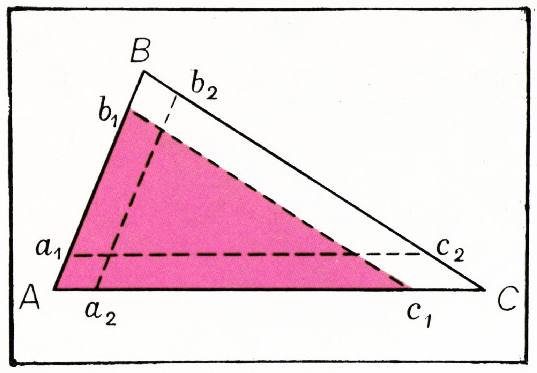
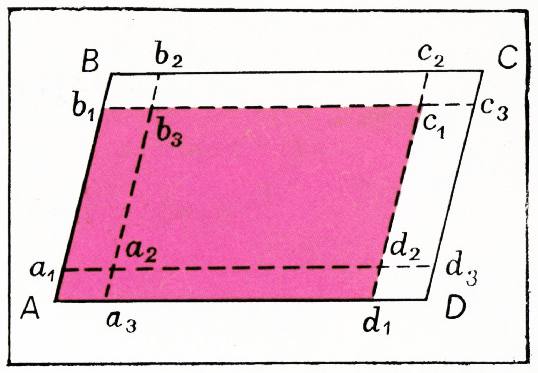
Fig. 2.
Parallelograms corresponding to a given parallelogram ABCD that can be covered by a parallelogram ABCD. In fact, if the side AB of the parallelogram ABCD is equal to c, then any segment belonging to ABCD parallel to AB will not exceed c; Therefore, in preparing an ABCD and less than ABCD parallelogram, every parallel segment AB will be less than c. It follows from this that both vertices A and B of the parallelogram ABCD cannot be covered by (any!) parallelogram prepared by ABCD or smaller than it. Thus, it is established that we will have to cover each vertex of the parallelogram ABCD with another parallelogram, less than ABCD and ready ABCD; therefore, the total number of covering ABCD less than ABCD less will be at least 4 (according to the number of vertices ABCD). In the same way, it is established that the total number of triangles covering triangle ABC, preparatory to ABC and smaller than it, cannot be less than 3 (since each vertex of ABC will have to be covered with its triangle).
The problem of how many polygons ready for a given (convex) polygon M and fewer are sufficient to cover M was posed in 1960 by the Kshshnev mathematicians I. Ts. Gokhberg and A. S. Markus (somewhat more recently, in the mid-50s, a related problem was
30
ki books; here we will show how the proof of this theorem can be derived from the result of Problem M89.
In fact, let ABC be a triangle appearing in the conditions of this problem, containing inside itself (different from a parallelogram!) a convex polygon M ≡ A₁A₂A₃…Aₙ, and side AB of the triangle contains the segment A₁A₂, side BC - segment AₖAₖ+1 and side CA - segment A₁A₁+1 (Fig. 5).
Let us now select some point O inside M and connect it with some points P, Q and R of the segments A₁A₂, AₖAₖ+1 and A₁A₁+1. When segmented, OP, OQ and OR will cut M into three parts m₁, m₂ and m₃. Now let’s reduce the polygon M to point A. If the polygon M₁ obtained from M in this way (see Fig. 5) differs little from M, then it will definitely completely cover m₁ - to prove this, it is enough to compare the boundaries of the polygons M₁ and m₁ (carry out this reasoning carefully yourself!).
Similarly, it is shown that with prepared M and smaller M polygons M₂ and M₃, obtained from M by slopes to points B and C, it is possible to completely cover parts m₂ and m₃ of the polygon M. So, M can be covered with trigons (polygons M₁, M₂ and M₃), economically M and smaller M.
We have proven that for each parallelogram of a convex polygon M, the number of ready-made M and smaller M polygons that can be completely covered by M is no more than 3. We can also prove that for any such polygon (not degenerating into a line segment) this number is exactly equal to 3 (see Problem 1 on page 32).
Let us now return to problem M89. Here is one of its simplest solutions. Note that if a convex polygon M is not a triangle or a parallelogram, then it has two non-parallel sides that do not have a common vertex *). Continuing them to the point of intersection, we obtain a convex polygon M₁ with a side number smaller than M, containing M (Fig. 6). If this polygon M₁ is again not a triangle or a parallelogram, then we can treat it as we did with M - and so on until we get a triangle or a parallelogram containing M, the sides of which, very indo, are obtained as a continuation of the side M.
If the last polygon we arrive at in the process of our transformations of the original polygon M is a triangle, then problem M89 is thereby solved (Fig. 7). If in the end we arrive at a parallelogram.
*) If a polygon M has five or more sides, then this follows from the fact that no convex polygon has three or more parallel sides; for a quadrilateral other than a parallelogram, this follows from the definition of a parallelogram.
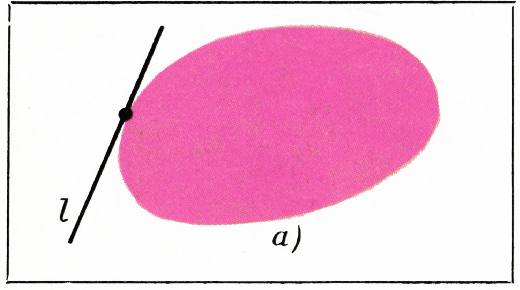
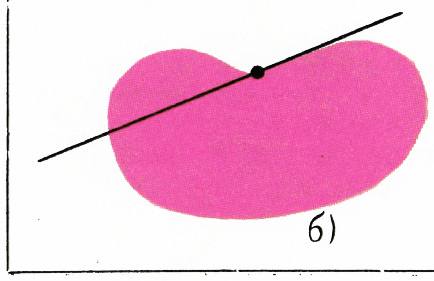
Fig. 4.
31
leloerm ABCD, but the original polygon M itself is not a parallelogram, then some of the vertices A, B, C and D of the parallelogram will not be a vertex of M. Let, for example, point A not be a vertex of M (Fig. 8). Then the distance between the vertex K close to A, which belongs to the segment AB, and the side KL starting from this vertex K, which does not belong to the straight line AB. Since the polygon M is convex and one of its sides belongs to the segment AD, the side KL can only go as shown in figure 8 (since the entire polygon M must lie on one side of KL). But in this case, when the lines BC, CD and KL, coinciding with the crown sides of the polygon M, define a triangle that satisfies the condition problem M89.
So, the only polygon for which there is no required triangle is a parallelogram.
So, we see that the Gochberg-Marcus theorem is not particularly difficult - the most difficult point in its proof can be considered the solution problem M89. But from I. Ts. Gokhberg and A. S. Markus (as well as from F. Levy) comes a stepeometric version of the same problem:
For each convex polygon M, indicate the smallest number of elements of M (that is, similar to M and located parallel to M*) polygons that can completely cover the polygon M - and this problem turns out to be imperfectly more difficult than the corresponding planning problem.
It is easy to see that for the tetrahedron T (triangular paramid) on
*) Two (convex) polygons M and μ are called economically if they are similar (that is, they are essentially polygons of the same type and all the dimensions of one of them are proportional to the corresponding sizes of the second), and each segment AB of the polygon M corresponds in the polygon μ to a segment ab parallel to AB.
32
the number of preparatory and smaller terrazds that can be covered by T is equal to four; for cube K the corresponding number of smaller cubes is equal to eight (prove it!). It is easy to see that the number we are interested in in the posed stereometric problem can take any value between 4 and 8 (see problem 2 at the end of the article). There is a proposal that we cannot accept any other values for this number (and it is equal to eight only in the case when the polyhedron in question is paralleled!). However, proving this statement is still only possible in one direction (see problem 3 at the end of the article). The proof (or refutation) that the number in question cannot in any way be greater than eight, while a problem is being compiled, which no one has been able to solve - and this despite the fact that the polyhedron M, the polyhedron M and less than M are trying to solve this problem.
The branch of geometry, to which the problems considered in this note relate, arose relatively recently - just some 15-20 years ago. This section is called combinatorial geometry; it is characterized by the simplicity of the conditions of large_instances of the problem under consideration (often understandable to any schoolchild!), but, unfortunately, the solutions to these problems are, as a rule, quite complex. Today, dozens of books and hundreds, if not thousands, of scientific articles are devoted to combinatorial geometry. Some books available to schoolchildren are listed at the end of this note.
All the problems posed below relate to combinatorial geometry; they are relevant to the topic of this note. Asterisks are removed from problems whose solution is not known to the author of the note; Here I would especially like to draw attention to problem 6, which seems to me very interesting (but perhaps also very difficult!).
Exercises
-
Prove that no convex polygon (cannot be expressed as a line segment) can be covered by two polygons equal to the given one and smaller than it.
-
Let us denote the smallest number of a polygon M and the smallest number of its polygons that can be completely covered by M by s(M); then s(T)=4, where T is a tetrahedron, and s(K)=8, where K is a cube.
Also indicate three polygons A, B and Γ, such that
s(A)=5, s(B)=6, s(Γ)=7.
-
Prove that no (not expressed in a flat polygon) convex polygon M can be covered by a third of a polygon M, ready for a given M and less than M.
-
Prove that every convex polygon can be covered by the following convex polygon M:
a) a triangle with sides a, b and c (the required number, of course, may depend on the values of a, b and c);
b) rectangular with sides m and n;
b*) parallelogram with sides m and n and angle α≤90°?
6*). From the result of Problem 4 it follows that the minimum number less than a convex polygon M and similar polygons that can cover it is always equal to 2 or 3. Characterize the class of those polygons M for which this number is equal to 2.
Literature on combinatorial geometry
-
G. Hadwiger, G. Debrunner, Combinatorial geometry of the plane, M., “Science”, 1965.
-
V. G. Boltyansky, I. Ts. Gokhberg, Dividing figures into smaller parts, M., “Nauka”, 1971.
-
V. G. Boltyansky, I. Ts. Gokhberg, Theorems and problems of combinatorial geometry, M., “Nauka”, 1965.
-
I. M. Yaglom, On combinatorial geometry, M., “Knowledge”, 1971.