Rough automatic draft, low quality: expect mistakes and awkward wording. It will be replaced by a better translation. Original →
10
We do not know all the resources of the Moon, but what is known is enough to assume that lunar stations and colonies will appear on the Moon in the future. One of the main difficulties in organizing a colony is providing people with water and oxygen. A person needs approximately 0.9 ke of anhydrous food, 0.9 ke of oxygen and 2.7 ke of water per day. No traces of water were found in lunar images delivered by Soviet and American spacecraft.
However, there is reason to believe that there was water on the Moon.
Nowadays, the theory of evolution has become widespread, according to which the Moon, like the Earth, was formed from a cloud of small solid particles. These particles on the Moon contained approximately the same amount of water (the so-called juvenile, that is, original water) as the substance of the Earth contained it: the “building material” of the Earth and the Moon was approximately the same. The decay of radioactive uranium and radioactive potassium led over time to the heating of the deep layers of the Moon to temperatures of 1000-2000°C. The water contained in the Moon’s substance evaporated and penetrated outward in the form of steam, to the surface. The fate of this steam depended on the conditions at the surface of the Moon and its temperature.
The surface temperature of the Moon reaches +120°C during the day, and drops to −160°C at night (in the polar regions to −200°C). The materials that make up the surface of the Moon (small fragments of various minerals - the so-called “regolith”) do not conduct heat well. Therefore, daily temperature fluctuations penetrate very shallowly, and already at a depth of less than a meter below the surface, the temperature does not depend on the time of the lunar day. In low latitudes, near the equator, it is approximately −30°C. At such a low temperature below the surface, the water vapor released from the depths of the Moon should have frozen, forming a layer of ice.
Let’s estimate the boundaries of the ice layer. Temperature increases with depth. On Earth, the temperature increases by 28°C for every kilometer traveled into the interior. Let us assume that the radioactive processes of heat generation on the Moon are the same as on Earth. Then the temperature on the Moon rises by 30°C to the ice melting point (0°C) at a depth of about 1 km. This is the lower boundary of the lunar permafrost layer (Fig. 1), and below it is a layer of water.
At the upper boundary of the ice layer, molecules continuously break off from its surface, and the ice evaporates. Rocks on the Moon, how are they established?
11
updated during the study of lunar samples, they always contain pores. The steam molecules flow through these pores and emerge onto the surface of the Moon.
We know the age of the Moon’s rocks from the relative abundance of radioactive isotopes and their decay products in lunar samples. This age is about 4.5 billion years. The calculation shows that with and the physical properties and structure of lunar rocks known to us, not all of the led from the lunar crust evaporated over these 4.5 billion years.
The hypothesis about permafrost and a deep layer of water on the Moon was envisioned in 1961 by the American astrophysicist Gold. However, his conclusion about the existence of ice and water deep in the lunar crust is based on some assumptions.
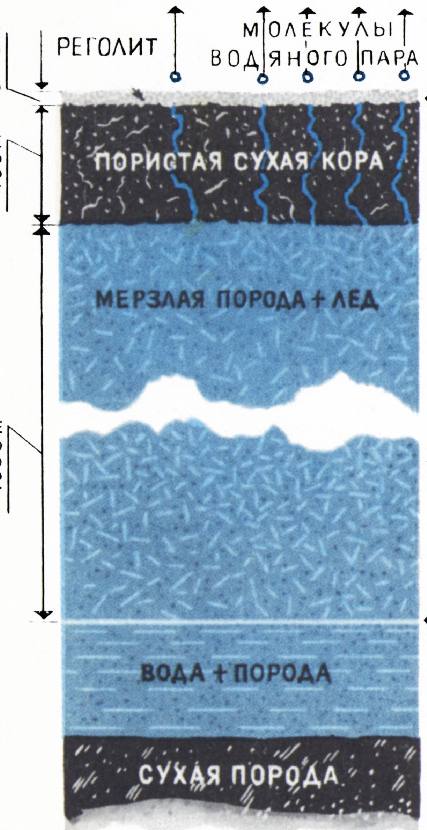
Fig. 1.
Firstly, it is believed that the total amount of juvenile water in 1 kg of matter of the Earth and the Moon was the same, and this total amount of juvenile water is estimated by the average depth of the world’s oceans (layers of water obtained by dividing the volume of water of the oceans, seas, ice of the Arctic and Antarctic, ice of mountainous regions on the surface of the Earth). On Earth this depth is ~1 km.
Secondly, it is believed that a significant part of the juvenile water comes to the surface after the lunar crust has cooled and therefore froze in the led, which evaporated slowly - through the pores.
If vapors of juvenile water managed to emerge on the surface of the lunar crust, in order to reliably calculate the process of evaporation of ice from it.
There are also subsurface ices on Earth. In those areas where the average pressure temperature is below 0°C, a layer of permafrost soil remains under the Earth’s surface, which only partially thaws in the summer. Permafrost areas make up 15% of the Earth’s land mass (and another 10% of the landmass is occupied by glaciers). In our country, permafrost covers the common areas of Siberia and the Far East.
Transformations led—water—steam on the Moon and on Earth *)
Let us now rise from the depths to the surface of the Moon. How water, LED and steam will behave during the day ()
*) This recommendation from the reader who popularized the book, Academician L. D. Landu and Prof. A.I. Kitaygorodsky “Physics for everyone”, M., “Nayka”, 1963. Chapter 12 of this book will serve as a guide on all physical issues raised in our country.
12
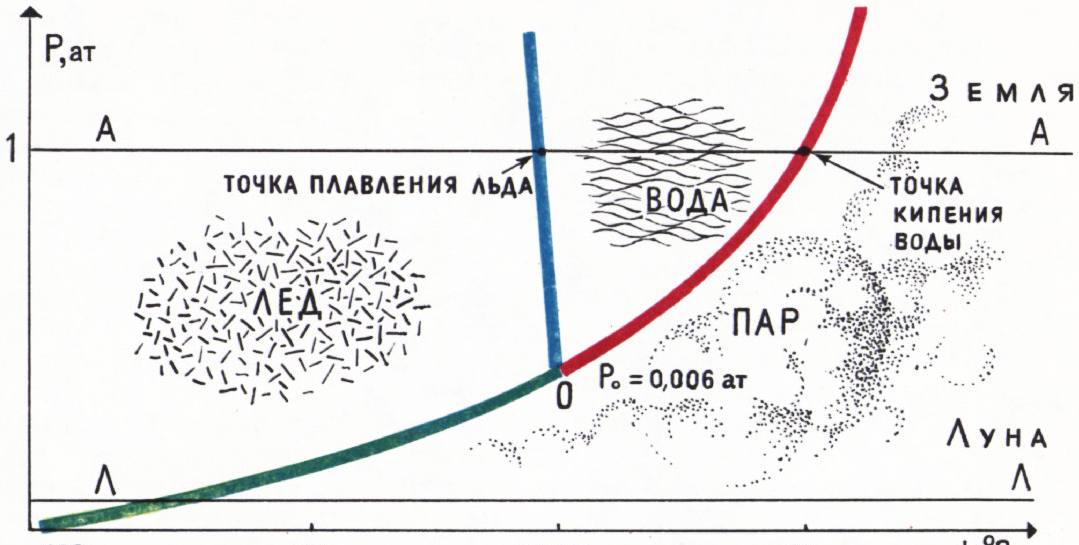
Fig. 2.
and night () on the surface itself, without a protected layer of the lunar crust? The answer to these questions is given by the so-called state diagram of water (Fig. 2), which we will now discuss.
We will plot the pressure under which ice, water or steam is located along the vertical axis, and their temperature along the horizontal axis. Each point on the plane bounded by the coordinate axes and corresponds to a certain state of water (ice, water or steam).
Let’s start with ice. The blue curve shows the dependence of the pressure under which ice melts on temperature. The higher the pressure, the lower the melting point. Let’s move away from the blue curve a little to the right: at the same pressure we will increase the temperature. The ice will completely melt - the points of the plane to the right of the blue curve correspond to water. If you move to the left from the blue curve and reduce the temperature, the water will freeze and turn into ice. At the blue points of the curve (and only at these pressures and temperatures) ice and water are in equilibrium with each other - how much ice melts, how much water turns into ice. Therefore, the blue curve is called the equilibrium curve of ice and water.
If we increase the temperature of water at a constant pressure, we will find ourselves in a region of temperatures at which only steam can exist. This region of temperature and pressure is to the right of the red curve - the equilibrium curve of water and steam, or, in other words, the curve of the dependence of the boiling point of water on pressure. This curve, as can be seen from figure, shows that the lower the pressure under which water is, the lower its boiling point. We know this well - for example, high in the mountains, where the air pressure is low, it is difficult for a climber to boil an egg in boiling water, so we have to fry the eggs. At the top of Elbrus, where the pressure is equal to the atmospheric atmosphere, water boils at .
Let’s reduce the pressure to 0.006 am. Experience shows that the boiling point drops to zero (more precisely, to ) - “boiling water” has the freezing temperature of water. What will happen if the pressure drops further? Boiling temperature drops below zero, “boiling water”
14
equal to or greater than atmospheric if the ice is covered with a layer of water (Fig. 3).
For the water-steam equilibrium curve, everything is circumstantial. All points to the right of the red curve correspond to the steady state - steam, to the left - to the steady state - water. If the water vapor pressure is less than the pressure on the red curve, then the water at a given temperature will completely evaporate (the steam above it is unsaturated). In atmospheric exposure, the vapor pressure of water is usually 0.013 am, that is, 60% of the saturated vapor pressure. Therefore, the water absorbed in the dish will always evaporate over time. When air is cooled, the pressure of 0.013 am becomes greater than the saturated vapor pressure at the new temperature and water vapor condenses (for example, morning dew).
But evaporation from the surface of a liquid is a very slow process. There is another process of transition of liquid into vapor, much more quickly - evaporation during boiling. In this case, vapor bubbles form throughout the entire volume of the liquid. External pressure (total pressure 1 am) is transmitted from the surface of the liquid to all points in its depth, so the resulting internal pressure is equal to (or greater than) the total pressure on the liquid, regardless of whether the cause of this external pressure is water vapor or atmospheric air pressure.
On the Moon, water always boils on the open surface, but freezes below. But depending on the time of day (that is, on heating by the Sun), there can be a wide variety of effects.
Whether steam freezes or not depends not only on its temperature, but also on pressure. On the Moon, at low pressures, water vapor could escape on its surface and not freeze. On figure 2 we see that under lunar conditions water vapor can exist at temperatures close to -200°C. It all depends on conditions (dependence of pressure on depth, temperature, porosity of the Moon’s substance), which over the 4.5 billion years of the Moon’s history could be very different.
Thus, both main points of the theory of subsurface ice - the release of a sufficient amount of water vapor from the depths of the Moon and its freezing at the surface - are based on certain assumptions and need to be tested experimentally. We are working on developing experimental methods for searching for ice and using them to examine the Moon over its entire surface, as well as in depth.
The temperature range on the lunar surface is very wide (from -160 to +120°C). It can be suggested that the properties of ice in such a wide temperature range are also not constant. The search for ice on the Moon (still theoretical) prompted new research into the properties of ice in laboratories on Earth.
In 1969, the process of freezing water was studied under conditions of the lunar shadow, that is, at a pressure less than ten millionths of the atmosphere, and a temperature of (-170°C) - (-180°C). At the same time, a hitherto unknown form of ice was discovered - amorphous ice. It is twice as dense as water: when water freezes at elevated temperatures, it does not expand (remember that general ice floats on the surface of water), but collapses.
The experimental design is very simple. Distilled water was introduced into a vacuum chamber and frozen into a thin layer of ice on a metal cone. The volume of ice was determined by comparing photographs of the cone before and after ice freezing, the mass was determined by weighing. From here comes the density. Ice frozen on the cone at a temperature below -175°C had a density of 2.3 e/cm³ and was sticky on the glass. Using two-mechanical methods of measuring the temperature of water, on the same scale, the temperature of water is measured using a thermometer.