Rough automatic draft, low quality: expect mistakes and awkward wording. It will be replaced by a better translation. Original →
20
Even 300 years BC, Greek scientists already knew that light travels in a straight line, has the property of being reflected from the eye surfaces, and that the angle of incidence is equal to the angle of reflection. Ancient knowledge is also about the refraction of light. Claudius Ptolemy, the great astronomer and mathematician of antiquity, compiled tables of his measurements of the angles of incidence and refraction. But there was no consensus on the issue of the speed of light in ancient science. Most scientists of that time, including Aristotle, believed that the speed of light was infinitely high - after all, it could not be measured even approximately by any of the instruments and methods that existed at that time. However, 900 years ago, the Arab scientist and physician Avicenna proposed that the speed of light, although very high, is finite. His contemporary Algazen also agreed with him. But, of course, none of them could support their opinion with facts or experiments.
One way or another, all generations over the centuries have passed or interest in the nature of light, as evidenced by the myths, legends, and traditions that have reached us. This inexhaustible interest in natural phenomena was at first the only motive that prompted scientists to accept the experimental measurement of the speed of light. However, from the largest experimental physicists
tator Albert Michelson, who devoted almost his entire life to measuring the speed of light, when asked by correspondents: “Why is this needed?” replied: “This is terribly interesting!” But even before Michelson’s work, determining the speed of light and its dependence on various conditions acquired the character of not only satisfying the curiosity of scientists. The increasingly exciting idea of the “luminiferous ether”, the question of the corpuscular or wave nature of light, and then the relative theory required an accurate knowledge of the speed of light. In our time, the precise determination of this quantity has purely practical significance. It is necessary to know it when calculating the energy of nuclear reactions, and for measuring distances between space objects in connection with the expansion of space research, and in many other equally important problems.
The first person to try to experimentally determine the speed of light was Galileo Galilei. His method was extremely simple, but, unfortunately, it did not produce results. This is how Galileo himself describes it:
“The experience I came up with is as follows. Two persons each hold a fire, enclosed in a lantern or the like, which can be opened or closed by the movement of the hand in plain sight.
22
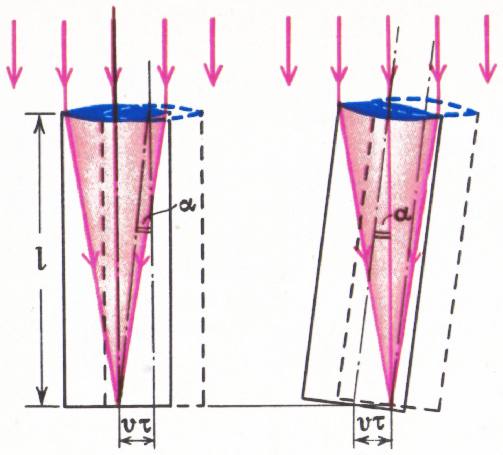
Fig. 2.
Will spread in the telescope tube (, where is the speed of light, is the length of the tube), the Earth will travel along the orbit a path equal to , and the image of the star will move away from the center of the field of view to the same distance (Fig. 2, a). To return the image of the star to its place, you need, very much, to tilt the telescope in the direction of the Earth’s movement at such an angle that (Fig. 2, b). Since , then . Hence . The same will happen in pro-
opposite point of the earth’s orbit, but the telephone will be tilted in the opposite direction. Thus, directions to the same star can differ by a maximum angle of . The changes showed that . During astronomical observations, the telescope, of course, is not tilted. Thanks to the change in the direction of the Earth’s speed, the image of the star will be at different points in the telescope’s field of view on different days and will form an ellipse throughout the year. The major axis of this ellipse will be visible from the center of the lens at an angle of . Knowing the angle , Bradley found the speed of light and obtained a value for it of 303,000 km/sec. This was in 1728.
However, scientists were not satisfied; they would like to change the insufficient early light on Earth, without leaving the boundaries of their home planet, so that all conditions of the experiment were under control. The solution to this problem had to wait one hundred and twenty years.
In 1849, the French physicist Armand Hippolyte Louis Fizeau came up with a fairly simple method for this. Its scheme is as follows (Fig. 3). A ray of light from a source falls on a semi-open mirror plate , reflected from it, directed through collecting lines to a stationary
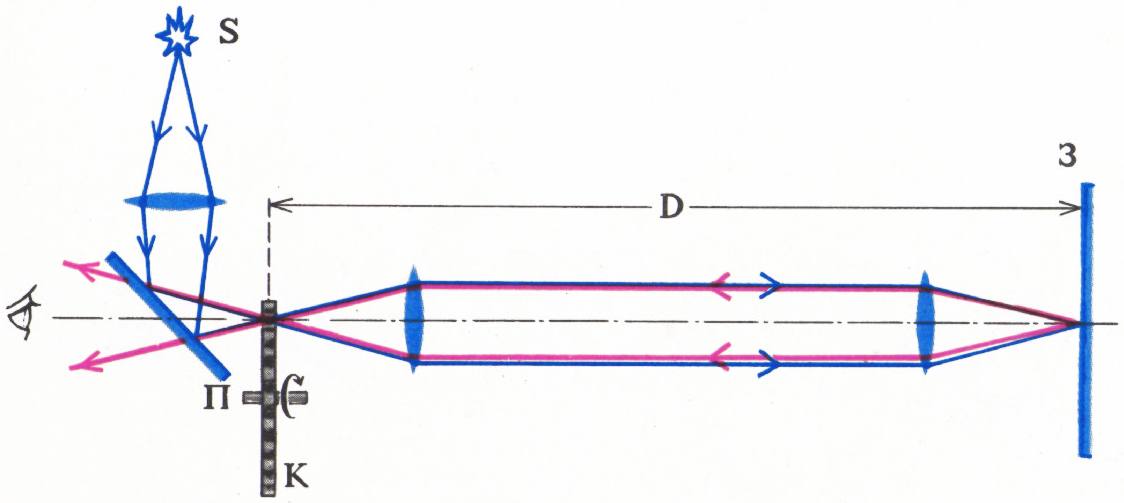
Fig. 3
24
The length of the base is , then let the light travel and back in time . During this time, the mirror , rotating with a frequency (rpm), will rotate through an angle . According to the law of reflection, the angle between rays 1 and 2 (see Fig. 4) on the path will be equal to .
Thus, the image , which is seen by the observer with a rotating mirror , turns out to be mixed from the image , obtained with a stationary mirror , by an angle equal to .
Using this method, Foucault obtained the value km/sec for the speed of light in air.
In accordance with Arago’s original plan, Foucault used his installation to change the speed of light in water. To do this, he slightly changed the property by equipping it with two symmetrically located spherical mirrors and placing water between one of them and the rotating mirror. This allows him to compare the speed of light in water and air and find that the speed of light in water is of its value in air. This result was the final blow to Newton’s corpuscular theory of light.
The methods of physics and Foucault made it possible to change the speed of light with an accuracy of km/sec.
In 1873, Alfred Cornu, who repeated the experiment of physics, changed the speed of light with an accuracy of km/sec.
In 1877, the American physicist Albert Michelson, the conditions of light with an accuracy of km/sec.
But Michelson was not satisfied with the result. From 1877 until the end of his life, he repeatedly returned to changing the speed of light, continuously improving his installation. The value km/sec obtained by Michels was considered for a long time to be the most accurate.
In the problem of changing the speed of light, Michelson’s experiments completed a stage that can be called classical. But even before the end of Michelson’s work, new experiments were carried out, already on a new technical and ideological basis, provided by the rapid development of physics. These experiments continue to the present day; their goal is to establish the most accurate value for the speed of light.
Modern methods of changing the speed of light can be divided into