Rough automatic draft, low quality: expect mistakes and awkward wording. It will be replaced by a better translation. Original →
60
In applied exams at institutes, there are often problems in which one has to decide about some location of a sphere (or several spheres) relative to parameters. Solutions to such problems are based essentially on the following three facts:
- if a plane (or straight line) touches a sphere, then consider from the center of the sphere to this plane (or straight line) equal to the radius of the sphere;
- if a sphere touches two intersecting planes, then the center of the sphere lies in the bisector plane of a two-dimensional area formed by the empirical planes;
- if the parameter is described around a sphere, then
(1)
food is the radius of the sphere, and are the volume and total surface parameters.
These facts are known to every student from a school mathematics course. But in mathematics it is not enough just to know the formulations of the theorems - it is important to understand these theorems and be able to apply them to solve problems.
As a rule, the problems proposed in entrance exams are formulated simply, and most applicants quickly find some way to a solution. But often the chosen method turns out to be very complex and cumbersome, requiring long calculations. Thus, it is very difficult to obtain the complete final result. For each problem, you need to try to find the shortest and most “elegant” solution possible.
Sometimes, during an oral exam, the applicant is not asked to solve a problem, but only to indicate the path to solution, thereby checking how well the applicant is oriented in this section of the theory.
In this article we will look at problems in which the use of several geometric messages helps to find a simple and beautiful solution.
Task 1 (MIPT, 1966). Inside a regular metrahedron with an edge of the aitripent, there are four equal spheres so that each sphere touches three other spheres and three faces of the metrahedron. The name of these spheres.
Solution. Let be a given tetrahedron, the center of a sphere within it, the radius of this sphere; are the data centers of the sphere, their radii will be denoted by .
The tetrahedron is correct, since each of its edges is equal to . The faces of the tetrahedron are parallel to the faces of the tetrahedron (prove it!), and the point is removed from each face of the tetrahedron by a distance . Therefore, point is the center of the sphere inscribed in the tetrahedron
62
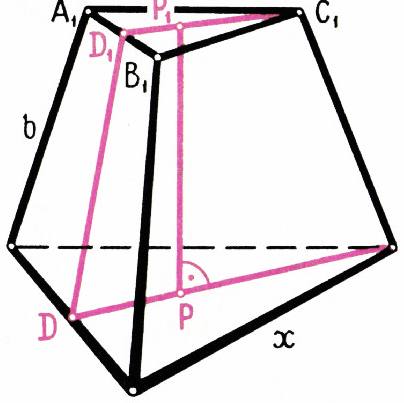
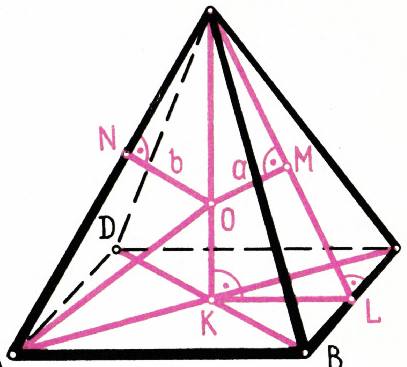
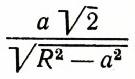
Fig. 3.
Solution. Let and be the centers of the main given truncated paramid, its apothem (Fig. 3). Let us denote the main sides by and . From the trapezoid is
The sphere described in the paramid touches the main paramid at points , and touches the apothem (prove it!). Hence,
where
In the section of the sphere touching all the edges of the paramid, the face turns out to be a circle circumscribed by the trapezoid . So, ,
Solving the system of equations (2) and (3), we find
Task 5 (MIPT, 1968). Appreciates the sphere described around the regular quadrangular paramid,
62
Fig. 4.
We are at a distance from the side face at a distance from the side edge. Find the radius of the sphere.
Solution. Let be the center of the sphere described near the paramid (Fig. 4), the radius of this sphere, the height of the paramid. Let’s do , , . According to the conditions of problem , (prove it!).
Since and , then
From here we find
Task 6 (MIPT, 1971). In a regular triangular paramid , the side of the base is and the height of the paramid is . The sphere described in the paramida touches face at point . Find the cross-sectional area of the paramid by a plane passing through point and edge .
Solution. Let be the height of the paramid (Fig. 5). Point lies on
64
tea .
Now from the right triangle we find , that is
The last correspondence in itself is quite interesting and can be used to solve other problems.
Consider the plane passing through the lines and . This plane intersects the sphere circumscribed about the triangle along the circle, which is indicated at figure 6. For this circle, the segments and are chords intersecting at the point . Hence,
(prove it!), that is
Similarly, from the equality
we get
From correspondence (4), (5) and (6) we find
Exercises
-
(MIPT, 1966). The edge of a regular triangle is equal to . A sphere is built on edge as on a diameter. Find the radius of the sphere inscribed in the triangular angle of the triangle with the vertex at point and tangent to the constructed sphere.
-
(MIPT, 1966). Inside a regular triangular paramide , the side of the base is , the height of the paramide is . Points and are the midpoints of the corresponding side edges and . Find the radius of the sphere tangent to the base of the paramide and lines and .
-
(MIPT, 1967). In a regular triangular paramid, the inscribed sphere passes through the center of the circumscribed one. How many times is the radius of the circumscribed sphere greater than the radius of the circumscribed sphere?
-
(MIPT, 1968). The center of a ball inscribed in a regular quadrangular paramide is at a distance from the side edge and at a distance from the side of the base. Find the radius of the ball.
-
(MIPT, 1968). The center of a ball inscribed in a regular quadrangular paramide is at a distance from the side edge and at a distance from the side of the base. Find the radius of the ball.
-
(MIPT, 1969). The edge of a regular triangle is equal to . Find the radius of the sphere passing through the vertices , the midpoint of the edge and the center of the face .
-
(MIPT, 1971). In a regular quadrangular paramid , the side of the base is and the height of the paramid is . The sphere inscribed in this paramide touches the lateral face at point . Find the cross-sectional area of the paramide by a plane passing through point and edge .
To task M86.
The statement becomes false. On the left figure there is a quadrangle, and on the right there are five.