Problem M126—M130; F138—F142
Rough automatic draft, low quality: expect mistakes and awkward wording. It will be replaced by a better translation. Original →
42
Tasks
Solutions to problems from the Kwan Problem Book can be sent no later than a month and a half after the corresponding issue of the journal is published. On the envelope, after the journal address, indicate the solutions to which problems you are sending (for example, “Kwan’s Problem Book” M126, F128). At the beginning of the letter, indicate your last name, first name, patronymic, six-digit postal code and address (as well as the class and school where you are a teacher). The solution to each problem must be written on a separate sheet(s); Please include your last name at the end of each decision. A star mark for a task of increased difficulty.
M126. A polygon circumscribed around a circle of radius is somehow cut into triangles. Prove that the sum of the radii of the inscribed circles of these triangles is greater than .
I. D. Novikov
M127. For each natural number we denote by the sum of its digits (in decimal notation). Let’s call a natural number special if it cannot be represented as , where is some natural number. (For example, the number 117 is not special because , but the number 121, as you can easily see, is special.) Is it true that there are only a finite number of special numbers?
M128. Find the ratio of the sides of a triangle, one of whose medians is divided by the incircle into three equal parts.
M129. a) 12 milk was poured into a bucket. How, using only jugs 5 and 7 , to divide the milk into two equal parts?
-
- Solve the general problem: for which and can we divide milk in half and use only the jugs in , and ?*.
V. V. Ushchakov
M130. What is the maximum number of points that can be placed?
a) on a plane;
b) * in space, so that none of the triangles with vertices at these points are obtuse?
G. A. Galperin
F138. An astronaut with a mass of 100 kg is outside a spacecraft whose mass is 5 , on a halyard 64 long. Find the tension of the halyard if the ship is located between the astronaut and the Earth on the line connecting their centers of gravity.
When calculating, assume that the ship is moving in a circular orbit, the height of the crust from the Earth’s surface is negligible compared to the radius of the Earth ( km).
*) In one transfusion from one vessel to another, you can pour out everything that is there, or fill the second vessel to the top.
F139. The football player hit the ball, giving it speed at an angle to the horizon, and hit the near bottom corner. If a football player hit the ball in the same place on the football field and the ball flew at the same angle to the horizon, but at a speed 5% greater than the speed , then it would hit the top of the goal post. Find the speed with which the ball begins to move if the height of the turn is and the angle is .
I. Sh. Slobodechkiy
F140. Will other barometers give correct readings of quality if part of its tube (below the level of mercury in it) is made of very soft rubber?
F141. Three wires are removed from the “black box” containing an unknown electrical circuit. Two of them are connected to ground and then to ground, plotting graphs for the three possible options for switching on the circuit. These graphs are shown in figure 1. The current is considered positive if it goes to the circuit located in the box and negative otherwise. Come up with the simplest diagrams of the contents of the “black box” and determine their parameters.
B. B. Bukhovtsev
F142. A steel ball suspended on a thread of length was deflected so that the thread assumed a horizontal position and was released. At the moment when the thread made an angle with the vertical, the ball hit a stationary steel plate (Fig. 2). To what height does the ball rise after hitting the plate, if the impact can be considered absolutely elastic?
G. L. Komkin
45
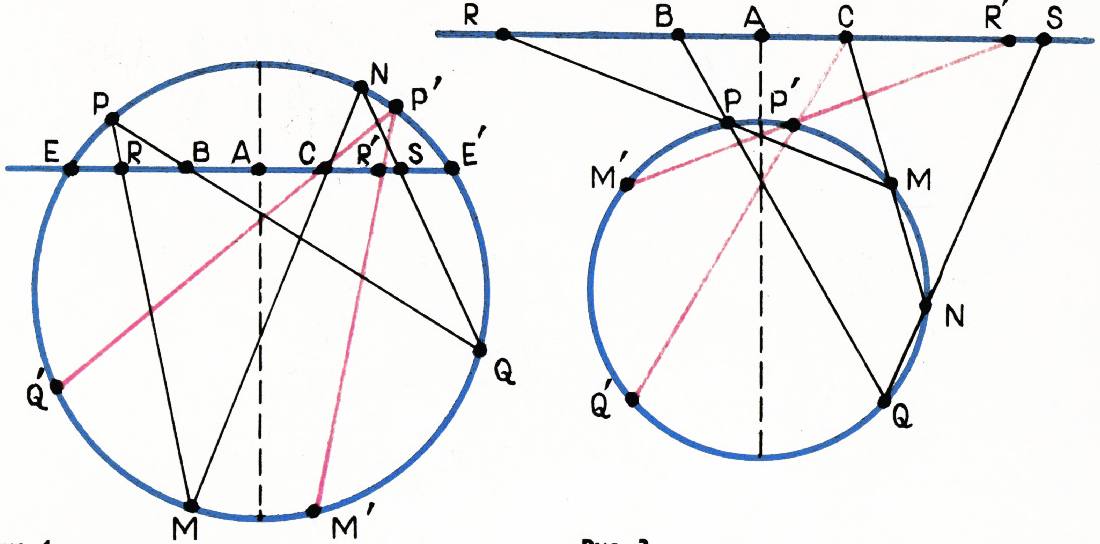
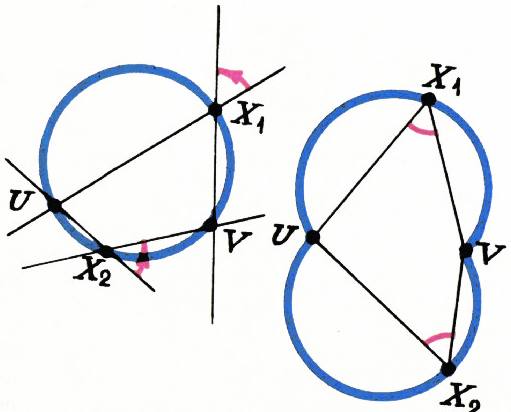
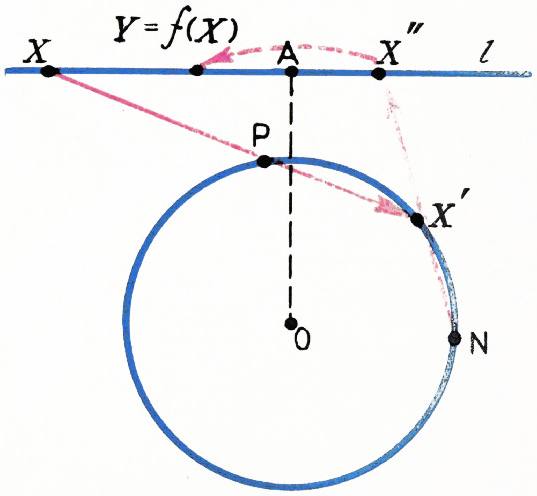
Fig. 1.
straight line so that it coincides with (). If the lines and are parallel or coincident, then, by definition, . Verify that for any two given points and and a given angle (), the set of points for which will be rounded (strictly speaking, excluding the points and themselves); in other words, what points and lie on the same circle moeda and (Fig. 3, a; comparison figure 3, a and 3, b explains the advantages of the new method of determining the angle).
Let’s return to our task. Now the statement that five points lie on the same circle (hence the following)
Fig. 2.
blows that coincides with ) follows from the equalities
;
.
These equalities are easy to check formally, without referring to the drawing - you just need to remember which points lie on the same straight line and which on the same circle; In addition to the theorem in italics above, it is used that . (Of course, we still need to analyze the “expressed” cases when any two points defining a line in these equalities coincide; they are all quite visible and we will not)
Fig. 3. Blue lines show the set of points for which: a) (left figure) and b) (right figure).
Fig. 4. Another formulation of problem M84: as a result of the three mappings shown in figure, from the point we obtain ; if you do the same for the point , it turns out that .
46
Let us dwell on them.) Now the problem is completely solved.
Let us give another, more natural formulation of this problem (think why this is the same problem!).
Let and be two distinct points of a circle with center ; is the base of the perpendicular dropped from the point to the given line , and is the mapping that assigns to each point the line the point of the same line according to the following rule: if is the point of intersection of the line with a circle, is the point of intersection of the straight line with , then is a point symmetrical to relative to . then the mapping coincides with its inverse, that is, for all (Fig. 4).
For those who are familiar with the basic concepts of project geometry, we suggest trying to find a simple “projective” proof of this theorem (note that even in its formulation it is necessary to consider an extended line, that is, add an infinite remote point to - then the mappings in question will be one-to-one). For a particular case, the solution is given in I.M. Yaglom’s book “Geometric Transformations” (GITTL, 1956; part II, problem 177), but it only applies if the straight line intersects the circle, and uses the formula of “double relations”. A blueprint for another solution, “without computing,” appears on page 71 of this issue of the journal.
N. B. Vasiliev
M86
The bottom of the rectangular box was made with tiles of sizes and . The tiles spilled out of the box and in the process lost one tile . Instead, remove the tile . Prove that now it is not possible to lay out tiles up to the box.
Let’s count up to a box into squares of size and mark those squares that are in odd places in odd boars (see Fig. 5). Note that each tile covering four squares at the bottom of the box will be

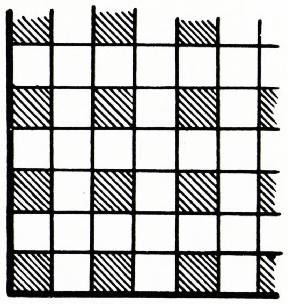


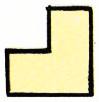

Fig. 5
Fig. 6.
Fig. 7.
It is necessary to cover an even number of squares we have displaced (two or none), and the tile always covers exactly one displaced square. Thus, if the tiles are completely covered to the box, then the number of tiles has the same parity as the total number of offset squares at the bottom of the box. Therefore, if the number of tiles has changed by one (or even by an odd number), then filling the box again will not be possible.
Think about whether the statement of the problem will remain true if, instead of tiles and (Fig. 6), tiles of three squares are considered: rectangular and “corners” (Fig. 7). You will find the solution to this problem at the end of the magazine, on page 64, but don’t rush to write it down!
The correct solutions to our problem were sent by A. Gritsoryan and E. Karasik from Baku, E. Turkevich from Chernovtsy, A. Chernyak from Minsk and A. Shamaev from Moscow.
L. G. Limanov
M87
Prove that if three circles of the same radius pass through one point, then three other points of pairwise intersection of these circles lie on a circle of the same radius.
Let all three circles of radius with centers and intersect at point , in addition, intersect in pairs at points ( and ), ( and ) and ( and ). It is obvious that the midpoints of the segments are at the same time the midpoints of the segments of the corresponding (Fig. 8). Therefore, each of the triangle and has sides twice as long as the corresponding side of the triangle (and parallel to them). Therefore, . But it is clear that the circumradius of the triangle is equal to (indeed,
47
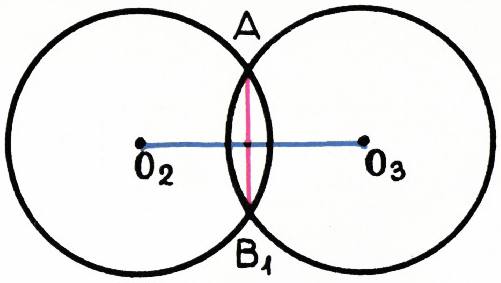
Fig. 8.
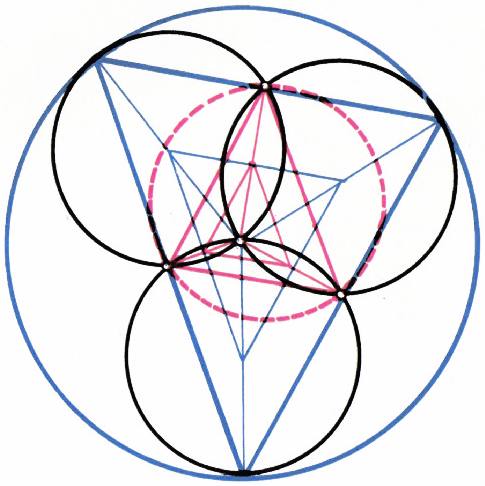
Fig. 9.
, therefore the radius of the circumscribed circle of triangle is also equal to , which is what needed to be proved.
Many readers have proven that triangles and are congruent in a more complex way, in which we had to separately consider various cases of the relative positions of these triangles (we deliberately did not refer to figure in our solution, where all the segments mentioned there are drawn, in order to emphasize that it does not depend on their location). A solution similar to ours can be obtained by considering the triangle together
triangle , where are points diametrically opposite points in the circle and , respectively; prove that and are the midpoints of the triangle . In the configuration that we received (Fig. 9), it is also interesting that point is the center of the circumcircle of triangles and and at the same time the point of intersection of the altitudes of triangles and ; the latter, however, is no longer used in our solution.
It is curious that D. Polya (and some readers who sent us letters) had a completely different idea for solving this problem. We publish an excerpt from the book “Mathematical Discovery”, which talks about the origin of this idea, on pp. 67-69.
V. N. Berezin
M88
What condition must the coefficients of the equation satisfy in order for its three roots to form an arithmetic progression?
Let’s give the answer right away. The desired match is (or, what is the same, one of the roots must equal ). Indeed, let and be the roots of our equation. Then, according to Vieta’s theorem,
On the other hand, in order for to form an arithmetic progression, it is necessary and sufficient that
Pose , opening . Try to derive the conditions under which equations of the fourth degree form an arithmetic progression.
L. I. Moscoviome
In this issue we publish problems F92—F99
F92
The mass hoop stands on the mass board (Fig. 10). The friction coefficient between the board and the hoop is . The board lies on a smooth table. With what acceleration will the board move if the hoop is pulled with a force of ?
Let’s write down the equation of motion of the hoops and boards (equation II of Newton’s law).
In the horizontal direction, two forces act on the hoop - the force and the tread force between the board and the hoop (see Fig. 10). The center of gravity of the body—in this case, the center of the hoop—moves as if all the forces acting on the body were applied to it. Therefore we can write that
( is the acceleration of the center of the hoop).
48
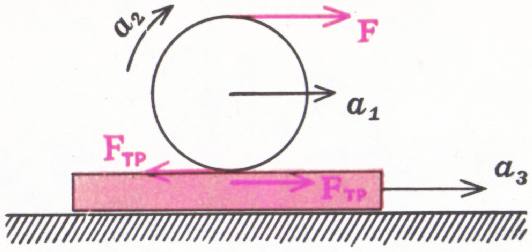
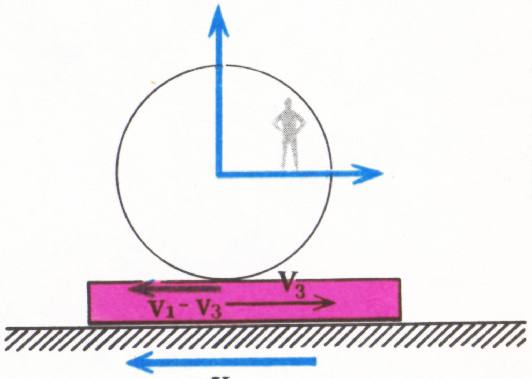
Fig. 10.
The hoop not only moves horizontally, but also rotates around the center. The acceleration of the rotational movement is imparted to it by the same forces and , but in this case they act “in concert”, spinning the hoop in one direction. The acceleration of the rotational motion of the hoop in the coordinate system associated with its center*) is denoted by . Then we can write that
Now let’s write down the equation of motion of the dock. In the horizontal direction, only one force acts on it - the force of friction of the hoop on the dock. Therefore, if the acceleration of dock is , then
So, we have three equations involving four unknown quantities: , , and . To find these unknowns, you need to create another equation.
When moving the hoop and docks, two cases arise: 1) the hoop does not slip relative to the dock and 2) the hoop slips relative to the dock.
Let’s consider the first case: the hoop does not slip relative to the dock. In this case, the speed of the translational movement of the center of the hoop, the linear speed
*) In fact, the coordinate system associated with the center of the hoop is not inertial. But, when considering the hoop equation, this can be ignored, since the force of inertia is applied to the center of gravity of the hoop, and its moment relative to the center of the hoop is zero.
**) Equation II of Newton’s law for a rotating body is written as follows:
where is the moment of inertia, is the angular acceleration and is the radius of the hoop (see the article by A.K. Kion “Rotational motion”, «Kvant» No. 1, 1971).
For hoop , . If we put these values into equation (*), we get equation (2).
rotation of the hoop around the center and staple docks are connected to staple (Fig. 11). Since the dock moves relative to the Earth to the right with a bracket of , then the bracket of the dock in the coordinate system associated with the center of the hoop is equal to . The lower point of the hoop touching the dock also moves with the same rigidity. This is the linear bending of the hoop around the center.
Since the forces acting on the hoop and dock are constant, the accelerations , and are also constant. Let the velocities , and of the body arrive after a time after the start of their motion. Then , and . Hence,
From here
We have obtained an equation relating the accelerations of bodies. Now solving equations (1), (2), (3) and (4) together, we find
And
We found that the acceleration of the dock is zero. From equation (3) it is clear that the friction force is also zero. This is due to the fact that if a force is applied to a hoop standing on an absolutely smooth dock, as shown in figure 10, then the acceleration of the translational motion of the hoop will coincide with the acceleration of its rotational motion. In this case, the lower point of the hoop rolls along the dock without slipping. This happens because all the mass of the hoop is concentrated in its thin rim and the force imparts to the hoop equal accelerations of translational and rotational motion. But this
49
means that the friction force does not depend on the force and is always equal to zero. Therefore, the hoop cannot slip relative to the point (the friction force cannot be equal to ), and we can not consider the second case.
F93
In the side wall of the vessel directed to liquid with a refractive index , a hole of small radius continues. A thin beam of light is directed horizontally from the vessel along the axis of the hole. To what level must there be liquid above the hole so that a ray of light emerges from the jet without ever experiencing internal reflection?
Neglect the change in the cross section of the jet; the refractive index of the liquid is assumed to be sufficiently large.
At the greatest angle to the surface of the water, a ray of light falls at the point scab (Fig. 12). The angle of incidence , at which the beam at this point does not experience total internal reflection, must be such that
This follows from the law of light refraction () and the condition that the angle is . The tangent to the jet at point makes an angle with the horizontal. Thus, a ray of light will emerge from the scab without ever experiencing internal reflection if the angle formed by the tangent to the jet at point makes an angle with the horizon such that cos .
But the tangent to the surface of the liquid is the tangent to the trajectory of the particle emerging at the upper edge of the hole. Therefore the direction of the tangent
Now expressing cos in terms of tg —
and taking into account that cos , we get
From here
F94
A cycle (closed process) is performed over one gram-molecule of an ideal gas, consisting of two outputs and two isobars (Fig. 13). The gas temperatures at points 1 and 3 are and , respectively. Determine the work done by the gas per cycle if it is known that points 2 and 4 lie on the same isotherm.
Expanding along isobar 2-3, the gas does work
When the gas slopes along the isobar 4-1 work
*) This also follows from the law of conservation of energy. Indeed, when a mass of water flows out of a vessel with liquid, the potential energy of water decreases by amounts (we can simply assume that the mass of water moved with the surface of the liquid to the hole).
50
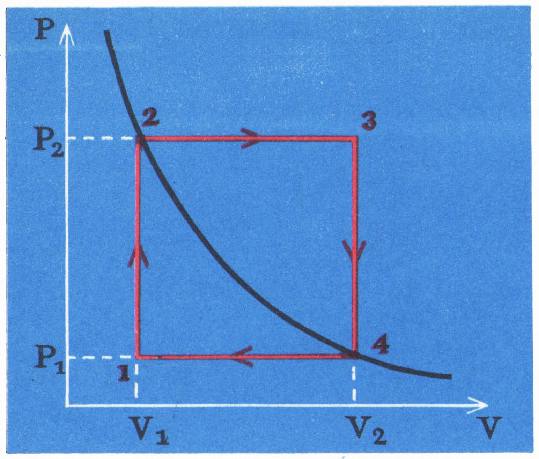
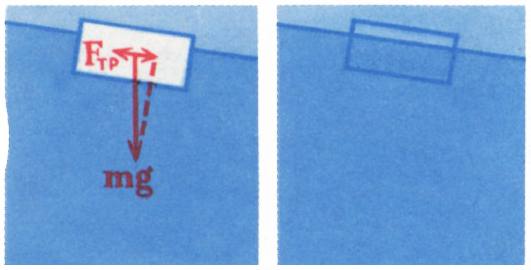
Fig. 13.
already occurs above the gas. It is equal
The total work done by the gas, very low, is equal to
Since points 2 and 4 lie on the same isotherm, the gas temperature in them is the same. Let’s denote it . then . Points 3 and 4 lie on the same isotherm, so . Points 2 and 1 also lie on the same isotherm and . From these two equations we find that
Hence,
F95
The surface of the river forms an inclined plane. Is it possible for a word to swim down a river at a speed exceeding the speed of the current?
If the body does not move relative to the water, then the friction force acting on it from the side of the water is zero. Therefore, the component of the gravity force, parallel to the surface of the water (Fig. 14), will straighten the body until it is balanced by the friction force on the water (which at low speeds is proportional to the speed of the body). In this case, it will flow at a speed greater than the speed of the current.
Now imagine that we, having left a thin, rigid, weightless shell, removed the body and poured water into the shell so that its volume was equal to the volume of the immersed part of the body (Fig. 15). Since the body was floating, the mass of the poured water is equal to the mass of the body. Therefore, the shell with water is equivalent to the body that we removed. But the water poured into the shell is no different from the water in the river. The friction in a fluid is related only to the thickness of the fluid itself and does not depend on the surface of the body. This is explained by the fact that a thin layer of water molecules “floats” to the surface of the body and the formation is determined by the interaction of water molecules with each other. This means that you can completely remove the shell, the friction force will not change. It turns out that the body must flow at a speed equal to the speed of the current.
What’s really going on?
Let’s first understand what “flow speed” means. Due to friction, the speed of the river flow varies at different points in the river. It increases from day to surface and from the shore to the middle of the river. Therefore, the speed of the flow in the place where the plush is located along the body river is also different. This water in the shell differs from the surrounding water, because the speed of the water in the shell is the same at all points.
Let us assume that the speed of the body is equal to the speed of the current at the edge of the body, which is close to the shore. Then the speed of the flow of water passing through the body at other points is greater than the speed of the body. Because of this, the water should carry the body, increasing its speed. On the other hand, when the speed of the body increases, it should slow down due to the fact that the speed of its point, located close to the shore, is greater than the speed of the current and the friction force is converted into movement of the body. As a result, the body must flow at a speed greater than the minimum, but less than the maximum of the flow rates throughout the body.
F96
Two identical balls connected by a thread. Find the height of rise of this system if one of the balls is thrown upward with a speed of .
The momentum of the entire system is , and its mass is . Therefore, at the initial moment
51
the speed of the center of mass of the system is .
Let us write down the law of conservation of energy for the entire system. In this case, we can consider the movement not of individual balls, but of the center of mass of the system, considering that the entire mass of the system is concentrated in it. If the maximum height at which the center of mass of the system rises is , then
From here
We received many solutions to this problem, but most of the letters had the same error. The authors of the solution believed that at the moment when the center of mass of the system reaches the maximum height of the boom, the balls are motionless and their kinetic energy is zero. This, however, is not true. The balls are moving and their kinetic energy at this moment is equal to
F97
A turn of an insulated wire is bent in the form of a bosmeasurement, when it has a radius of cm and cm. The turn is in a magnetic field with induction ec, perpendicular to the plane of the turn. The wire insulation is designed for a voltage of 10 V. Will insulation breakdown occur if the magnetic field is suddenly turned off? Field switch-off time sec.
The coil can be bent in different ways, and the wires may or may not intersect each other. We will consider both cases.
Let us denote by and e. d.s. inductions induced in circuits I and II (Fig. 16), and through and - the resistance of these circuits.
If the circuit wiring intersects (Fig. 16, a), then bypassing the circuit, it is easy to notice that e. d.s. and are directed in different directions. Therefore, the current flowing through the wiring is equal to
The potential difference between points and is obviously equal to the difference and pa-
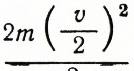
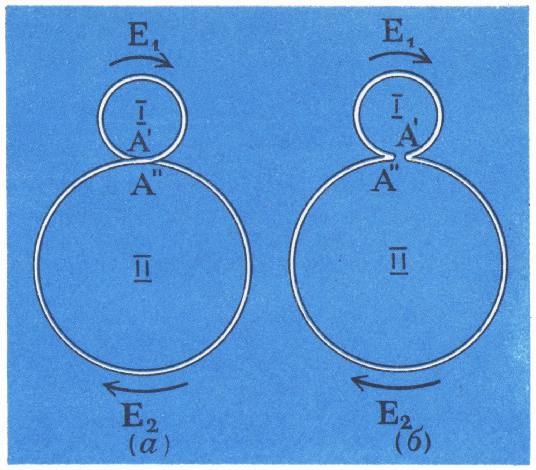
Fig. 16.
voltage difference in circuit II (or the difference between and the voltage drop in circuit I; in both cases we should get the same result)
But
similar,
The circuit resistances are equal
From here we get:
If the circuit wiring does not intersect (Fig. 16, b), then e. d.s. and point in the same direction. In this case
And
In the second case, the potential difference between points and of the wiring is times less than in the first case.
Substituting numerical values of the quantity into formula (1), we find that . You-
52
The potential difference numerically according to formula (2) is even smaller. This means that the insulation will not be penetrated.
F98
What is the maximum potential difference that can be obtained with a source with emf at its disposal? c.E and n identical capacitors with capacitance C each?
Let us first examine the simpler case with n=2.
By charging both capacitors from the source to a potential difference E and connecting the source and both capacitors together in series, a potential difference of 3E can be obtained. However, this is not the maximum potential difference. Let us prove that having two capacitors and a source, you can obtain a potential difference as close as you like to 4E.
We connect the source in series with one of the capacitors, and connect the second capacitor to this pair: connect the “—” of the capacitor to the “—” of the source, and connect the “+” of the capacitor to the “+” of the second capacitor (Fig. 17). In this case, the charge on the capacitors is redistributed. Denoting the charges on the condensates after redistribution through q₁ and q₂, and the voltage drop across the condensates through u₁ and u₂, we can write
(1)
The total charge of the right plates of the capacitor is 2CE. This charge is redistributed between the plates, but cannot change. That’s why
(2)
Solving equations (1) and (2) together, we find
Let’s charge capacitor 1 again to potential difference E and connect the same circuit. Now u₂ becomes equal to .
By repeating this operation many times, you can charge capacitor 2 to a potential difference arbitrarily close to 2E. Now connecting the source and both capacitors in series, we get the difference
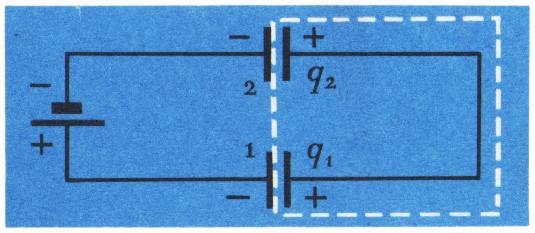
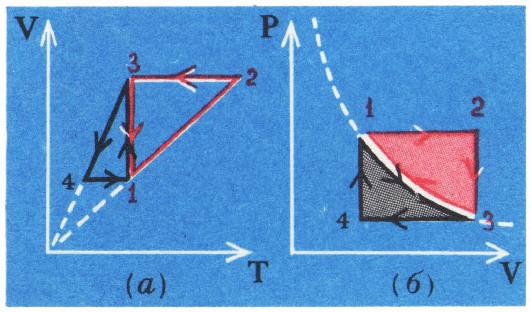
Fig. 17.
52
potentiality, as close as possible to 4E.
Thus, it is clear that having the opportunity to obtain a battery with e.m. using two capacitors. p.4E, the third capacitor can be charged to a potential difference of 4E, and then, by connecting the capacitors and the source in series, a potential difference of 8E can be obtained. Up to this potential difference is 2E, the third up to a potential difference 4E and so on. The nth capacitor can be charged to a potential difference of 2^{n-1}E. By then connecting all the capacitors and the source in series, you can obtain the potential difference
F99
figure 18a shows V-T diagrams of two circular processes. In which of them does the gas do more work: in the process 1-2-3-1 or in the process 1-3-4-1?
Let us redraw the diagrams of the processes shown on figure in coordinates P→V.
Points 1 and 3 lie on the same isotherm, and point 1 corresponds to a smaller volume than point 3. Therefore, having drawn the isotherm, we select two points on it - points 1 and 3, as shown in figure 18, 6. Now it is not difficult to construct cycle diagrams. Line 1-2 is an isobar, and the volume at point 2 is greater than the volume at point 1. Line 2-3 is an isochore. On a P-V diagram it should be vertical. The diagram of the second process is constructed in exactly the same way.
We know that the work done by the gas per cycle is equal to the area of the figure limited by the cycle graph. But from figure it is clear that the area of the “red” process is larger than the area of the “gray” process. This means that more work is done by the gas during the 1-2-3-1 process.